
Understanding the precise temperature requirements for chicken isn't just about following rules—it's your first line of defense against foodborne illness. Each year, millions suffer from preventable food poisoning, with poultry being a common culprit. Getting the temperature right means you can enjoy juicy, flavorful chicken without risking your health or your guests' wellbeing.
The Science Behind Safe Chicken Cooking Temperatures
When you're preparing chicken, you're not just chasing doneness—you're engaging in a critical food safety process. The 165°F (73.9°C) threshold isn't arbitrary; it's the temperature at which dangerous pathogens like Salmonella and Campylobacter are instantly destroyed. These bacteria can cause severe gastrointestinal illness, with symptoms ranging from uncomfortable to life-threatening, particularly for vulnerable populations.
Unlike some foods where lower temperatures might be acceptable with proper holding times, chicken requires immediate pasteurization at 165°F. This differs from beef, where surface bacteria are the primary concern and internal temperatures can be lower for medium-rare preparations. With poultry, bacteria can penetrate throughout the muscle tissue, making thorough cooking essential.
Authoritative Guidelines Compared
| Organization | Recommended Temperature | Special Considerations |
|---|---|---|
| USDA Food Safety and Inspection Service | 165°F (73.9°C) | Applies to all poultry products including ground chicken and turkey |
| FDA Food Code | 165°F (73.9°C) | Required for commercial food establishments |
| CDC | 165°F (73.9°C) | Emphasizes this as critical for preventing foodborne illness |
| UK Food Standards Agency | 75°C (167°F) | Measured at thickest part with instant-read thermometer |
The consistency across major food safety organizations worldwide confirms that 165°F represents the scientifically established minimum for safe poultry consumption. While international standards vary slightly in measurement (Fahrenheit vs. Celsius), they all converge on the same critical temperature point.
How Cooking Temperature Guidelines Have Evolved
Food safety recommendations for chicken haven't always been this precise. In the early 20th century, visual cues like clear juices were the primary indicators of doneness. The 1970s brought the first thermometer-based guidelines, initially set at 180°F for whole chickens—a temperature that often resulted in dry, overcooked poultry.
The USDA lowered the recommended temperature to 165°F in 2006 after research demonstrated that this lower temperature was equally effective at destroying pathogens while preserving moisture and texture. This change reflected improved understanding of bacterial death rates at various temperatures and the realization that precise thermometer use could ensure safety without sacrificing quality.
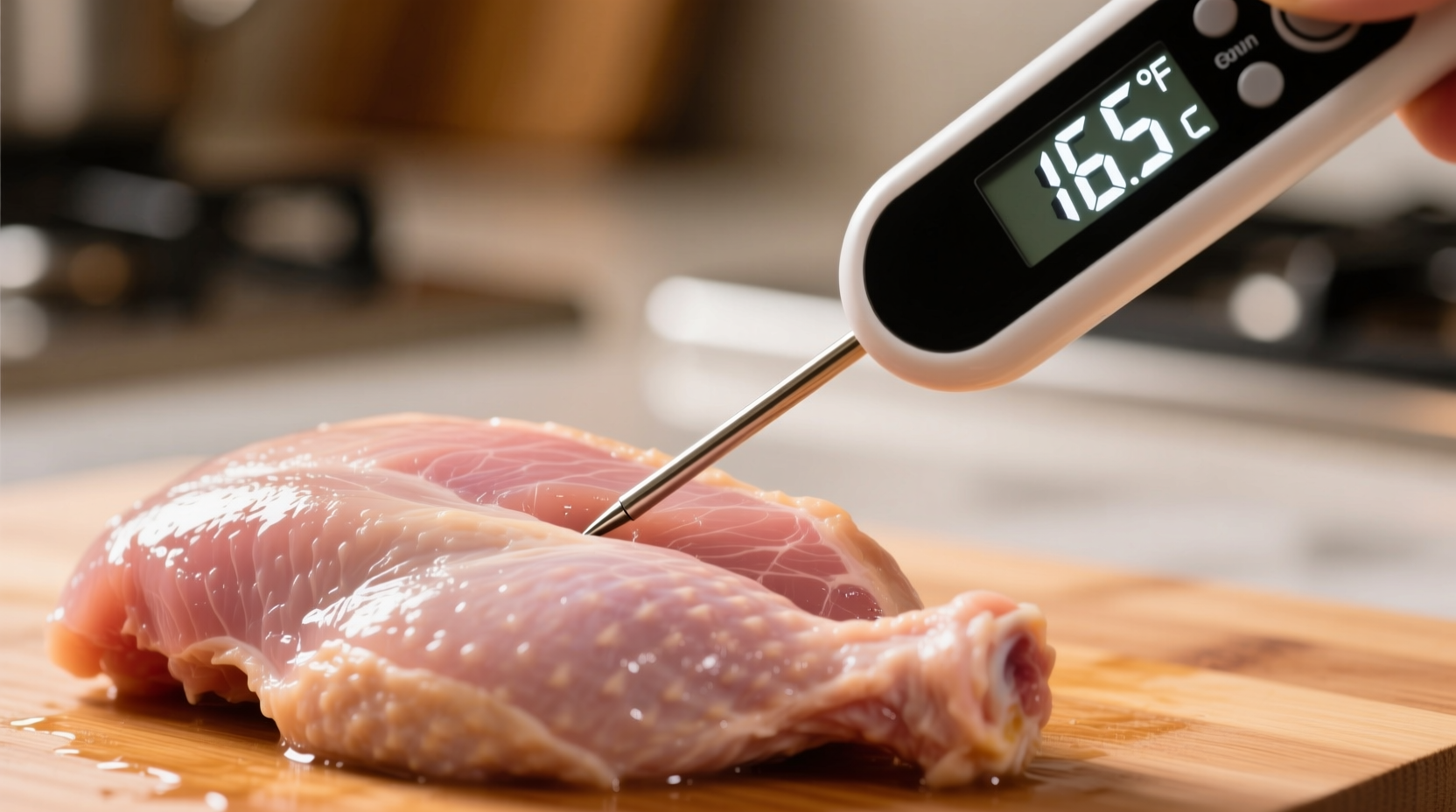
Measuring Temperature Correctly: Common Mistakes to Avoid
Knowing the target temperature is only half the battle—accurate measurement is equally critical. Many home cooks make these common thermometer errors:
- Incorrect placement - Insert your thermometer into the thickest part of the meat, avoiding bones which can give false high readings
- Single-point testing - Check multiple locations, especially in larger pieces or whole birds
- Early removal - Don't pull chicken from heat until it reaches 165°F; carryover cooking will increase temperature 5-10 degrees
- Cross-contamination - Clean your thermometer probe between measurements
For the most reliable results, use an instant-read digital thermometer rather than dial thermometers, which are less precise. Calibrate your thermometer regularly by testing it in ice water (should read 32°F/0°C) or boiling water (212°F/100°C at sea level).
Temperature Requirements for Different Chicken Cuts
While 165°F remains the universal safety standard for all poultry, different cuts have unique considerations:
- Chicken breasts - Lean white meat dries out quickly above 165°F; remove at exactly 165°F and let rest
- Thighs and legs - Dark meat can safely be removed at 160°F and allowed to rest to 165°F, resulting in more tender meat
- Whole chicken - Check multiple points: breast, thigh, and wing joint
- Ground chicken - Must reach 165°F throughout due to increased surface area and bacterial exposure
- Stuffed chicken - Both the chicken and stuffing must reach 165°F
Professional chefs often use a technique called “carryover cooking” to achieve perfect results. Remove chicken from heat at 155-160°F and let it rest for 5-10 minutes, during which the internal temperature will continue to rise to the safe 165°F mark while preserving moisture.
Special Cooking Methods and Temperature Considerations
Certain cooking techniques require special temperature considerations:
- Sous vide cooking - Chicken can be safely cooked at lower temperatures (145°F/63°C) for extended periods (at least 30 minutes), but must still reach 165°F if not following precise time-temperature tables
- Smoking - Maintain smoker temperature between 225-275°F and verify chicken reaches 165°F internally
- Grilling - Use two-zone cooking to avoid charring while ensuring thorough cooking
Remember that color is NOT a reliable indicator of doneness. Fully cooked chicken can appear slightly pink near bones due to myoglobin reaction, while undercooked chicken might look white. Only a properly used thermometer provides certainty.
What Happens If Chicken Isn't Cooked to 165°F?
Serving chicken below the recommended temperature carries significant risks. Salmonella bacteria begin to die at temperatures above 130°F, but require both sufficient temperature AND time to be fully eliminated. At 160°F, it takes approximately 14 seconds to destroy these pathogens—but at 150°F, the required time jumps to over 3 minutes.
The margin for error is small. A piece of chicken measuring 162°F might seem close enough, but could still harbor dangerous bacteria if not held at that temperature long enough. This is why the 165°F standard exists—it provides a safety buffer that ensures pathogens are destroyed instantly.
Practical Tips for Perfectly Cooked Chicken Every Time
Follow these professional techniques to achieve safe, delicious results:
- Always start with a calibrated thermometer—test it in ice water before cooking
- Bring chicken to room temperature for 20-30 minutes before cooking for more even results
- Use the poke test as a secondary indicator: properly cooked chicken should feel firm but yield slightly
- Allow proper resting time (5-10 minutes) to redistribute juices and complete carryover cooking
- When in doubt, check again—it's better to verify than risk illness
For meal preppers and batch cooks, remember that reheating previously cooked chicken should bring it back to 165°F for safety, not just “hot.” Leftovers should be cooled quickly and stored within two hours of cooking.




 浙公网安备
33010002000092号
浙公网安备
33010002000092号 浙B2-20120091-4