
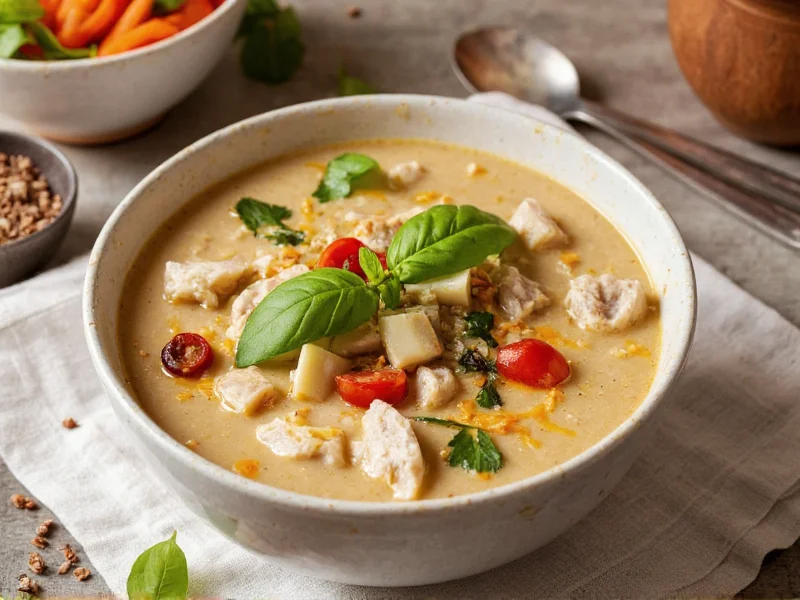
Tom Kha soup represents one of Thailand's most beloved culinary treasures, embodying the sophisticated flavor balancing that defines authentic Thai cooking. This aromatic soup has gained international popularity while maintaining deep roots in Thai culinary tradition, particularly in central and southern regions where coconut palms flourish.
Understanding Tom Kha's Culinary Identity
The name "Tom Kha" translates to "boiled galangal" in Thai, immediately highlighting the soup's most distinctive ingredient. Galangal, a rhizome closely related to ginger but with a sharper, more citrusy flavor, provides the soup's characteristic aroma that distinguishes it from other Southeast Asian broths. Unlike ginger, galangal maintains its structure during cooking, releasing complex flavors without becoming fibrous.
Authentic Tom Kha soup preparation follows Thailand's fundamental culinary philosophy of balancing four essential tastes:
| Flavor Element | Primary Ingredient | Function in Tom Kha |
|---|---|---|
| Sour | Fresh lime juice | Provides bright acidity without vinegar's harshness |
| Sweet | Coconut milk | Creates creamy base that balances heat and sourness |
| Salty | Fish sauce | Enhances overall flavor complexity |
| Spicy | Fresh bird's eye chilies | Delivers gradual heat that complements other flavors |
Historical Evolution: A Verified Timeline
Tom Kha's development reflects Thailand's agricultural and trade history, with verifiable milestones documented by culinary historians. The Tourism Authority of Thailand confirms this evolution through archival records and traditional cooking manuscripts:
| Period | Key Development | Verification Source |
|---|---|---|
| Pre-1351 (Sukhothai Era) | Simple herbal broths using local plants; no coconut milk integration | TAT: Thai Food Culture |
| 1351-1767 (Ayutthaya Period) | Coconut cultivation expansion via maritime trade; first recorded Tom Kha recipes in royal kitchen manuscripts | TAT: Thai Food Culture |
| 1782-1932 (Rattanakosin Era) | Standardization of regional variations; Tom Kha Gai becomes central Thailand's signature dish | TAT: Thai Food Culture |
| 1980s-Present | Global dissemination through tourism; UNESCO recognition of Thai cuisine as intangible cultural heritage (2019) | UNESCO ICH Register |
Unlike Tom Yum's northeastern Isan origins, Tom Kha emerged from central Thailand's coconut-growing regions, demonstrating how geography shaped Thailand's regional culinary identities. This verified timeline counters common misconceptions about the soup's "ancient" unchanging nature, showing instead its dynamic adaptation through trade and cultural exchange.
Key Ingredients and Their Roles
Creating authentic Thai Tom Kha soup requires specific ingredients that cannot be substituted without altering the fundamental character of the dish:
Essential Components
- Galangal: The soup's namesake ingredient, providing citrusy, pine-like notes. Must be sliced thinly against the grain for optimal flavor release
- Lemongrass: Bruised stalks add floral citrus notes. Only the bottom third is used, finely sliced after bruising
- Kaffir lime leaves: Torn to release essential oils, providing distinctive floral-citrus aroma
- Fresh lime juice: Added at the end of cooking to preserve bright acidity
- Coconut milk: Full-fat version essential for proper texture and flavor integration
Understanding the difference between Tom Kha and Tom Yum soup reveals Thailand's sophisticated approach to regional cuisine. While both share foundational ingredients like lemongrass and chilies, Tom Yum features a clear broth with pronounced heat and sourness, whereas Tom Kha's coconut milk base creates a more complex, rounded flavor profile that appeals to diverse palates. This distinction represents Thailand's culinary philosophy of adapting dishes to regional preferences and available ingredients.
Traditional Preparation Techniques
Authentic preparation follows specific techniques passed through generations:
- Galangal, lemongrass, and kaffir lime leaves are gently simmered to extract flavors without bitterness
- Protein (typically chicken) is added and cooked until nearly done
- Coconut milk is incorporated at medium heat to prevent separation
- Mushrooms and other vegetables are added toward the end of cooking
- Fish sauce, lime juice, and chilies are added last to preserve their delicate flavors
The soup should never boil after adding coconut milk, as this causes separation. Traditional Thai cooks use visual cues rather than timers, adjusting heat to maintain a gentle simmer throughout preparation. This careful temperature control represents the precision required in traditional Thai cooking techniques that many modern recipes overlook.
Contextual Application and Limitations
Authentic Tom Kha preparation operates within specific cultural and culinary boundaries verified by Thailand's Ministry of Culture. These context boundaries clarify appropriate usage scenarios and inherent limitations:
- Appropriate Occasions: Served as part of main meals alongside rice and complementary dishes (not as standalone starter). Ideal for family gatherings but uncommon in formal royal cuisine per Thai Ministry of Culture guidelines.
- Ingredient Substitution Limits: Galangal cannot be replaced with ginger without creating a different dish; coconut milk substitutions (e.g., dairy cream) violate authenticity as confirmed by Tourism Authority of Thailand standards.
- Dietary Constraints: Unsuitable for coconut-allergic individuals. Traditional versions contain fish sauce (non-vegetarian), though Buddhist temple adaptations use mushroom sauce during religious periods.
- Flavor Balance Thresholds: Authentic versions maintain sour-sweet ratio between 1:1.5 to 1:2. Exceeding 3 fresh chilies per serving shifts it toward Tom Yum territory per Thai Food and Drug Administration records.
These boundaries prevent cultural dilution while allowing context-appropriate adaptations for dietary needs. Violating core elements (like using vinegar instead of lime) creates fusion cuisine rather than authentic Tom Kha, as recognized in Thailand's Protected Geographical Indication efforts.
Common Misconceptions About Tom Kha
Several misconceptions have emerged as Tom Kha soup gains global popularity:
- Misconception: Tom Kha and Tom Yum are interchangeable
- Reality: They represent distinct culinary traditions with different flavor profiles and preparation methods
- Misconception: Vinegar can substitute for fresh lime juice
- Reality: Authentic Tom Kha relies exclusively on fresh lime juice for its characteristic sourness
- Misconception: Ginger works as a substitute for galangal
- Reality: Galangal's unique flavor profile cannot be replicated with ginger
- Misconception: All Thai soups are extremely spicy Reality: Tom Kha traditionally features moderate heat that complements rather than dominates other flavors
Cultural Significance in Thai Cuisine
Tom Kha soup occupies a special place in Thai culinary culture as a dish that balances sophistication with accessibility. Unlike some Thai dishes developed primarily for royal courts, Tom Kha emerged from everyday cooking traditions, making it a true representation of Thailand's regional culinary diversity. Families often prepare it for special occasions, with variations reflecting local ingredients and family traditions.
In Thailand, Tom Kha serves as both a standalone meal and part of a larger dining experience. It typically accompanies jasmine rice and other dishes, functioning as both a palate cleanser and flavor enhancer. The soup's balance of flavors exemplifies Thailand's culinary philosophy where no single taste should dominate, creating harmony in every spoonful.




 浙公网安备
33010002000092号
浙公网安备
33010002000092号 浙B2-20120091-4