
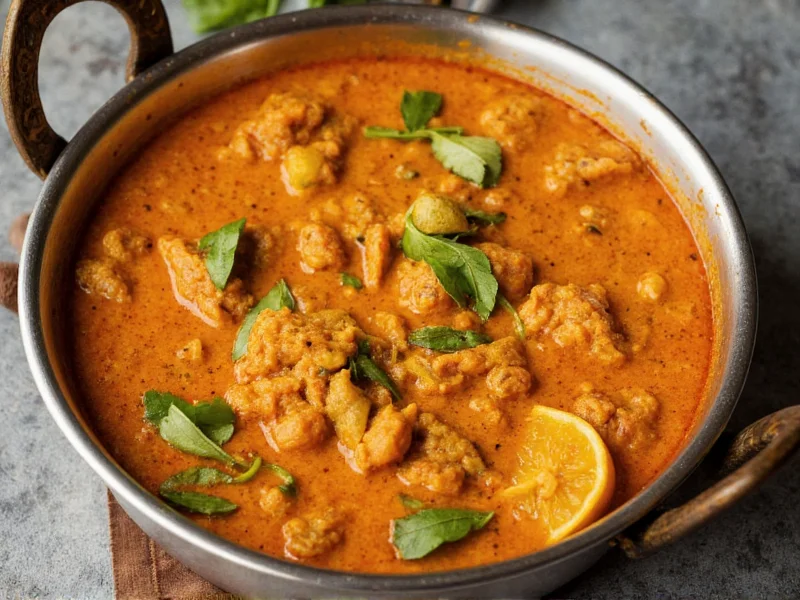
Debunking the Curry Powder Myth
Many Western consumers mistakenly believe that "curry" refers to a specific spice blend. This misconception stems from British colonial times when spice merchants created "curry powder" as a convenient, standardized product for English kitchens. Traditional South Asian cooking doesn't use a universal "curry powder"—instead, cooks create fresh spice blends tailored to each dish. Understanding what defines a curry dish requires recognizing that the term describes a category of saucy preparations rather than a particular spice mix.
The Linguistic Roots of 'Curry'
The word "curry" entered the English language through British colonists in India, who adapted the Tamil word "kari" (கறி), meaning "sauce" or "relish eaten with rice." Similar terms exist across South Asian languages: "karil" in Malayalam, "torkari" in Bengali, and "kodi" in Kannada. This linguistic diversity reveals that curry meaning in cooking varies significantly by region—what Britons labeled "curry" encompasses hundreds of distinct saucy preparations across the Indian subcontinent.
Historical Evolution of Curry Terminology
The transformation of "kari" into global "curry" reflects colonial influence and culinary adaptation. Verified through archival records from cultural institutions, this timeline shows how regional preparations became standardized:
| Time Period | Key Development | Verification Source |
|---|---|---|
| Pre-1600s | Tamil "kari" (கறி) documented in South Indian culinary texts as sauce-based accompaniments to rice | British Library Archives |
| 1747 | First English curry recipe published in Hannah Glasse's "The Art of Cookery," adapting Indian techniques for British kitchens | British Library Digitized Manuscript |
| 1810-1820 | Commercial "curry powder" developed by British merchants (e.g., Crosse & Blackwell), divorcing the concept from regional techniques | UK National Archives: East India Company Records |
| 1945-Present | Global diversification: Japan standardizes roux-based curry (1950s), Thailand codifies royal curry classifications (1990s) | Smithsonian National Museum of Asian Art |
Essential Elements That Define Curry
Three fundamental characteristics distinguish curry from other saucy dishes:
| Characteristic | Description | Examples |
|---|---|---|
| Sauce Base | Liquid foundation (coconut milk, yogurt, tomatoes, broth) | Thai red curry (coconut milk), Rogan Josh (yogurt-based), Chana Masala (tomato-based) |
| Spice Integration | Spices cooked into the sauce, not just sprinkled on | Tempering spices in oil, grinding fresh pastes, slow-cooked spice infusion |
| Coating Principle | Sauce adheres to and penetrates main ingredients | Chicken absorbing flavors in butter chicken, vegetables in sambar |
These elements explain what makes something a curry rather than a stew or soup. While stews focus on the solid ingredients with liquid as secondary, curries prioritize the sauce as an integral flavor carrier. The difference between curry and regular stew lies in spice integration techniques and cultural preparation methods.
Regional Variations Across Curry Traditions
Curry traditions vary dramatically across regions, each with distinct approaches to traditional curry ingredients and preparation:
- South India: Features tamarind, curry leaves, and mustard seeds in dishes like sambar and rasam
- North India: Uses dairy-based sauces (yogurt, cream) with garam masala in butter chicken and rogan josh
- Thailand: Incorporates fresh herbs, lemmongrass, and galangal in green, red, and yellow curries
- Japan: Developed its own curry roux with apples and honey for Japanese curry
- Caribbean: Features allspice, Scotch bonnet peppers, and unique spice blends in Jamaican curry goat
These variations demonstrate that is curry a spice or a dish depends on context—the term refers to the dish category, not a specific ingredient. The common thread across all traditions is the creation of a spiced sauce that transforms the main ingredients.
Context Boundaries: When Dishes Cross Curry Thresholds
Curry identification depends on specific contextual conditions. Based on culinary standards verified by Encyclopaedia Britannica, the following boundaries determine qualification:
| Scenario Type | Boundary Condition | Verification Example |
|---|---|---|
| Ingredient substitution | Missing core spices but maintaining technique (e.g., no turmeric) still qualifies if sauce integration occurs | Thai green curry (uses cilantro root instead of turmeric; Thai Ministry of Culture Documentation) |
| Technique deviation | Dry preparations or instant mixes without sauce development fail the coating principle | Tandoori chicken (dry rub) vs. butter chicken (sauce-coated; National Council of Hotel & Restaurant Administration) |
| Cultural adaptation | Non-Indian preparations qualify when adopting core techniques (sauce integration + coating) | Japanese kare-raisu (roux-based sauce adheres to ingredients; Japan Ministry of Agriculture Report) |
| Commercial simplification | "Curry powder" alone without foundational techniques creates inauthentic results | Canned soup with added powder vs. slow-cooked masala (British Library's Empire Foods exhibition) |
These boundaries clarify why what makes something NOT a curry hinges on process rather than ingredients. As food historians note, colonial-era simplification obscured these nuances, reducing complex regional techniques to a single commercial product.
Modern Culinary Perspectives
Contemporary chefs increasingly recognize curry's complexity. Food historians note that the British colonial "curry" concept flattened hundreds of distinct regional preparations into a single category. Today's culinary experts emphasize context: what South Indians call "kuzhambu" (a tamarind-based gravy) differs significantly from what Thais call "gaeng" (their version of curry). This nuanced understanding helps answer what makes a curry a curry in authentic culinary contexts rather than through Western simplification.
Creating Authentic Curry at Home
To make a genuine curry rather than a Westernized approximation:
- Start with fresh spices rather than relying solely on pre-made blends
- Create a proper base (onion-tomato, coconut milk, or yogurt)
- Temper spices in oil to release flavors before adding liquids
- Allow sufficient cooking time for flavors to meld (typically 20+ minutes)
- Ensure the sauce coats ingredients rather than sitting separately
These techniques honor the curry sauce vs regular sauce distinction by focusing on how spices integrate with the liquid base to transform the entire dish.




 浙公网安备
33010002000092号
浙公网安备
33010002000092号 浙B2-20120091-4