
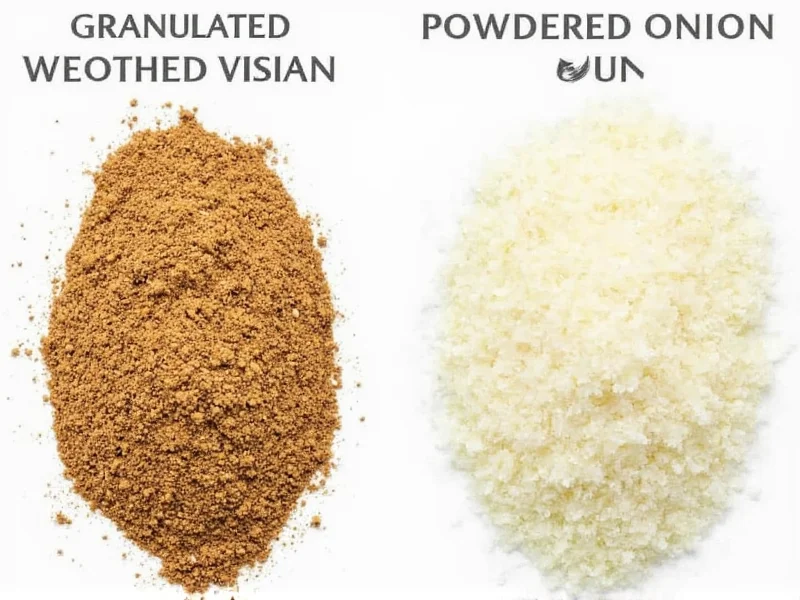
Granulated onion and powdered onion differ primarily in texture and moisture content. Granulated onion has a coarse, sand-like consistency with visible颗粒, while powdered onion is finely ground to a flour-like texture. Granulated onion retains more natural onion flavor and rehydrates better in cooking, whereas powdered onion dissolves completely and delivers more concentrated onion flavor. For most recipes, use 1 tablespoon granulated onion for every 1½ teaspoons powdered onion when substituting.
Understanding the subtle yet significant differences between granulated and powdered onion can transform your cooking results. These two common pantry staples often get confused, but they serve distinct purposes in the kitchen. Let's explore their characteristics, applications, and how to use them effectively.
What Exactly Are Granulated and Powdered Onions?
Both products start as fresh onions that undergo dehydration and grinding processes, but their final forms differ substantially. Granulated onion consists of small, visible颗粒 that resemble coarse sand. These颗粒 retain some of the onion's cellular structure, resulting in a product that rehydrates more effectively when added to dishes. Powdered onion, by contrast, undergoes additional processing to create a fine, uniform powder similar to flour in consistency.
The production process affects not just texture but also flavor concentration. Powdered onion typically contains about 10-15% more concentrated onion flavor than its granulated counterpart due to the additional processing that removes more moisture. This concentration difference becomes crucial when following recipes or making substitutions.
| Characteristic | Granulated Onion | Powdered Onion |
|---|---|---|
| Texture | Coarse, sand-like颗粒 | Fine, flour-like powder |
| Moisture Content | Approximately 4-6% | Approximately 2-4% |
| Flavor Intensity | Milder, more natural onion taste | More concentrated, slightly sharper flavor |
| Dissolution in Liquids | Partially dissolves, retains some texture | Completely dissolves |
| Best For | Rubbed on meats, dry mixes, soups | Sauces, dressings, spice blends |
Practical Applications in Cooking
Knowing when to reach for granulated versus powdered onion makes a noticeable difference in your dishes. Granulated onion works best when you want some texture and gradual flavor release. It's ideal for:
- Rubbing on meats before grilling or smoking
- Dry soup mixes where you want visible onion颗粒
- Casseroles and baked dishes where texture matters
- Seasoning blends where visual appeal is important
Powdered onion shines in applications where complete dissolution is necessary:
- Salad dressings and marinades
- Sauces and gravies
- Commercial spice blends
- Any recipe requiring uniform flavor distribution
Substitution Guidelines
When substituting between granulated and powdered onion, understanding the proper ratio prevents flavor imbalances. The general rule for granulated onion vs powdered substitution is:
Use 1 tablespoon granulated onion for every 1½ teaspoons powdered onion. This accounts for the higher concentration in powdered form. Conversely, when replacing granulated with powdered, use 1½ teaspoons powdered for each tablespoon of granulated onion called for.
When making substitutions in recipes, consider the dish's moisture content. In wet applications like soups or stews, the difference matters less as both will rehydrate. In dry rubs or spice blends, the texture difference becomes more significant to the final product.
Storage and Shelf Life Considerations
Both forms offer extended shelf life compared to fresh onions, but proper storage maximizes their flavor retention. Store both in airtight containers away from light, heat, and moisture. Under ideal conditions:
- Granulated onion maintains peak flavor for 18-24 months
- Powdered onion typically lasts 12-18 months before noticeable flavor degradation
The slightly shorter shelf life of powdered onion stems from its greater surface area, which accelerates flavor loss through oxidation. Check for potency by smelling your onion products - a weak aroma indicates diminished flavor strength.
Common Misconceptions Clarified
Several myths persist about these onion products. First, neither contains additives - pure forms consist solely of dehydrated onion. Second, despite what some believe, neither is "healthier" than the other - nutritional profiles are nearly identical per equivalent serving.
Another misconception involves "onion salt" - this is a separate product combining onion powder with salt, typically in a 3:1 ratio. Don't confuse onion salt with pure powdered onion when following recipes.
Professional Chef Tips
Many professional chefs maintain both forms in their kitchens for specific applications. For dry rubs, granulated onion provides better texture adherence to meats. When making compound butters, powdered onion dissolves more evenly.
For the most authentic flavor, some chefs recommend briefly toasting granulated onion in a dry pan before use to enhance its natural sweetness - a technique that doesn't work as well with powdered onion due to its fine texture and increased burning risk.
Understanding Flavor Development
The texture difference affects how flavor releases during cooking. Granulated onion's larger颗粒 create a slower, more gradual flavor release as they rehydrate. Powdered onion delivers immediate flavor impact since it dissolves instantly.
This explains why many commercial soup mixes use granulated onion - it provides consistent flavor throughout the cooking process rather than an initial burst that might dissipate. For quick-cooking dishes, powdered onion often works better as it doesn't require time to rehydrate.
FAQ Section
Can I use granulated onion instead of onion powder in gravy?
Yes, but with adjustments. Use 1 tablespoon granulated onion for every 1½ teaspoons onion powder called for. Keep in mind that granulated onion won't dissolve completely, so you may want to blend the gravy after adding it for smoother texture. The granulated form actually provides more authentic onion flavor in gravies as it rehydrates during cooking.
Which has stronger flavor, granulated or powdered onion?
Powdered onion has approximately 10-15% stronger flavor concentration than granulated onion due to additional processing that removes more moisture. This is why substitution ratios aren't 1:1 - you need less powdered onion to achieve equivalent flavor. However, granulated onion often provides a more natural, rounded onion flavor profile in finished dishes.
Does granulated onion dissolve in liquid?
Granulated onion partially dissolves in liquid but retains some texture. The颗粒 will soften and rehydrate but won't disappear completely like powdered onion. This partial dissolution makes granulated onion ideal for soups, stews, and sauces where you want visible onion texture. In cold applications like dressings, granulated onion may remain noticeably颗粒y.
How do I know if my powdered onion has gone bad?
Fresh powdered onion has a strong, distinctive aroma. If it smells weak, musty, or significantly different from when purchased, it's lost potency. Check for clumping (beyond normal settling), color changes from light yellow to brown, or visible moisture. Properly stored in an airtight container away from light and heat, powdered onion maintains best quality for 12-18 months.
Can I make powdered onion from granulated onion?
Yes, though the results won't be identical to commercially produced powdered onion. Use a spice grinder or high-powered blender to process granulated onion into a fine powder. You'll need to sift it to remove any larger颗粒. Note that homemade powdered onion may have slightly different moisture content and might not dissolve as completely as commercial products due to differences in industrial processing.




 浙公网安备
33010002000092号
浙公网安备
33010002000092号 浙B2-20120091-4