
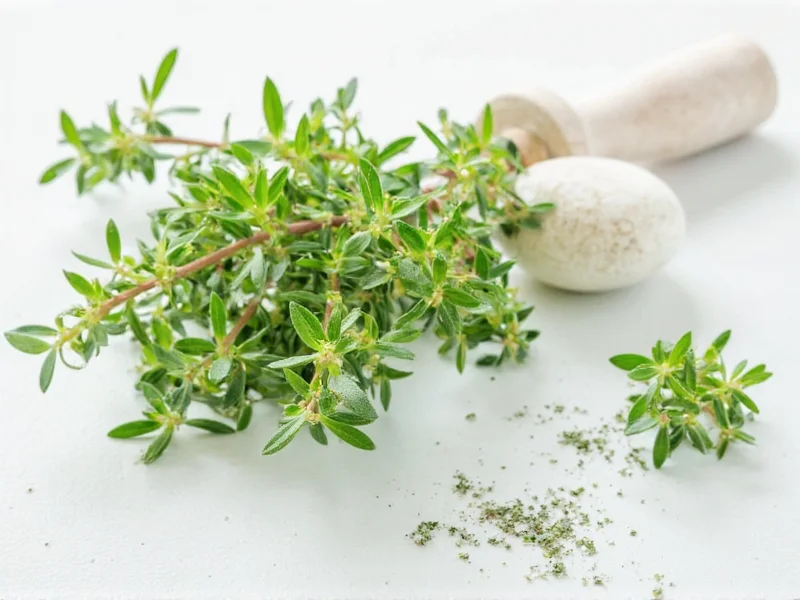
Thyme Alternatives Aren’t Substitutions—They’re Contextual Replacements
Most people fixate on thyme alternatives because they’ve been told thyme is ‘essential’ in certain dishes—roast chicken, tomato sauce, lentil soup. That instruction usually comes from a printed recipe or a cooking video where timing, heat control, and ingredient layering are tightly managed. But in real homes—where dinner starts 40 minutes after the kids get home, where the oven runs hot on one side, where dried herbs sit unsealed in a cupboard for 18 months—the idea of a ‘correct’ thyme substitute collapses before it’s even tested. The consequence isn’t ruined food. It’s wasted mental bandwidth: comparing oregano vs marjoram online while the onions burn, or buying three small jars of ‘artisanal’ dried herbs that never get used past their first month.
The core judgment isn’t about flavor fidelity. It’s this: Thyme alternatives matter only when thyme’s structural role—its slow-releasing, earthy backbone—is actively carrying the dish’s aromatic architecture. That rarely happens in weeknight meals. It does happen—suddenly and decisively—in slow-simmered stocks, long-braised beans, or layered herb crusts on roasted lamb where thyme’s camphoraceous lift interacts with fat and time. Outside those narrow windows, the difference between thyme and its alternatives is functionally silent—not subtle, not nuanced, but acoustically absent in the sensory field of a home meal.
First invalid fixation: ‘Which herb tastes closest to thyme?’ That question assumes taste is linear and additive. In practice, dried thyme’s dominant note is thymol—a sharp, medicinal compound that softens only with prolonged heat and fat. Oregano has carvacrol, which overlaps but doesn’t mimic; marjoram lacks thymol entirely and reads as sweet, not grounding. Comparing them by sniffing dry leaves misleads completely. Second invalid fixation: ‘Should I use fresh or dried?’ Irrelevant unless you’re using thyme itself—and even then, only if the dish simmers >45 minutes. For alternatives, freshness rarely compensates for mismatched chemical behavior. A fresh oregano leaf won’t behave like dried thyme in a quick sauté—not because it’s ‘weaker,’ but because its volatile oils evaporate before thyme’s compounds even begin to diffuse.
The real constraint isn’t flavor matching. It’s storage stability under typical home conditions. Thyme holds up—dried, unrefrigerated, in ambient light—for 18–24 months with minimal degradation. Most alternatives don’t. Dried marjoram loses its floral top notes in under 6 months in a warm kitchen cupboard; fresh sage wilts within days unless vacuum-sealed or frozen; lemon thyme oxidizes visibly at the stem tips after 3 days in a plastic bag. This isn’t about shelf life labels—it’s about what’s actually usable when you open the jar at 6:15 p.m. on a Tuesday. If your ‘thyme alternative’ has already volatilized into background dust, no amount of precise ratio adjustment saves it.
Lately, the misunderstanding is shifting—not because people know more, but because they cook less predictably. Meal kits drop rosemary-infused oil instead of thyme; grocery apps auto-substitute ‘mediterranean herb blend’ without prompting; smart ovens default to ‘herb-roast’ presets that ignore botanical distinctions entirely. These aren’t errors. They’re signals that the system no longer assumes thyme is a fixed node in the cooking graph. The friction isn’t in choosing an alternative—it’s in insisting there must be one correct answer across all contexts. That insistence breaks down the moment you realize thyme isn’t a flavor, but a timing device: it’s present to unfold, not to announce.
Here’s how to cut through: If the dish spends <30 minutes in active heat, skip the thyme-alternative calculus entirely—use whatever dried herb you have open, at half the listed thyme quantity. Why? Because below that thermal threshold, no common alternative replicates thyme’s delayed release—but none need to. What matters is aromatic presence, not structural fidelity. You’ll taste herb. You won’t taste ‘missing thyme.’ That’s not compromise. It’s alignment with how home cooking actually works: iterative, adaptive, and indifferent to botanical hierarchy.
| What people fixate on | What it affects | When it matters | When it doesn't |
|---|---|---|---|
| Flavor similarity to dried thyme | Initial aroma impression | In slow-simmered stocks or braises >90 min | In pan sauces, stir-fries, or sheet-pan roasts |
| Fresh vs dried form | Oil solubility and release speed | In herb-forward marinades applied >2 hrs pre-cook | In last-minute garnishes or quick sautés |
| Botanical family (Lamiaceae) | Shared terpene profiles | In raw applications (e.g., herb butter for cold roast beef) | In soups where herbs simmer >40 min |
| Price per gram | Cost-per-use realism | When buying bulk dried oregano for weekly use | When using a $12 jar of ‘gourmet’ lemon thyme once |
Quick verdicts for home cooks
- If you’re making tomato sauce for next-day leftovers, use oregano—it builds depth over time, unlike thyme’s early spike.
- For a 20-minute roasted vegetable sheet pan, skip the search—any dried Mediterranean herb blend works identically.
- When cooking for someone with thyme sensitivity, marjoram is safer than sage, but only if used dried and pre-toasted.
- If your dried thyme is older than six months, swap to rosemary only in fatty dishes—its pine notes need fat to round out.
- Using fresh thyme? Its alternatives fail outright—no common fresh herb replicates its stem-integrated release pattern.
- For vegetarian stews thickened with lentils, skip thyme alternatives entirely—bay leaf + black pepper delivers the same structural anchor.
Frequently asked questions
Why do people think marjoram is the ‘mild thyme’?
Because early 20th-century American herb guides labeled it that way—ignoring that marjoram’s linalool dominance creates sweetness, not dilution. Thyme’s bite comes from thymol, which marjoram lacks.
Is it actually necessary to adjust quantities when substituting thyme?
No—unless you’re using rosemary, which is significantly more potent and resinous. Oregano, marjoram, and savory require near-identical amounts, but their impact arrives earlier and fades faster.
What happens if you ignore thyme’s role in slow-cooked dishes?
You lose aromatic scaffolding—not flavor. The dish tastes complete, but lacks the quiet, woody resonance that makes long-cooked foods feel ‘settled’ rather than ‘bright.’




 浙公网安备
33010002000092号
浙公网安备
33010002000092号 浙B2-20120091-4