
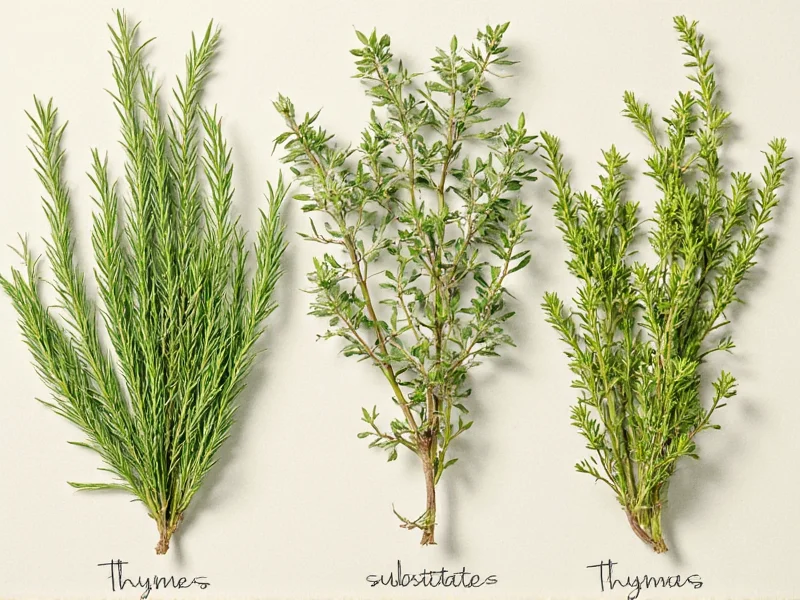
Thyme Substitutes Aren’t About Flavor Matching — They’re About Thermal Stability and Shelf-Life Reality
Most home cooks believe thyme substitution is a flavor puzzle: Which herb tastes closest? That assumption comes from grocery labels, recipe blogs, and decades of ‘herb family’ charts that treat Mediterranean perennials like interchangeable notes on a scale. But in practice, what breaks a stew or dries out a roasted chicken isn’t taste drift — it’s volatility. Thyme’s active compounds (thymol, carvacrol) resist heat and time better than nearly all common substitutes. When people chase ‘closest taste’ instead of ‘most stable compound’, they misdiagnose the real failure point: not the first bite, but the third reheated portion — where oregano turns medicinal and rosemary goes pine-needle sharp.
The core judgment isn’t about preference — it’s about functional durability. Thyme matters most when thermal exposure or storage duration crosses invisible thresholds. Below those thresholds? It doesn’t matter at all. A 20-minute tomato sauce with dried oregano instead of thyme tastes identical to the version with thyme — not because oregano mimics thyme, but because neither herb has time to degrade or dominate. The flavor gap only opens when the pot stays warm past simmering, or when leftovers sit overnight. In those cases, thyme’s molecular resilience becomes structural — not stylistic.
Two ineffective fixations dominate home substitution logic. First: ‘Dried vs. fresh’ as a primary decision variable. In practice, dried thyme and dried oregano behave similarly under heat — both lose top notes fast, but thyme’s base notes hold longer. Swapping one dried herb for another rarely solves anything; switching between dried and fresh within the same herb does far more. Second: ‘One-to-one volume replacement’. This ignores density differences — crushed thyme packs tighter than leafy marjoram, so equal spoonfuls deliver unequal mass. But since most home cooks measure by eye anyway, precision here creates false confidence without measurable impact on outcome.
The real constraint isn’t taste or technique — it’s pantry decay. Most households store dried herbs in clear jars near stoves or windows. Under those conditions, thyme retains usable potency for 18–24 months; oregano fades noticeably after 12. So the ‘substitute’ you reach for may already be half-dead — and you won’t taste the difference until you compare side-by-side in a simple broth. That decay isn’t theoretical: it’s visible as faded green color, brittle texture, and loss of aroma when rubbed between fingers. No label date, no expiration stamp — just slow chemical attrition accelerated by light and ambient heat. This is the unspoken bottleneck: your substitute isn’t weak because it’s wrong — it’s weak because it’s old.
Here’s how judgment shifts across real home use cases: If you’re roasting root vegetables at 425°F for 35 minutes, thyme and marjoram perform identically — both survive intact, both contribute background earthiness. If you’re braising short ribs for 3 hours, thyme holds its aromatic structure while oregano flattens into bitterness. If you’re making herb butter for immediate use, rosemary works — but if you plan to freeze it for three weeks, thyme’s lower volatility prevents off-notes upon thawing. And if your household includes someone sensitive to strong phenolics (a mild but real sensitivity some report with oregano), thyme’s gentler profile avoids discomfort without requiring label scrutiny.
Stop asking ‘What tastes like thyme?’ Ask instead: How long will this dish stay hot or sit cold before eating? That single question collapses 90% of substitution anxiety. If the answer is ‘under 30 minutes, served immediately’, any Mediterranean dried herb works — thyme included. If it’s ‘simmered >1 hour, then refrigerated’, thyme isn’t optional — it’s the baseline stabilizer. You don’t need to memorize ratios or source rare cultivars. You need only track time and temperature — two variables already visible on your stove and fridge.
| What people fixate on | What it affects | When it matters | When it doesn't |
|---|---|---|---|
| Flavor similarity to thyme | Initial aroma perception | When serving raw or barely warmed dishes (e.g., herb-infused oil drizzled cold) | In any cooked application >25 minutes |
| Dried vs. fresh form | Intensity onset speed | In quick sautés or finishing garnishes | In slow-cooked stews or baked casseroles |
| Botanical family (Lamiaceae) | None — no predictive value for stability | Never | Always |
| Gram-for-gram weight substitution | Consistency across batches | Only in commercial production with calibrated scales | In home kitchens using spoons or pinches |
Quick verdicts for home cooks
- If your soup simmers 20 minutes and you’ll eat it tonight, use oregano — thyme offers zero detectable advantage.
- If you’re prepping freezer meals for later in the month, thyme is the only safe choice among common substitutes.
- If your dried herbs have lost their scent when crushed, no substitution fixes that — replace the jar first.
- If you’re seasoning ground meat for burgers cooked immediately, marjoram and thyme are functionally identical.
- If your household includes someone who finds oregano harsh or medicinal, thyme is reliably milder — not tastier, just less reactive.
- If you’re baking herb bread and plan to toast slices two days later, thyme’s residual aroma survives better than rosemary’s.
Frequently asked questions
Why do people think marjoram is the ‘best’ thyme substitute?
Because early herb guides grouped them botanically and noted shared mint-family traits — but marjoram degrades faster under heat and lacks thyme’s antiseptic compound stability.
Is it actually necessary to adjust quantity when substituting dried oregano for dried thyme?
No — volume adjustments rarely change outcomes in home cooking, since both herbs vary widely in density and potency batch-to-batch; eyeballing works fine below 45-minute cook times.
What happens if you ignore thyme’s thermal stability in a long braise?
Oregano or rosemary can develop bitter, resinous off-notes after 2+ hours — not from ‘too much herb’, but from breakdown products accumulating in low-acid liquid.
Lately, recipe platforms have quietly dropped ‘substitute’ callouts for thyme in slow-cooked categories — not because alternatives improved, but because user comments increasingly report off-flavors with non-thyme herbs in multi-hour dishes. That shift isn’t algorithmic; it’s observational drift. Home cooks are learning — slowly, anecdotally — that thyme’s role isn’t aromatic decoration. It’s time-resistance infrastructure. In a home kitchen, thyme is rarely the thing that ruins a dish — but when it’s missing from a long-cooked one, it’s often the first silent casualty.




 浙公网安备
33010002000092号
浙公网安备
33010002000092号 浙B2-20120091-4