
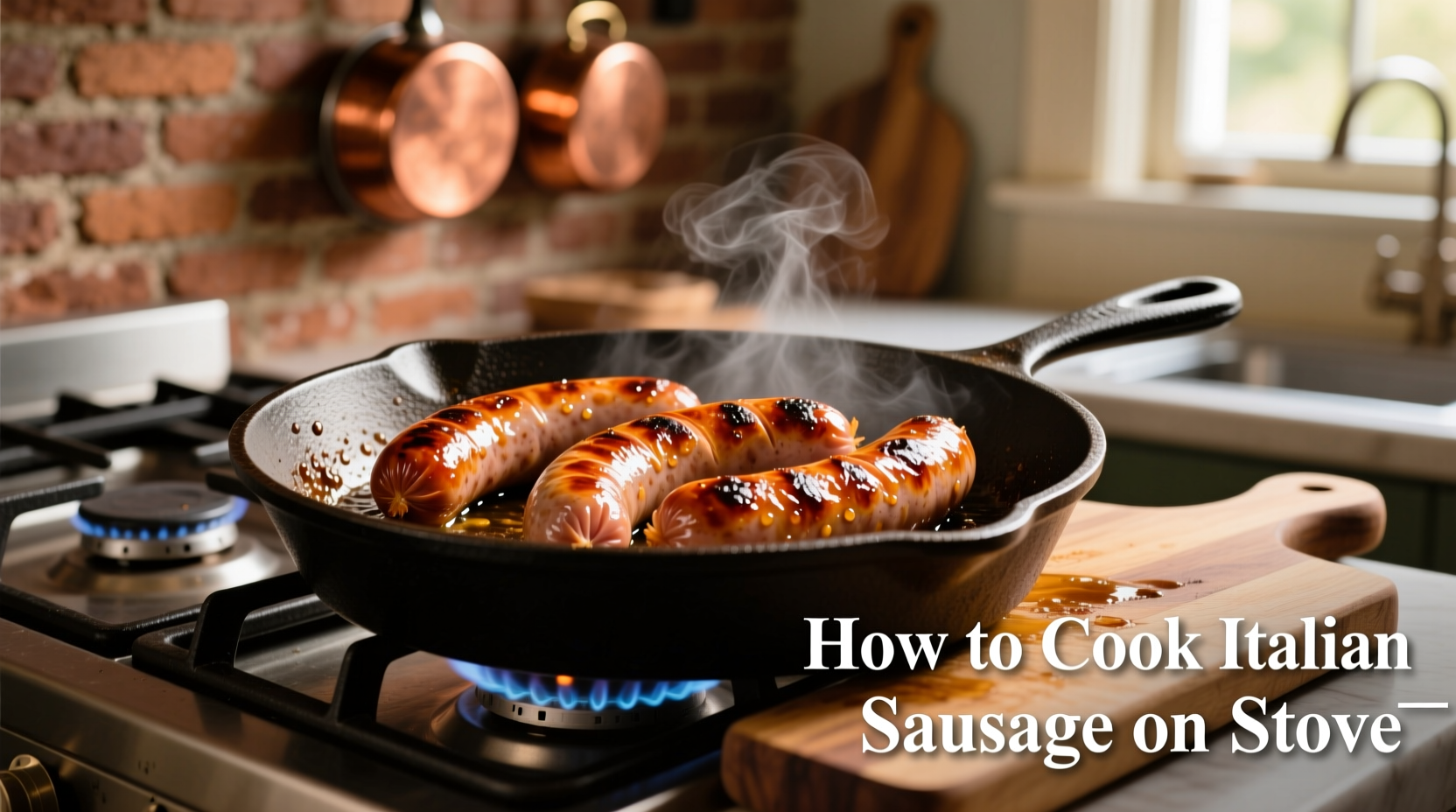
The best way to cook Italian sausage on stove involves preheating a skillet over medium heat, pricking the sausages lightly, and cooking them for 15-20 minutes while turning frequently until they reach an internal temperature of 160°F (71°C) with a golden-brown exterior. Never boil Italian sausage before pan-frying, as this removes flavor and creates a mushy texture.
Essential Tools and Ingredients for Perfect Stovetop Italian Sausage
Cooking Italian sausage on the stove requires minimal equipment but precise technique. You'll need a heavy-bottomed skillet (cast iron works best for even heat distribution), tongs for turning, a meat thermometer (critical for food safety), and paper towels for draining excess grease. For ingredients, select high-quality Italian sausage links - either sweet or hot varieties based on your preference. Avoid pre-cooked sausages if you want authentic flavor development through the Maillard reaction during cooking.
Step-by-Step Stovetop Cooking Method
Follow this professional technique for perfectly cooked Italian sausage every time:
- Preparation: Remove sausages from packaging and pat completely dry with paper towels. Moisture prevents proper browning. Lightly prick each sausage in 3-4 places with a fork to prevent bursting.
- Skillet Setup: Place a heavy skillet over medium heat (not high) for 2-3 minutes until evenly heated. Add 1 tablespoon of high-smoke point oil like avocado or canola oil.
- Cooking Process: Arrange sausages in a single layer without crowding. Cook undisturbed for 4-5 minutes until a deep golden crust forms.
- Turning Technique: Rotate sausages 90 degrees to create attractive cross-hatch marks, then cook another 4-5 minutes.
- Completion: Turn sausages to cook all sides evenly, including the ends. Total cooking time should be 15-20 minutes.
| Cooking Stage | Time | Visual Indicator | Internal Temperature |
|---|---|---|---|
| Initial Sear | 4-5 minutes | Deep golden crust | 100-120°F |
| Middle Stage | 8-10 minutes | Brown on most sides | 130-145°F |
| Final Cooking | 15-20 minutes | Uniform golden brown | 160°F (required) |
Temperature Guidelines and Food Safety
Proper internal temperature is non-negotiable when cooking Italian sausage on stove. The USDA requires pork products to reach 160°F (71°C) for safe consumption. Relying solely on color or cooking time leads to either undercooked sausage (food safety risk) or overcooked, dry sausage. Insert an instant-read thermometer into the thickest part of the sausage, avoiding contact with the skillet. Remember that carryover cooking will raise the temperature 5-10 degrees after removal from heat, so pull sausages at 155°F.
Historical Evolution of Pork Safety Standards
Understanding the timeline of temperature guidelines reveals critical food safety advancements. Scientific research has progressively refined recommendations as trichinella risks decreased through modern farming practices:
- Pre-1980s: Universal recommendation of 170°F (77°C) for all pork products to eliminate trichinosis risk
- 1980s-2011: USDA reduced safe temperature to 160°F (71°C) for whole cuts after swine management improvements, but maintained 160°F for ground meats due to bacterial distribution during grinding
- 2011-Present: Current guidelines specify 145°F (63°C) with 3-minute rest for whole pork cuts, while ground products like Italian sausage remain at 160°F to address pathogen risks inherent in grinding processes
This evolution demonstrates how evidence-based research directly impacts home cooking practices. The persistent 160°F requirement for ground meats acknowledges that grinding distributes surface contaminants throughout the product, necessitating higher temperatures for safety.
Source: USDA Food Safety and Inspection Service, Safe Minimum Cooking Temperatures
Contextual Limitations of Stovetop Cooking
While ideal for standard household batches, stovetop cooking has specific constraints where alternative methods prove superior. Recognizing these boundaries prevents suboptimal results:
- Batch Size Limitations: Cooking more than 6 sausages simultaneously causes overcrowding and steaming. For gatherings of 8+ people, oven baking at 400°F (204°C) for 20-25 minutes yields more consistent results with less hands-on time
- Casing Sensitivity: Artisanal sausages with natural casings may split when pricked. In these cases, eliminate pricking and cook at medium-low heat for 25-30 minutes with frequent turning
- Pre-Cooked Product Handling: Commercial "fully cooked" sausages only require reheating to 140°F (60°C). Boiling or microwaving is more efficient than stovetop searing for these products
These contextual boundaries highlight why technique must adapt to ingredient variables and meal requirements. Always verify product labeling and adjust methods accordingly to maintain both safety and quality.
Source: University of Nebraska-Lincoln Food Safety Extension, Cooking Sausage Safely
Visual Doneness Indicators Beyond Temperature
While a thermometer provides definitive safety assurance, experienced cooks watch for these visual cues when preparing Italian sausage on stove:
- Texture: Firm but slightly springy when pressed (not hard or mushy)
- Juices: Clear, not pink when pierced
- Color: Uniform golden brown exterior with no gray patches
- Shrinkage: Sausages will reduce slightly in size as fat renders
Common Mistakes to Avoid When Cooking Italian Sausage
Many home cooks make these critical errors when attempting to cook Italian sausage on stove:
- High heat cooking: Causes burnt exterior with raw interior - always use medium heat
- Crowding the pan: Creates steam instead of sear - cook in batches if necessary
- Skipping the dry step: Wet sausages won't brown properly
- Boiling first: Removes flavor and creates texture issues
- Not resting: Always let sausages rest 3-5 minutes before serving
Serving Suggestions for Perfectly Cooked Italian Sausage
After mastering how to cook Italian sausage on stove, elevate your meal with these serving options. Slice cooked sausages diagonally for sandwiches with grilled peppers and onions, or serve whole with traditional sides like sautéed broccoli rabe, creamy polenta, or hearty pasta. For breakfast applications, pair sweet Italian sausage with eggs and roasted potatoes. Always garnish with fresh herbs like parsley or basil to cut through the richness. The natural casing should provide a satisfying snap when bitten into - a hallmark of properly cooked Italian sausage.
Storage and Reheating Techniques
Store leftover cooked Italian sausage in an airtight container in the refrigerator for up to 4 days. For longer storage, freeze in portion-sized containers for up to 3 months. When reheating stovetop Italian sausage, avoid the microwave which creates rubbery texture. Instead, warm in a lightly oiled skillet over medium-low heat for 3-4 minutes, turning occasionally until heated through. Add a splash of broth or water to create gentle steam and maintain moisture. Never reheat sausage more than once for optimal food safety and texture.




 浙公网安备
33010002000092号
浙公网安备
33010002000092号 浙B2-20120091-4