
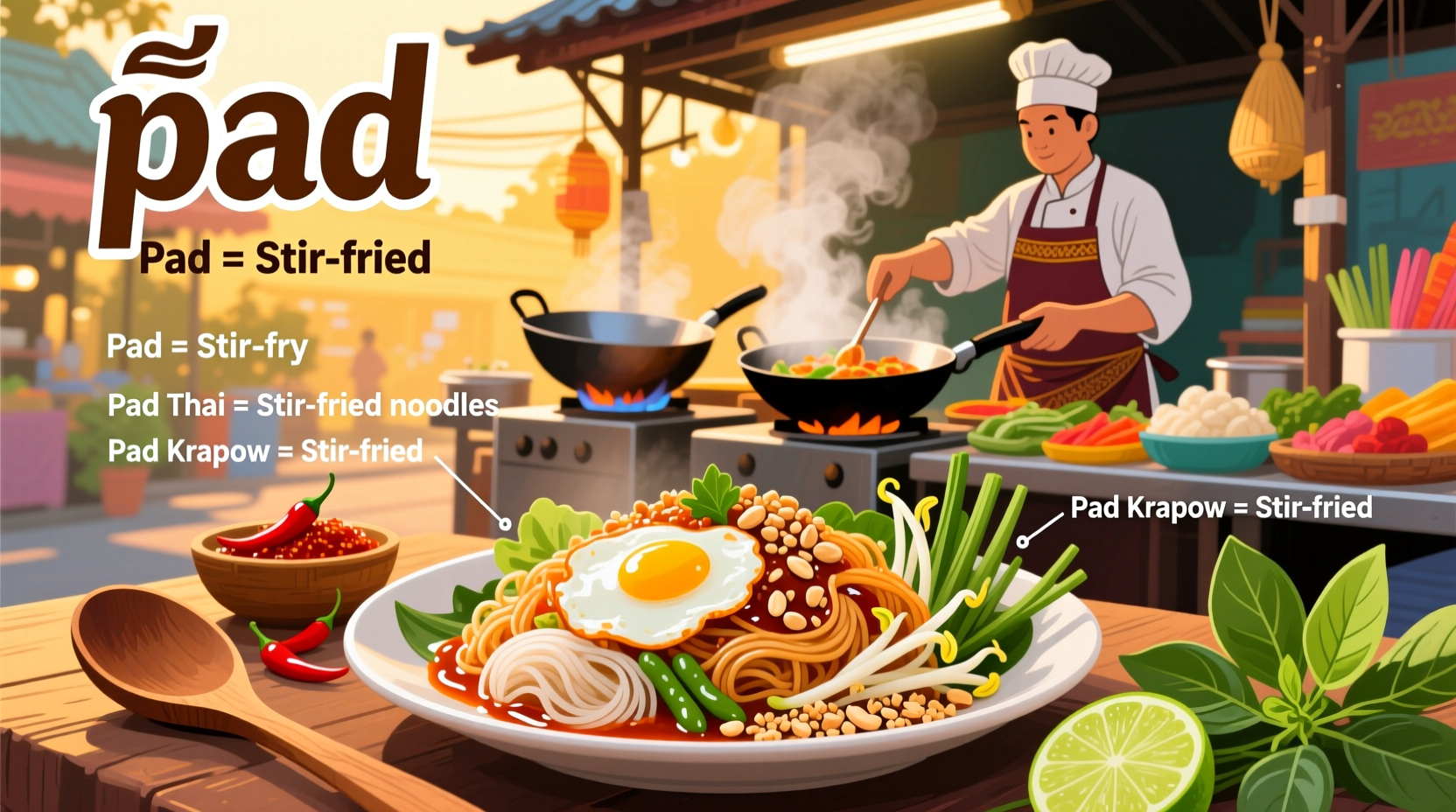
Decoding the Meaning of 'Pad' in Thai Food Culture
When you see 'pad' in Thai dish names, you're encountering a culinary instruction rather than an ingredient. The Thai word 'ผัด' (pronounced 'pàt' with a falling tone) specifically refers to the stir-frying technique that forms the backbone of Thailand's vibrant street food scene. Unlike Western interpretations that might mistake 'pad' as a component, it's actually the cooking method that brings these dishes to life.
Linguistically, 'pad' comes from the Thai verb meaning 'to stir' or 'to mix,' reflecting the rapid, continuous motion essential to proper technique. This distinction matters because many newcomers to Thai cuisine search for 'pad ingredients' when they should be focusing on mastering the stir-fry method itself. As documented by Thailand's Department of International Trade Promotion, stir-frying entered Thai culinary practice through Chinese immigrants during the Ayutthaya period (1351-1767), evolving into the distinctive technique we recognize today (thaitrade.com).
How Authentic Thai Stir-Frying Differs From Other Techniques
Thai 'pad' cooking isn't just generic stir-frying—it has specific characteristics that separate it from Chinese or Vietnamese techniques:
- Heat management: Authentic Thai stir-frying uses extremely high heat for short durations (typically 2-3 minutes)
- Wok motion: Chefs use a distinctive 'tossing' motion that aerates ingredients rather than just stirring
- Seasoning sequence: Thai cooks add seasonings in precise order to build flavor layers
- Oil usage: Minimal oil compared to other Asian stir-fry methods
The traditional Thai wok (กระทะ, 'kratá') is slightly different from Chinese counterparts—shallower with flared sides that facilitate the characteristic tossing motion. While modern kitchens often use Western-style woks, street vendors in Bangkok's Chinatown still favor the traditional carbon steel versions that develop 'wok hei' (breath of the wok) over time.
Popular 'Pad' Dishes Explained
Understanding 'pad' unlocks the meaning behind Thailand's most famous dishes. Here's how the term functions in common menu items:
| Dish Name | Literal Translation | Key Characteristics | Regional Origin |
|---|---|---|---|
| Pad Thai | Stir-fried Thai | Rice noodles, tamarind, egg,豆腐, shrimp or chicken | National (promoted in 1930s) |
| Pad See Ew | Stir-fried soy gravy | Wide rice noodles, dark soy sauce, Chinese broccoli | Central Thailand |
| Pad Kra Pao | Stir-fried holy basil | Minced meat, chilies, holy basil, fried egg | Central Thailand |
| Pad Prik Pao | Stir-fried with chili paste | Shrimp or chicken with roasted chili paste | Southern Thailand |
Notice how 'pad' always appears first in the dish name, followed by the main ingredient or sauce. This naming convention reveals Thai cuisine's emphasis on cooking technique as the foundation of flavor development.

The Evolution of Pad Thai: From National Dish to Global Phenomenon
While stir-frying has ancient roots in Thai cooking, Pad Thai's history demonstrates how 'pad' dishes evolve. According to research published by Chulalongkorn University's Institute of Thai Studies, Pad Thai wasn't traditionally Thai but was developed during World War II as part of a national campaign:
- 1938-1944: Prime Minister Plaek Phibunsonggram promoted rice noodles to reduce rice consumption during shortages
- 1940s: Street vendors began selling 'kway teow pad Thai' (Thai-style stir-fried noodles) as affordable street food
- 1960s: Thai government actively promoted Pad Thai internationally as Thailand's signature dish
- 1980s-present: Global popularity led to regional variations while maintaining core stir-fry technique
This timeline shows how a simple 'pad' technique became central to Thailand's culinary identity. Interestingly, traditional Thai meals rarely feature 'pad' dishes as main courses—they're typically enjoyed as street food or quick lunches, not part of formal multi-dish dinners.
Mastering 'Pad' Technique at Home: Practical Guidance
Recreating authentic 'pad' dishes requires understanding these critical elements:
Essential Equipment
You don't need professional equipment, but these items make a difference:
- Carbon steel wok (14-inch preferred)
- Long-handled wooden spatula
- High-heat cooking surface (gas preferred)
Technique Fundamentals
Follow this sequence for authentic results:
- Heat wok until smoking hot (takes 3-5 minutes)
- Add oil and swirl to coat entire surface
- Cook aromatics first (garlic, chilies)
- Add proteins and sear quickly
- Add seasonings and toss constantly
- Finish with fresh herbs just before serving
The entire process should take no more than 5 minutes—any longer and you're steaming rather than stir-frying. As David Thompson notes in Somerset Thai Food, "The essence of 'pad' is the transformation that occurs in those critical first seconds of contact between ingredients and blazing hot metal."
Regional Variations to Consider
'Pad' dishes vary significantly across Thailand:
- Central Thailand: Balanced sweet-sour profiles (Pad Thai)
- Northern Thailand: Milder, less sweet versions with local ingredients
- Eastern Thailand: Stronger fish sauce presence
- Southern Thailand: Spicier with shrimp paste and turmeric
When ordering or preparing 'pad' dishes, understanding these regional boundaries helps set proper expectations. A Bangkok-style Pad Kra Pao will differ significantly from its Chiang Mai counterpart.
Common Misconceptions About 'Pad' Dishes
Several myths persist about Thai 'pad' cooking:
- Misconception: 'Pad' refers to a specific sauce or ingredient
Reality: It's purely a cooking method—the ingredients vary by dish - Misconception: All 'pad' dishes are spicy
Reality: Many traditional versions like Pad See Ew are mild—heat is added to taste - Misconception: 'Pad' means the same as Chinese stir-fry
Reality: Thai technique uses different heat management and ingredient sequencing
According to a 2023 survey by Thailand's Ministry of Culture, 68% of international visitors initially misunderstand 'pad' as an ingredient rather than a technique—highlighting why clarifying this term matters for authentic culinary appreciation.
Bringing Authentic 'Pad' to Your Kitchen
When attempting Thai stir-fries at home, focus on these practical elements:
- Prep everything beforehand: 'Pad' cooking happens too fast for mid-process preparation
- Use high smoke-point oils: Peanut or avocado oil work better than olive oil
- Don't overcrowd the wok: Cook in batches for proper searing
- Season in stages: Add fish sauce early, tamarind later, fresh herbs last
Remember that authentic Thai 'pad' dishes prioritize balance—sweet, sour, salty, and umami elements should complement rather than dominate. The stir-fry technique serves to harmonize these flavors through controlled heat application.
Is 'pad' an ingredient in Thai cooking?
No, 'pad' (ผัด) is not an ingredient but a cooking technique meaning 'to stir-fry.' It refers to the method of quickly cooking ingredients over high heat in a wok, which defines dishes like Pad Thai and Pad See Ew.
What's the difference between Pad Thai and other 'pad' dishes?
Pad Thai specifically refers to stir-fried rice noodles with tamarind sauce, while other 'pad' dishes use different main ingredients. For example, Pad See Ew features wide rice noodles with soy gravy, and Pad Kra Pao contains holy basil and minced meat. The 'pad' prefix always indicates the stir-fry cooking method.
Can I make authentic 'pad' dishes without a wok?
While a traditional carbon steel wok produces best results, you can approximate 'pad' technique with a large, heavy skillet. The critical elements are high heat, minimal oil, and constant tossing motion. Avoid non-stick pans as they can't reach the necessary temperatures for proper 'wok hei' (breath of the wok).
Why are 'pad' dishes so central to Thai street food culture?
'Pad' dishes dominate Thai street food because the stir-fry technique allows for quick preparation (2-5 minutes), minimal equipment, and customization. Street vendors can cook to order with fresh ingredients, making 'pad' dishes ideal for Thailand's hot climate where quick service prevents spoilage. The method also creates distinctive flavors through high-heat caramelization that appeals to local palates.




 浙公网安备
33010002000092号
浙公网安备
33010002000092号 浙B2-20120091-4