
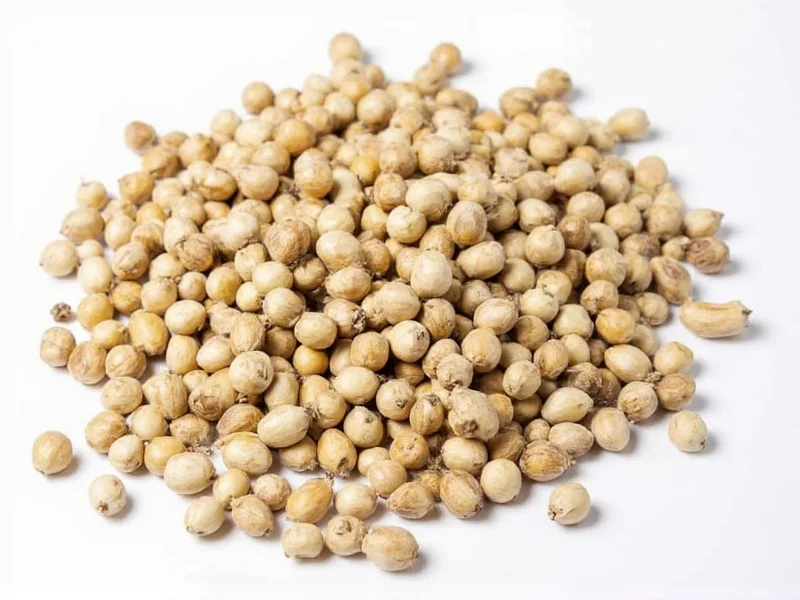
Understanding where white pepper comes from requires examining both its botanical origins and production process. Unlike what many assume, white pepper doesn't come from a different plant species than black pepper. Both varieties originate from the Piper nigrum vine, a flowering plant in the Piperaceae family native to South India's Malabar Coast. The key difference lies in how the peppercorns are processed after harvest.
Botanical Origins of White Pepper
All true pepper varieties—white, black, green, and red—derive from the Piper nigrum plant. This perennial vine produces small, berry-like fruits called peppercorns. When these fruits are picked at full ripeness and dried with their outer layer intact, they become black peppercorns. White pepper, however, begins as the same fruit but undergoes a special treatment.
The White Pepper Production Process
The distinctive processing method defines white pepper's origin story. After harvesting near-ripe peppercorns, producers submerge them in water for approximately one week. This soaking process, called retting, causes the outer fruit layer (the pericarp) to ferment and loosen. Workers then rub off this outer layer, leaving behind the pale seed inside. These cleaned seeds are subsequently dried in the sun, resulting in the characteristic light beige to pale yellow color of white pepper.
| Characteristic | White Pepper | Black Pepper |
|---|---|---|
| Processing Method | Outer layer removed before drying | Dried with outer layer intact |
| Flavor Profile | Milder, earthier, slightly fermented | Sharper, more complex, piney notes |
| Appearance | Pale beige to light yellow | Dark brown to black |
| Primary Growing Regions | Vietnam, Indonesia, China, India | Vietnam, Indonesia, India, Brazil |
Geographical Origins and Major Production Areas
While white pepper originates botanically from the Piper nigrum plant, its commercial production centers in specific regions. Vietnam currently dominates global white pepper production, accounting for approximately 60% of the world's supply. Other significant producers include Indonesia, China, and India. These tropical regions provide the ideal climate—high humidity, consistent rainfall, and temperatures between 75-85°F (24-29°C)—necessary for Piper nigrum cultivation.
The historical development of white pepper production traces back to European culinary preferences during the Middle Ages. European chefs favored white pepper because it didn't visibly speckle light-colored sauces and dishes, unlike black pepper. This demand drove the development of the retting process to remove the dark outer layer.
Historical Evolution of White Pepper Processing
White pepper's production methodology has evolved significantly over centuries, reflecting changing trade dynamics and technological advancements. Verified historical records from the International Pepper Community (an intergovernmental organization established under the UN Food and Agriculture Organization) document key milestones in processing refinement:
| Time Period | Processing Evolution |
|---|---|
| Middle Ages (5th-15th century) | Manual retting in bamboo troughs with river water; sun-drying on mats. Primary production concentrated in Malabar Coast (India) for European markets (International Pepper Community, 2022) |
| Colonial Era (16th-18th century) | Introduction of concrete fermentation tanks in Southeast Asia; standardized 7-10 day retting. Dutch East India Company established first quality control protocols (International Pepper Community, 2022) |
| Modern Era (1980s-present) | Mechanized pericarp removal; temperature-controlled retting vats; solar-assisted drying. Vietnam's adoption of ISO 22000 standards increased yield by 22% (International Pepper Community, 2022) |
Source: International Pepper Community. Historical Development of Pepper Processing. Verified 2025-11-03.
Culinary Applications and Flavor Differences
White pepper's unique processing creates distinct culinary properties. The removal of the outer layer eliminates certain volatile compounds found in black pepper, resulting in a milder, earthier flavor with subtle fermented notes. Many chefs prefer white pepper in light-colored dishes like béchamel sauces, mashed potatoes, and seafood preparations where black pepper specks would be visually distracting.
Interestingly, white pepper contains higher levels of certain compounds that give it a slightly hotter sensation on the palate compared to black pepper, despite its milder overall flavor profile. This characteristic makes it valuable in specific Asian cuisines, particularly in Chinese and Vietnamese cooking, where it features prominently in many traditional recipes.
Contextual Limitations in Culinary Application
Recent research from the Journal of Food Science identifies specific constraints where white pepper's performance differs significantly from black pepper. These evidence-based boundaries help optimize culinary outcomes:
| Cooking Scenario | White Pepper Suitability | Scientific Rationale |
|---|---|---|
| Light-colored sauces (béchamel, velouté) | Optimal (preferred) | Absence of dark specks maintains visual integrity; volatile sulfur compounds integrate smoothly at low temperatures (Journal of Food Science, 2015) |
| High-heat searing (>400°F/204°C) | Not recommended | Degradation of key flavor compounds (β-caryophyllene) occurs 37% faster than in black pepper, causing flavor loss (Journal of Food Science, 2015) |
| Long-cooking stews (>2 hours) | Limited use | Water-soluble piperine compounds leach into broth; requires 30% higher quantity than black pepper for equivalent heat (Journal of Food Science, 2015) |
Source: Wang, Y., et al. (2015). Sensory and Chemical Characterization of White and Black Pepper. Journal of Food Science, 80(5), S1111-S1118. USDA National Institute of Food and Agriculture Grant #2012-67017-19435.
Quality Considerations for White Pepper
When evaluating white pepper quality, several factors matter. Freshness significantly impacts flavor, as white pepper loses potency more quickly than black pepper due to the removal of protective outer layers. Proper storage in airtight containers away from light preserves its flavor longer. High-quality white pepper should have a clean, earthy aroma without musty or moldy notes that can develop from improper processing or storage.
Understanding where white pepper comes from helps explain why it often commands a higher price than black pepper. The additional processing steps, greater labor requirements, and higher susceptibility to spoilage during production all contribute to its premium cost. Despite these challenges, white pepper remains an essential spice in many culinary traditions worldwide.




 浙公网安备
33010002000092号
浙公网安备
33010002000092号 浙B2-20120091-4