
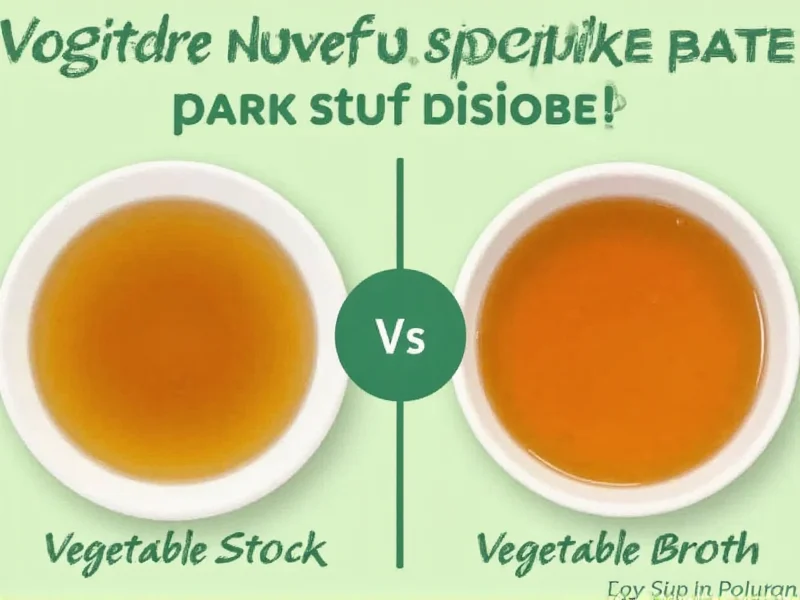
Home cooks and professional chefs often use the terms "vegetable stock" and "vegetable broth" interchangeably, creating confusion in kitchens worldwide. Understanding the subtle yet significant differences between these foundational cooking liquids can dramatically impact your culinary results. This comprehensive guide clarifies the distinctions that matter most in your cooking.
Defining Vegetable Stock and Broth
While both serve as flavor bases for soups, sauces, and braises, their preparation methods create distinct characteristics. Vegetable stock traditionally refers to a liquid made by simmering vegetable scraps, herbs, and sometimes bones for extended periods (3-4 hours). The goal is to extract maximum flavor and body without added seasoning. In contrast, vegetable broth contains added salt and seasonings, making it suitable for direct consumption. Commercial broth products typically contain 400-800mg of sodium per cup, while stocks contain minimal added salt.
Key Differences at a Glance
| Characteristic | Vegetable Stock | Vegetable Broth |
|---|---|---|
| Sodium Content | Minimal to none (unsalted) | Significant (400-800mg per cup) |
| Preparation Time | 3-4 hours | 1-2 hours |
| Primary Ingredients | Vegetable scraps, mirepoix, herbs | Vegetables, salt, seasonings |
| Culinary Purpose | Flavor foundation for sauces/soups | Ready-to-consume base or finished product |
| Texture | Thicker, more concentrated | Thinner, lighter body |
Ingredient Composition Explained
Traditional vegetable stock recipes emphasize vegetable scraps—carrot peels, onion ends, celery leaves—that would otherwise be discarded. Professional kitchens often include mushroom stems and tomato trimmings for umami depth. The extended simmering time (typically 3-4 hours) extracts collagen and nutrients, creating a richer mouthfeel. Vegetable broth, however, starts with fresh vegetables and includes salt during preparation. Commercial broth producers add seasonings like garlic powder, onion powder, and herbs to create a finished product that tastes complete.
Historical Context: Terminology Evolution
The distinction between stock and broth has shifted significantly since the 13th century. Originally, "broth" (from Old English "brod") referred to any seasoned soup served as a first course, while "stock" (first recorded in 1603) described foundational unsalted liquids for sauces. Professional kitchens maintained strict separation through the 19th century, with stocks simmered 6-8 hours for maximum collagen extraction. The commercial canning boom of the 1950s triggered terminology blurring, as manufacturers labeled salted products "stock" for perceived culinary prestige. Today's labeling inconsistencies stem from USDA's non-regulation of these terms—a 2022 FDA market survey found 68% of "vegetable stock" products contained added salt, contradicting traditional preparation standards (FDA Food Labeling Guide, updated 2023).
Culinary Applications: When to Use Each
Understanding vegetable stock vs broth for soup preparation reveals their distinct roles. Use unsalted vegetable stock when you need complete control over seasoning, particularly in reduction sauces where salt concentration becomes critical. Professional chefs prefer stock as a building block because it won't overpower other ingredients. However, stock's unsalted nature makes it unsuitable for direct consumption without seasoning—this critical boundary matters for dietary applications. Vegetable broth works best when you need a quick flavor base or want to serve a simple soup immediately, but its pre-added salt becomes problematic in long-cooking dishes where reduction concentrates sodium beyond palatable thresholds. The FDA defines "low sodium" broth as containing ≤140mg per serving (21 CFR 101.54), while true unsalted stocks typically contain <5mg per cup—providing essential context for sodium-restricted diets (21 CFR 101.54). The "difference between vegetable stock and broth in recipes" becomes apparent when substituting—one requires salt adjustment while the other doesn't.
Homemade vs Commercial Products
When comparing homemade vegetable stock vs store-bought broth, significant quality differences emerge. Artisanal stock makers simmer vegetable trimmings with cold water, gradually extracting flavors without clouding the liquid. Commercial broths often contain yeast extract or natural flavors to compensate for shorter cooking times. Reading labels reveals that many products labeled "stock" actually contain added salt, blurring the traditional distinction. For health-conscious cooks, "low sodium vegetable broth vs regular" comparisons show 50-70% less sodium in specifically labeled low-sodium versions.
Substitution Guidelines
When substituting vegetable broth for stock in recipes, reduce added salt by 25-50% to compensate for the broth's sodium content. For the reverse substitution (stock for broth), add 1/4 teaspoon salt per cup of stock. In vegan cooking, where "vegetable stock vs broth vegan" concerns arise, ensure commercial products don't contain hidden animal derivatives like bonito flakes. The "vegetable stock vs broth for risotto" question has a clear answer—use unsalted stock to maintain precise control over the dish's final seasoning.
Common Misconceptions Clarified
Many believe vegetable stock always contains bones, but authentic vegetarian versions use only plant materials. The confusion stems from meat-based stocks that do include bones. Another misconception suggests broth is inherently more flavorful, when in reality, properly made stock offers deeper, more complex flavors due to longer simmering. Understanding "vegetable stock vs broth differences" prevents recipe failures, especially in delicate dishes where salt balance is crucial.
Practical Recommendations
For serious home cooks, making your own vegetable stock from kitchen scraps provides superior flavor control and reduces food waste. Freeze stock in ice cube trays for convenient portioning. When purchasing commercial products, read labels carefully—many "stocks" contain added salt. For health considerations, "vegetable broth vs stock sodium content" comparisons show stocks generally contain less sodium, making them preferable for sodium-restricted diets when properly prepared.




 浙公网安备
33010002000092号
浙公网安备
33010002000092号 浙B2-20120091-4