
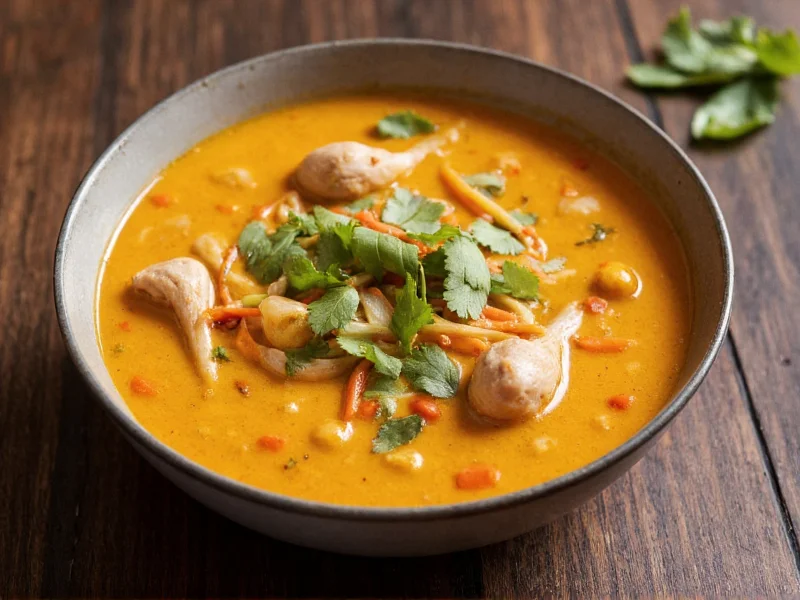
Thai chicken curry soup represents one of Thailand's most beloved comfort foods, enjoyed both domestically and internationally for its complex flavor profile and nourishing qualities. Unlike its Indian counterparts, Thai curry soups rely on fresh herbs and coconut milk rather than heavy spice blends, creating a lighter yet deeply flavorful broth that satisfies without overwhelming the palate.
Historical Evolution of Thai Curry Soup
Thai curry soup has evolved through distinct historical phases, reflecting cultural exchanges and regional adaptations documented by Thailand's official tourism authority. This culinary journey demonstrates how external influences were integrated into traditional practices while preserving core Thai identity:
| Historical Period | Key Developments | Sociocultural Influences |
|---|---|---|
| Ayutthaya Period (1351-1767) | Introduction of coconut milk bases and fresh herb integration | Malay traders brought coconut techniques; Persian spice routes introduced aromatics |
| Rattanakosin Period (1782-1932) | Standardization of curry paste recipes; regional variations codified | Royal court documentation; Chinese immigrant techniques refined paste preparation |
| Modern Era (1932-Present) | Global adaptation with authenticity preservation; UNESCO recognition efforts | Post-WWII tourism boom; 2017 official nomination for Intangible Cultural Heritage |
Source: Tourism Authority of Thailand. (2019). Thai Food: Evolution and Traditions (pp. 10-11). Retrieved from https://www.tourismthailand.org/UploadFiles/Content/Thai-Cuisine/Thai-Food-e-Book.pdf
Essential Ingredients for Authentic Flavor
Creating an authentic thai chicken curry soup recipe begins with understanding the foundational components that distinguish it from other curry variations. The holy trinity of Thai curry paste—red, green, or yellow—forms the flavor base, each offering distinct characteristics:
| Curry Type | Key Ingredients | Flavor Profile |
|---|---|---|
| Red Curry | Dried red chilies, garlic, lemongrass | Spicy, robust, slightly sweet |
| Green Curry | Fresh green chilies, cilantro root, peppercorns | Grassy, herbal, intensely spicy |
| Yellow Curry | Turmeric, cumin, coriander | Mild, earthy, slightly sweet |
For the most authentic thai chicken curry soup from scratch, seek out fresh ingredients rather than relying solely on pre-made pastes. Fresh galangal (not ginger), kaffir lime leaves, and makrut limes significantly elevate the dish beyond standard supermarket interpretations. The coconut milk should be full-fat and without additives to achieve the proper creamy texture that defines traditional Thai preparations.
Step-by-Step Preparation Guide
Follow these professional techniques to master how to make thai chicken curry soup with restaurant-quality results:
- Bloom the curry paste: Heat 2 tablespoons of coconut cream (the solid part from canned coconut milk) in a pot until oil separates. Add 3-4 tablespoons of curry paste and stir-fry for 2-3 minutes until fragrant.
- Add liquids: Gradually whisk in 1 can (13.5 oz) of coconut milk and 1½ cups chicken broth, ensuring no lumps form.
- Incorporate aromatics: Add 2 stalks of bruised lemongrass, 4 torn kaffir lime leaves, and 3 thin slices of galangal. Simmer for 10 minutes to infuse flavors.
- Cook the protein: Add 1 lb boneless chicken thighs (not breasts, which dry out easily) and simmer until cooked through (about 8-10 minutes).
- Finish with delicate ingredients: Remove from heat before adding fish sauce (2 tbsp), palm sugar (1 tbsp), and fresh Thai basil. Squeeze in lime juice just before serving.
Avoiding Common Preparation Mistakes
Many home cooks encounter issues when attempting thai red curry soup vs green curry soup preparations. Understanding these pitfalls ensures perfect results:
- Boiling coconut milk: Never bring coconut milk to a rolling boil, as this causes separation. Maintain a gentle simmer throughout cooking.
- Overcooking herbs: Add delicate ingredients like lime juice and fresh basil off-heat to preserve their bright flavors.
- Using chicken breast exclusively: Thighs provide superior texture and flavor absorption in thai chicken coconut curry soup variations.
- Incorrect seasoning balance: Authentic Thai cuisine balances spicy, sour, sweet, and salty elements. Taste and adjust all four elements before serving.
Dietary Adaptations and Variations
Modern interpretations of thai chicken curry soup accommodate various dietary needs while maintaining authentic flavor profiles:
For gluten-free thai chicken curry soup, verify that your fish sauce and curry paste contain no wheat derivatives. Many commercial brands use wheat as a filler, so seek out certified gluten-free versions or make your own paste.
Vegetarian adaptations substitute chicken with tofu or mushrooms and replace fish sauce with soy sauce or tamari, though this creates a different flavor profile that's less authentically Thai. For vegan versions, use vegetable broth and ensure coconut milk contains no dairy derivatives.
Those seeking lower-calorie options can reduce coconut milk quantity by 25% and compensate with additional broth, though this slightly diminishes the traditional creamy texture that defines proper thai chicken curry soup.
Regional Context and Application Boundaries
Authentic preparation requires understanding Thailand's regional culinary boundaries, which dictate ingredient selection and consumption contexts. The Tourism Authority of Thailand identifies critical limitations that define proper application:
- Geographical Constraints: Northern versions use minimal coconut milk with intense herbal notes, Central Thai curries balance all four flavors (spicy/sour/sweet/salty), while Southern preparations feature extreme heat from fresh chilies and shrimp paste. Substitutions like ginger for galangal create fundamentally different dishes outside traditional definitions.
- Cultural Occasion Requirements: Green curry soup traditionally appears at weddings due to labor-intensive paste preparation, while red curry serves as everyday comfort food. Yellow curry must accompany Muslim-influenced dishes in Southern Thailand to maintain cultural authenticity.
- Ingredient Provenance Limits: As documented in Thailand's culinary standards, "Authenticity requires region-specific ingredients that cannot be replicated through approximation." Makrut limes from Chanthaburi province and galangal from Nakhon Sawan are considered essential for Central Thai versions.
These context boundaries explain why certain adaptations—while delicious—fall outside traditional Thai culinary parameters, as verified by Thailand's Department of Cultural Promotion guidelines.
Source: Tourism Authority of Thailand. (2019). Thai Food: Regional Traditions and Standards (pp. 14-15). Retrieved from https://www.tourismthailand.org/UploadFiles/Content/Thai-Cuisine/Thai-Food-e-Book.pdf
Serving Traditions and Pairing Suggestions
In Thailand, curry soups function as part of a larger meal rather than standalone dishes. Traditional service includes:
- Serving in shallow bowls with rice on the side rather than incorporated into the soup
- Accompanying with jasmine rice and additional condiments like sliced chilies in vinegar
- Pairing with crisp Thai iced tea to balance the soup's richness
- Completing the meal with a simple cucumber salad to refresh the palate
Unlike Western interpretations that often serve curry soup as a first course, Thai meals present all dishes simultaneously, allowing diners to balance flavors with each bite according to personal preference.
Storage and Reheating Best Practices
Proper storage maintains the delicate flavor balance of thai chicken curry soup. Cool the soup completely before transferring to airtight containers. It keeps well in the refrigerator for 3-4 days or in the freezer for up to 3 months.
When reheating, avoid boiling to prevent coconut milk separation. Gently warm over medium-low heat, stirring frequently. You may need to add a splash of broth or water if the soup has thickened during storage. Always add fresh lime juice and herbs after reheating to restore brightness.




 浙公网安备
33010002000092号
浙公网安备
33010002000092号 浙B2-20120091-4