
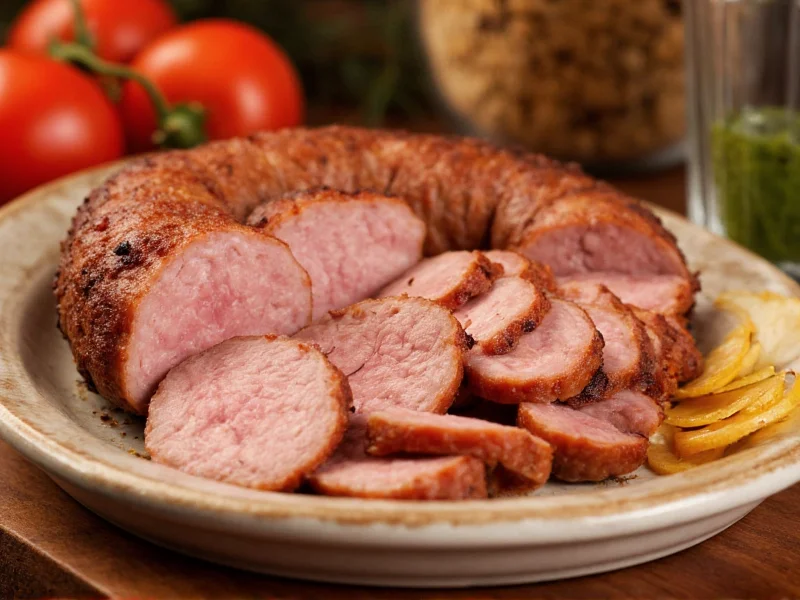
Understanding Smoked Turkey Sausage: More Than Just a Breakfast Option
\nSmoked turkey sausage has become increasingly popular among health-conscious consumers seeking leaner alternatives to traditional pork sausage. This fully cooked product undergoes a smoking process that infuses rich flavor while preserving the meat. Unlike fresh sausages that require thorough cooking, smoked varieties only need reheating, making them ideal for quick meals without sacrificing taste or nutrition.
\n\nHistorical Evolution of Turkey Sausage
\nSmoked turkey sausage's journey from niche product to kitchen staple reflects broader dietary shifts. As documented by the National Turkey Federation, turkey-based processed meats evolved significantly over recent decades:
\n- \n
- Late 1980s: Initial introduction of turkey sausage as a low-fat alternative during America's fat-conscious dietary movement \n
- 1990s: Expansion beyond health food stores into mainstream supermarkets with improved flavor profiles \n
- Early 2000s: Development of nitrate-free and organic varieties responding to clean-label consumer demand \n
- 2010s-Present: Culinary integration into diverse ethnic dishes and recognition as a versatile protein source across multiple meal occasions \n
This evolution demonstrates how consumer preferences for leaner proteins transformed turkey sausage from a limited breakfast option into a multi-meal ingredient.
\n\nThe Smoking Process Explained
\nTrue smoked turkey sausage receives its distinctive flavor through actual wood smoking, not just liquid smoke flavoring. The process involves two primary methods:
\n\n| Smoking Method | \nTemperature Range | \nDuration | \nResulting Product | \n
|---|---|---|---|
| Cold Smoking | \n68-86°F (20-30°C) | \nSeveral days | \nRequires additional cooking | \n
| Hot Smoking | \n150-180°F (65-82°C) | \nSeveral hours | \nFully cooked and ready to eat | \n
Most commercially available smoked turkey sausage uses hot smoking, which fully cooks the product while imparting that characteristic smoky flavor. Some manufacturers supplement with natural smoke flavoring to enhance the smokiness without extended smoking times.
\n\nNutritional Profile: Why Choose Turkey Over Pork?
\nWhen comparing smoked turkey sausage to traditional pork varieties, the nutritional differences are significant. A typical 3-ounce serving of smoked turkey sausage contains approximately:
\n\n- \n
- 140-180 calories (compared to 250-300 in pork sausage) \n
- 8-12 grams of fat (versus 20-25 grams in pork) \n
- 15-18 grams of protein \n
- 500-700mg sodium \n
- Naturally lower in saturated fat \n
The leaner profile makes smoked turkey sausage an excellent choice for those monitoring fat intake while still wanting satisfying flavor. However, consumers should check labels carefully, as sodium content can vary significantly between brands. Those following specific dietary restrictions should look for low-sodium varieties or check with their healthcare provider about appropriate consumption levels.
\n\nSelecting Quality Smoked Turkey Sausage
\nNot all smoked turkey sausages are created equal. When choosing a product, consider these factors to ensure you're getting a quality item:
\n\n- \n
- Ingredient list: Look for products where turkey is the first ingredient, with minimal fillers or artificial additives \n
- Sodium content: Compare options if you're watching sodium intake \n
- Smoke source: Products specifying "naturally smoked" typically offer better flavor than those using liquid smoke flavoring \n
- Fat content: Even lean turkey contains some fat for flavor and moisture—avoid products with excessively low fat that may be dry \n
- Seasoning profile: Consider whether you prefer traditional sage seasoning, spicy varieties, or more unique flavor combinations \n
For those with specific dietary needs, many brands now offer gluten-free, nitrate-free, and organic smoked turkey sausage options. Reading labels carefully helps identify products that align with your nutritional goals and preferences when cooking with smoked turkey sausage.
\n\nProper Storage and Handling Guidelines
\nSince smoked turkey sausage is fully cooked, proper storage is essential for food safety. Follow these guidelines to maximize freshness and safety:
\n\n- \n
- Keep refrigerated at 40°F or below and use within 7 days of opening \n
- Unopened packages typically remain fresh until the "use by" date \n
- For longer storage, freeze in airtight packaging for up to 3 months \n
- Thaw frozen sausage in the refrigerator, not at room temperature \n
- Never refreeze previously frozen smoked turkey sausage \n
When handling smoked turkey sausage, treat it like any other cooked meat product. Wash hands and surfaces that come in contact with the sausage to prevent cross-contamination. Though fully cooked, smoked turkey sausage should be heated to 165°F before consumption for optimal safety, especially for vulnerable populations.
\n\nBest Cooking Methods for Smoked Turkey Sausage
\nWhile smoked turkey sausage is fully cooked and safe to eat cold, heating enhances both flavor and texture. Here are the most effective preparation methods:
\n\nPan-Frying Technique
\nThis method creates a delicious caramelized exterior. Slice sausage into 1/2-inch pieces and cook in a lightly oiled skillet over medium heat for 5-7 minutes, turning occasionally until golden brown. For added flavor, include onions, peppers, or garlic during the last few minutes of cooking.
\n\nOven Baking Method
\nFor hands-off preparation, arrange sausage slices on a baking sheet and bake at 375°F for 15-20 minutes. This method works well when preparing larger quantities or when incorporating sausage into casseroles or sheet pan meals.
\n\nGrilling Instructions
\nThough already cooked, smoked turkey sausage develops excellent grill marks and additional smoky flavor when grilled. Cook over medium heat for 8-10 minutes, turning frequently. This technique shines when preparing smoked turkey sausage for sandwiches or as part of a grilled vegetable platter.
\n\nPractical Limitations and Optimal Usage Scenarios
\nUnderstanding where smoked turkey sausage excels—and where adjustments are needed—maximizes culinary success. The National Turkey Federation specifically notes: "Because turkey sausage is leaner, it may not produce as much grease. You may need to add a small amount of oil when cooking." This characteristic creates both opportunities and constraints:
\nIdeal Applications:
\n- \n
- Breakfast scrambles (where lower fat aligns with health goals) \n
- Bean-based soups and stews (the smoky flavor infuses broth without excessive fat) \n
- Casseroles with moisture-rich ingredients (vegetables, sauces, cheeses) \n
Requires Adjustment:
\n- \n
- Sausage gravy (supplement with 1-2 tsp oil during cooking) \n
- High-heat searing applications (cook over medium heat to prevent drying) \n
- Dishes requiring long simmering (add during last 15 minutes of cooking) \n
These boundaries ensure optimal texture and flavor while leveraging the product's nutritional advantages.
\n\nVersatile Recipe Applications
\nThe robust flavor of smoked turkey sausage makes it suitable for numerous dishes beyond traditional breakfast pairings. Consider these creative applications:
\n\nBreakfast Innovations
\nWhile classic with eggs and potatoes, try crumbling smoked turkey sausage into breakfast burritos with black beans and avocado, or slice it thin for a protein boost in breakfast strata. The smoky flavor complements sweet potato hash beautifully.
\n\nHearty Main Dishes
\nCut into coins and add to pasta sauces for a lean protein option in dishes like smoked turkey sausage and mushroom pasta. It also works wonderfully in jambalaya, substituting for traditional andouille while providing a lighter alternative that still delivers authentic flavor.
\n\nSoups, Stews, and Casseroles
\nChop smoked turkey sausage into bite-sized pieces for white bean soup, gumbo, or vegetable stew. The sausage infuses the broth with rich flavor while adding substantial protein. For casseroles, layer sliced sausage between pasta, vegetables, and cheese for a complete meal that reheats well.
\n\nCommon Questions About Smoked Turkey Sausage
\nUnderstanding these frequently asked questions helps maximize your experience with this versatile ingredient:
\n\n




 浙公网安备
33010002000092号
浙公网安备
33010002000092号 浙B2-20120091-4