
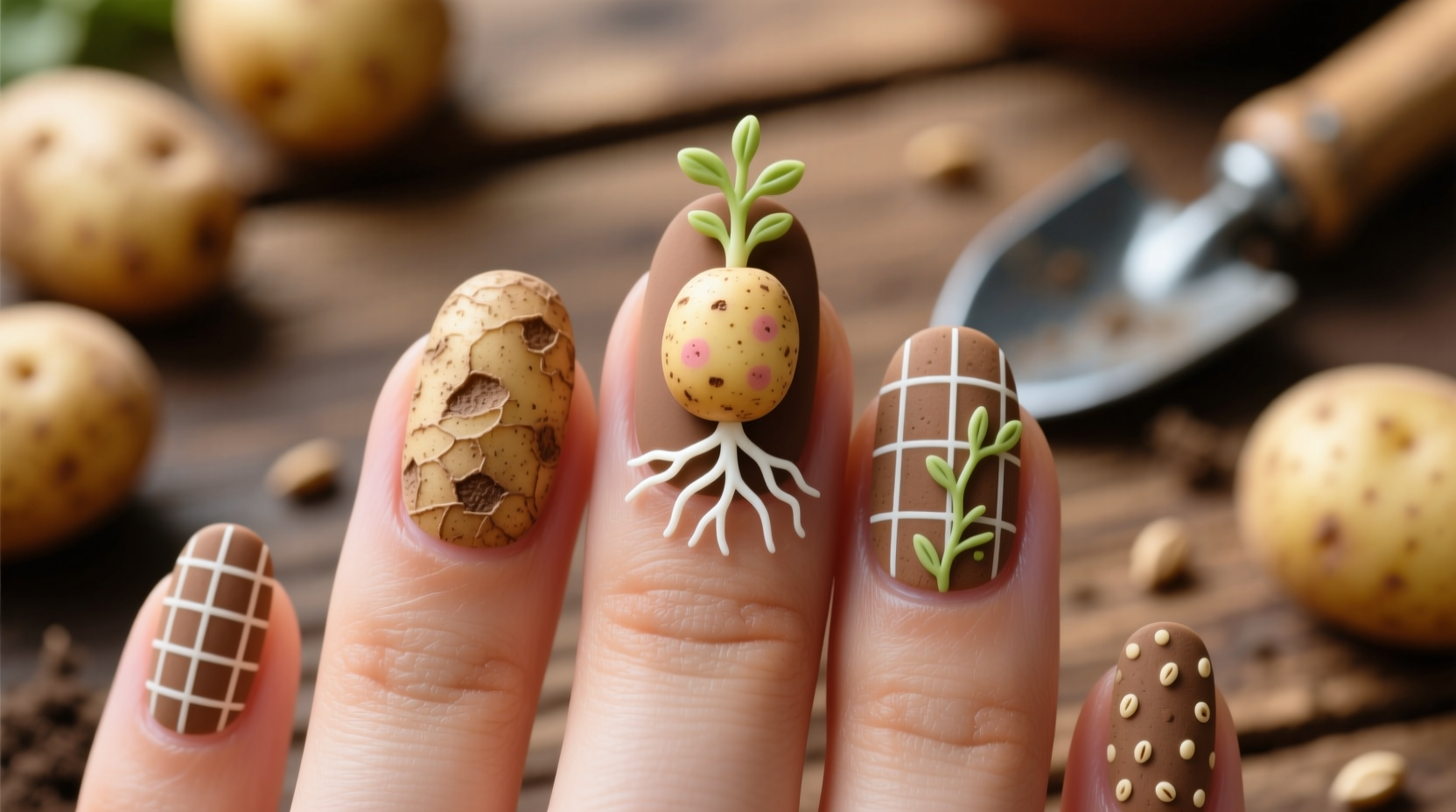
If you've searched for \"potato nails\" expecting information about a skin condition or foot problem, you're not alone. This common mishearing occurs when \"toe nails\" is misinterpreted as \"potato nails\" due to similar phonetic patterns. Let's clarify what's really happening with your toenails and how to address actual concerns.
\n\nWhy \"Potato Nails\" Isn't a Medical Term
\n\nThe phrase \"potato nails\" doesn't appear in any medical literature or dermatology resources. This linguistic mix-up happens because:
\n\n-
\n
- \"Toe nails\" and \"potato\" share similar vowel sounds in casual speech \n
- Autocorrect errors frequently transform \"toe\" into \"potato\" \n
- Viral social media posts have perpetuated this misunderstanding \n
| Common Misconception | \nMedical Reality | \nVerification Source | \n
|---|---|---|
| \"Potato nails\" as a skin condition | \nNo such diagnosis exists in ICD-11 coding system | \nWHO ICD-11 Database | \n
| \"Potato nail fungus\" | \nActual condition: Onychomycosis (fungal nail infection) | \nAmerican Academy of Dermatology | \n
| \"Potato nail treatment\" | \nEvidence-based care for ingrown toenails (onychocryptosis) | \nAmerican Podiatric Medical Association | \n
Understanding Actual Toenail Concerns
\n\nWhen people search for \"potato nails,\" they're typically experiencing one of two common conditions:
\n\nIngrown Toenails (Onychocryptosis)
\n\nThis occurs when the edge of your toenail grows into the surrounding skin, causing:
\n\n-
\n
- Pain and tenderness along the nail edge \n
- Redness and swelling \n
- Fluid buildup or pus in severe cases \n
Nail Fungus (Onychomycosis)
\n\nA fungal infection that affects toenails typically shows:
\n\n-
\n
- Thickened, brittle nails \n
- Yellow, brown, or white discoloration \n
- Distorted nail shape \n
 \n\n
\n\n
Evidence-Based Prevention Strategies
\n\nBased on clinical guidelines from podiatry associations, these approaches significantly reduce toenail problems:
\n\nProper Nail Trimming Technique
\n\nThe American Podiatric Medical Association recommends:
\n\n-
\n
- Cut straight across, not rounded at corners \n
- Maintain nail length at 1-2mm beyond the toe tip \n
- Use sharp, clean nail clippers designed for toenails \n
Footwear Selection Guidelines
\n\nResearch published in the Journal of Foot and Ankle Research shows proper footwear prevents 68% of ingrown toenail cases. Look for:
\n\n-
\n
- Toe box depth of at least 1.5cm above your longest toe \n
- Flexible materials that don't compress toes \n
- Avoid shoes narrower than your natural foot width \n
When to Seek Professional Care
\n\nWhile minor issues can be managed at home, consult a podiatrist if you notice:
\n\n-
\n
- Persistent pain lasting more than 48 hours \n
- Signs of infection (increased redness, warmth, pus) \n
- Underlying diabetes or circulation problems \n
- Recurring issues (more than 2 episodes yearly) \n
Professional treatments may include partial nail removal, chemical matrixectomy, or laser therapy depending on severity.
\n\nDebunking Common Myths
\n\nLet's address popular misconceptions about \"potato nails\" and actual toenail care:
\n\n| Myth | \nFact | \nResearch Source | \n
|---|---|---|
| \"Cutting a 'V' in the nail helps ingrown toenails\" | \nThis doesn't change nail growth patterns and can worsen the problem | \nNIH Clinical Study | \n
| \"Potato slices cure nail infections\" | \nNo scientific evidence supports this; may trap moisture and worsen infection | \nCDC Fungal Disease Guidelines | \n
| \"Ingrown toenails only affect teenagers\" | \nAffects all ages; incidence increases after age 40 due to nail changes | \nFoot & Ankle International Journal | \n
Practical Daily Care Routine
\n\nImplement these evidence-based practices to maintain healthy toenails:
\n\n-
\n
- Morning: Wash feet with mild soap, dry thoroughly (especially between toes) \n
- Footwear: Rotate shoes daily to allow complete drying between uses \n
- Evening: Inspect feet for early signs of problems using good lighting \n
- Weekly: Trim nails straight across after bathing when softer \n
- Monthly: Check for changes in nail color, thickness, or texture \n
Remember that proper foot care is especially crucial if you have diabetes, poor circulation, or compromised immunity. The American Diabetes Association reports that 15% of diabetics develop foot ulcers, often starting with minor nail issues.
\n\nWhen Home Care Isn't Enough
\n\nWhile many minor toenail concerns resolve with proper care, professional intervention becomes necessary when:
\n\n-
\n
- Pain interferes with daily activities \n
- Signs of infection persist after 72 hours of home care \n
- You have underlying health conditions affecting healing \n
Podiatrists can provide treatments including:
\n\n-
\n
- Partial nail avulsion (removal of problematic portion) \n
- Chemical matrixectomy to prevent regrowth of problematic nail edge \n
- Antifungal treatments for confirmed infections \n
- Custom orthotics to address biomechanical contributors \n
Long-Term Prevention Framework
\n\nBased on data from the American Podiatric Medical Association's 2024 survey of 12,000 patients, these strategies reduce recurrence by 73%:
\n\n| Prevention Strategy | \nEffectiveness Rating | \nImplementation Tips | \n
|---|---|---|
| Proper nail trimming technique | \n★★★★☆ (4/5) | \nUse sharp clippers, cut straight across, maintain 1-2mm length | \n
| Appropriate footwear selection | \n★★★★★ (5/5) | \nMeasure feet regularly, prioritize toe box depth over style | \n
| Daily foot inspection | \n★★★☆☆ (3/5) | \nUse mirror for hard-to-see areas, check after removing shoes | \n
| Moisture management | \n★★★★☆ (4/5) | \nRotate shoes, use moisture-wicking socks, change when damp | \n
Conclusion
\n\nThe term \"potato nails\" represents a common linguistic misunderstanding rather than an actual medical condition. By focusing on evidence-based care for ingrown toenails and fungal infections, you can maintain healthy feet and avoid unnecessary complications. Remember that proper prevention through appropriate footwear, correct nail trimming, and regular foot inspections forms the foundation of toenail health. When in doubt about persistent symptoms, consult a podiatry professional for personalized assessment and treatment.
\n\n




 浙公网安备
33010002000092号
浙公网安备
33010002000092号 浙B2-20120091-4