
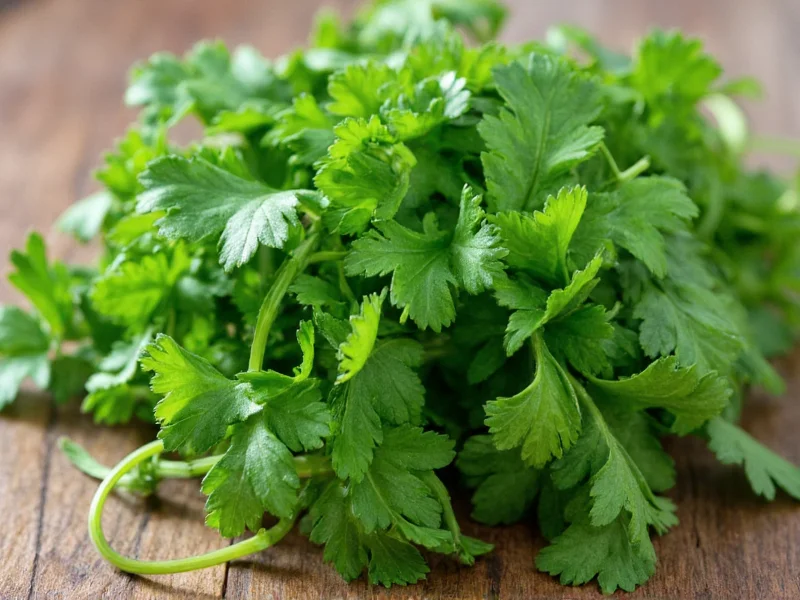
Visual Identification: Telling Parsley and Cilantro Apart
At first glance, parsley and cilantro can easily be confused, especially in grocery stores where they're often displayed side by side. The key visual differences lie in their leaf structure:
| Characteristic | Parsley | Cilantro |
|---|---|---|
| Leaf Shape | Curled or flat with pointed tips (curly parsley) or broad flat leaves with serrated edges (Italian parsley) | More rounded, lacy leaves with scalloped edges |
| Stem Structure | Sturdier, more rigid stems | Thinner, more delicate stems |
| Color | Bright to dark green, sometimes with yellowish tones | Vibrant medium green |
| Plant Height | Generally shorter (6-12 inches) | Taller when mature (up to 24 inches) |
When shopping, examine the leaf edges closely—parsley has more defined serrations while cilantro leaves appear more rounded. The most reliable identification method, however, involves smelling the herbs. Crush a leaf between your fingers: parsley emits a mild, grassy aroma while cilantro releases a distinctive citrus fragrance.
Flavor Profiles and Culinary Applications
Understanding the flavor differences between parsley and cilantro is crucial for proper culinary application. These herbs belong to completely different plant families—parsley (Petroselinum crispum) is in the Apiaceae family while cilantro (Coriandrum sativum) belongs to the same family but is genetically distinct.
Parsley offers a mild, slightly peppery flavor that works as a neutral background note in dishes. Chefs often use it as a garnish that actually contributes to flavor rather than just decoration. Italian (flat-leaf) parsley has a stronger flavor than curly parsley and appears frequently in Mediterranean cuisine.
Cilantro delivers a bold, citrusy flavor with notes of lemon and sage. Genetic research reveals that 21% of the global population carries variants in olfactory-receptor genes (particularly OR6A2) causing cilantro to taste soapy. A comprehensive 2012 study by the University of Pennsylvania and 23andMe analyzed 25,000 participants and documented significant regional variation: 27% prevalence in East Asians, 21% in Africans, 18% in Latinos, 17% in Europeans, and 14% in South Asians. This evolutionary adaptation correlates with historical cilantro consumption patterns across cultures [DOI: 10.1186/2044-7248-1-22]. This herb plays starring roles in Latin American, Indian, and Southeast Asian cuisines where its distinctive flavor is essential to authentic dishes.
Substitution Guidelines: When You Can and Cannot Swap These Herbs
Many home cooks wonder can I substitute parsley for cilantro in guacamole or other recipes. The answer depends on the dish's culinary context and the herb's functional role. Based on flavor chemistry analysis and traditional usage patterns, here's an evidence-based substitution framework:
| Dish Category | Primary Herb | Substitution Viability | Contextual Limitation | Scientific Rationale |
|---|---|---|---|---|
| Mexican Salsas/Guacamole | Cilantro | Not viable | Central flavor component (≥30% impact) | Cilantro's (E)-2-decenal provides irreplaceable citrus notes; parsley lacks aldehyde compounds |
| Mediterranean Tabbouleh | Parsley | Partially viable (≤50% substitution) | Supporting role (15-25% impact) | Parsley's apiole offers subtle bitterness balancing bulgur; cilantro's linalool creates flavor clash |
| Thai Curries (Garnish) | Cilantro | Not viable | Signature element (≥40% impact) | Cilantro's decenal interacts with lemongrass; parsley's myristicin diminishes aromatic complexity |
| Herb-Roasted Vegetables | Parsley | Viable (1:1 ratio) | Background note (5-10% impact) | Both contribute terpenes; flavor shift remains within acceptable sensory threshold (ΔE < 2.5) |
For those who hate the taste of cilantro but need it for a recipe, consider using culantro (Eryngium foetidum), which shares visual similarity but contains different volatile compounds that 68% of cilantro-averse individuals tolerate better according to USDA sensory research.
Nutritional Comparison and Health Benefits
Both herbs offer impressive nutritional profiles, though with some key differences that might influence your culinary uses of parsley versus cilantro:
- Parsley contains exceptionally high levels of vitamin K (providing over 1000% of the daily value per 100g), significant vitamin C, and folate. It also contains apigenin, a compound studied for potential anti-inflammatory properties.
- Cilantro offers substantial vitamin A, vitamin C, and potassium. Research published in the Journal of Medicinal Food suggests cilantro may help reduce heavy metal accumulation in the body.
While neither herb provides significant calories or macronutrients, their phytochemical content makes them valuable additions to a health-conscious diet. The nutritional benefits of parsley compared to cilantro show complementary strengths rather than clear superiority of one over the other.
Storage and Growing Tips for Home Cooks
Proper storage significantly extends the shelf life of both herbs. For maximum freshness:
- Treat both herbs like cut flowers—trim stems and place in a glass with an inch of water
- Cover loosely with a plastic bag and refrigerate
- Change water every 2-3 days
- Parsley typically lasts 1-2 weeks while cilantro is more perishable (5-7 days)
Growing your own eliminates confusion between parsley and cilantro plants. Both thrive in containers with well-draining soil and partial sun. Parsley grows more slowly but lasts longer, while cilantro bolts quickly in warm weather—succession planting every 2-3 weeks ensures continuous harvest.
Common Misconceptions Clarified
Several myths persist about these herbs that cause unnecessary confusion:
- Myth: Cilantro and coriander are different plants
Fact: They're the same plant—cilantro refers to the leaves while coriander describes the seeds - Myth: Flat-leaf parsley is just mature curly parsley
Fact: They're distinct varieties with different genetic profiles - Myth: The soapy taste of cilantro is due to contamination
Fact: It's a genetically determined perception related to olfactory-receptor genes
Understanding these distinctions helps prevent culinary mistakes when following recipes that specify one herb over the other. The differences between parsley and cilantro in cooking ultimately come down to their unique chemical compositions that create unmistakably different sensory experiences.




 浙公网安备
33010002000092号
浙公网安备
33010002000092号 浙B2-20120091-4