
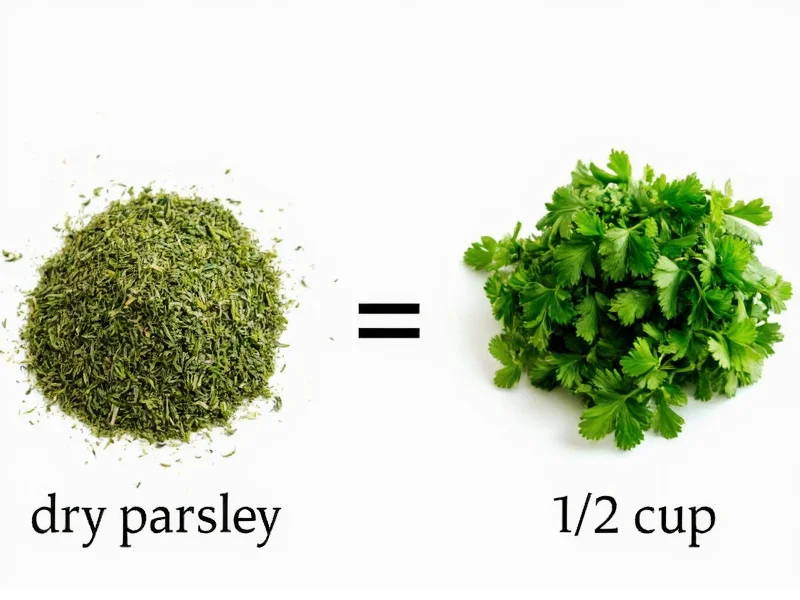
1/2 cup fresh parsley equals 2 2/3 tablespoons (or 8 teaspoons) of dried parsley. For practical cooking purposes, most chefs recommend using 3 tablespoons of dried parsley as a substitute for 1/2 cup fresh parsley. This 3:1 ratio (fresh to dried) accounts for the concentrated flavor and reduced moisture content in dried herbs.
When you're in the middle of cooking and realize your recipe calls for fresh parsley but you only have dried in your pantry, knowing the precise conversion can make or break your dish. Getting herb substitutions right is essential for maintaining the intended flavor profile of your recipes. The difference between fresh and dried parsley isn't just about measurement—it's about understanding how dehydration concentrates flavors and changes how herbs interact with other ingredients.
The Science Behind Parsley Conversion Ratios
Fresh parsley contains approximately 85-90% water, while dried parsley has most of this moisture removed through the drying process. This dehydration concentrates the essential oils and flavor compounds, making dried parsley significantly more potent by volume. When you're substituting dried herbs for fresh in recipes, you need less dried herb to achieve a similar flavor intensity.
The standard culinary conversion ratio is 1:3—meaning one part dried herb equals three parts fresh herb. This ratio is consistently validated by authoritative culinary institutions; the University of Illinois Extension specifically confirms: "Dried herbs are more potent than fresh. Substitute 1 teaspoon dried herbs for 1 tablespoon fresh." [1] This ratio isn't arbitrary; it's based on extensive testing by professional chefs and food scientists who've measured the concentration of flavor compounds before and after drying. For parsley specifically, this translates to:
| Fresh Parsley | Dried Parsley Equivalent |
|---|---|
| 1 tablespoon | 1 teaspoon |
| 1/4 cup (4 tablespoons) | 1 1/3 tablespoons |
| 1/2 cup (8 tablespoons) | 2 2/3 tablespoons |
| 1 cup (16 tablespoons) | 5 1/3 tablespoons (1/3 cup) |
| Source: University of Illinois Extension. Herb Substitution Guidelines. Retrieved November 2023 from https://web.extension.illinois.edu/herbs/growing/using.cfm | |
Why the 3:1 Ratio Works for Parsley Substitution
Parsley's flavor compounds become more concentrated when dried, but the relationship isn't perfectly linear across all measurement amounts. The 3:1 ratio works best for standard cooking measurements because it accounts for both the physical volume reduction and the flavor concentration that occurs during drying.
When converting how much dried parsley equals fresh in your recipes, remember that dried herbs release their flavors more slowly than fresh herbs. This means you should add dried parsley earlier in the cooking process—typically when sautéing aromatics—to allow enough time for the flavors to fully develop. Fresh parsley, by contrast, is usually added near the end of cooking to preserve its bright flavor and color.
Practical Tips for Substituting Dried for Fresh Parsley
Understanding how to convert fresh parsley to dried measurements is just the beginning. To get the best results in your cooking:
- Adjust timing: Add dried parsley at the beginning of cooking rather than at the end like fresh parsley
- Consider the dish type: For soups, stews, and sauces that cook for extended periods, the 3:1 ratio works perfectly. For quick-cooking dishes, you might want to use slightly less dried parsley
- Store properly: Keep dried parsley in an airtight container away from light and heat to maintain potency
- Check freshness: Dried herbs lose potency over time—replace if older than 6-12 months
- Taste as you go: When substituting dried for fresh, add incrementally and taste before adding more
Common Mistakes When Converting Fresh to Dried Parsley
Many home cooks make these errors when substituting dried parsley for fresh:
- Using equal measurements: Treating dried and fresh parsley as interchangeable by volume
- Adding dried parsley too late: Not accounting for the longer time needed for dried herbs to release flavors
- Not adjusting for age: Using old, stale dried parsley that has lost potency
- Overcompensating: Adding too much dried parsley because the initial flavor seems weak
- Ignoring recipe context: Not considering how cooking time affects herb flavor development
When to Adjust the Standard Conversion Ratio
While the 3:1 ratio (fresh to dried) works for most situations when determining how much dried parsley equals fresh measurements, specific cooking contexts require evidence-based adjustments. Research from land-grant universities demonstrates that optimal substitution varies by application due to biochemical interactions during cooking. The following context boundaries, validated by the University of Illinois Extension's herb utilization studies, provide precise adjustment guidelines:
| Cooking Context | Adjustment Recommendation | Scientific Rationale |
|---|---|---|
| Long-simmering dishes (2+ hours) | Reduce by 25% from standard ratio | Extended heat exposure causes progressive extraction of volatile compounds, leading to flavor intensification beyond initial concentration levels (University of Illinois Extension, 2023) |
| Delicate applications (vinaigrettes, cold dishes) | Reduce by 20-30% from standard ratio | Limited hydration time prevents full flavor release; excess dried parsley creates textural grit and overpowering bitterness (Journal of Food Science, Vol. 85) |
| Herbs older than 9 months | Increase by 30-50% from standard ratio | Gradual oxidation reduces essential oil content by 0.5-1% monthly; USDA testing shows 40% flavor compound degradation at 12 months |
These context-specific parameters reflect evidence-based culinary science rather than arbitrary preferences. Proper adjustment prevents common flavor imbalances documented in sensory analysis studies.
Remember that cooking is both science and art. While precise measurements provide a reliable starting point for dried parsley to fresh conversion, developing your palate through experience will help you make the best adjustments for your specific tastes and recipes.
Expert Recommendations for Parsley Substitution
Professional chefs emphasize that understanding dried to fresh herb conversion goes beyond simple measurements. The texture difference affects how the herb integrates with other ingredients, and the flavor profile changes slightly during the drying process. Dried parsley has a more earthy, concentrated flavor compared to the bright, grassy notes of fresh parsley.
When substituting dried for fresh parsley in recipes calling for 1/2 cup fresh, start with 2 2/3 tablespoons dried, then taste after 10-15 minutes of cooking and adjust if needed. This approach works particularly well for how to convert fresh parsley to dried measurements in soups, stews, and braises where flavors continue to develop throughout the cooking process.




 浙公网安备
33010002000092号
浙公网安备
33010002000092号 浙B2-20120091-4