
The perfect internal temperature for safely cooked chicken breasts is 165°F (74°C) according to USDA Food Safety and Inspection Service guidelines. This precise temperature eliminates harmful bacteria like salmonella while preserving juiciness when followed with proper resting techniques.
Getting chicken breast temperature right separates dry, rubbery results from perfectly tender, restaurant-quality poultry. Whether you're pan-searing, baking, or grilling, understanding the science behind safe cooking temperatures transforms your weeknight dinners. Let's explore exactly how to achieve flawless chicken every time.
Why 165°F Is the Chicken Breast Sweet Spot
Food safety isn't negotiable when cooking poultry. The USDA's official guideline specifies 165°F (74°C) as the minimum internal temperature for all poultry products. This temperature instantly destroys dangerous pathogens like salmonella and campylobacter that commonly contaminate raw chicken.
But why not cook to a lower temperature for juicier results? Unlike beef, chicken contains virtually no fat to protect against bacterial contamination. The Food Safety Authority of Ireland confirms that 165°F is non-negotiable for immediate pathogen destruction in poultry. Attempting sous vide-style lower temperatures requires precise time controls that aren't practical for most home cooks.
| Temperature | Texture Result | Food Safety Status |
|---|---|---|
| 145°F (63°C) | Extremely juicy but risky | Requires 8.5 minutes hold time |
| 150°F (66°C) | Juicy with slight risk | Requires 2.8 minutes hold time |
| 155°F (68°C) | Moist with minimal risk | Requires 50 seconds hold time |
| 160°F (71°C) | Slightly drier but safe | Requires 15 seconds hold time |
| 165°F (74°C) | Perfectly safe | Instant pathogen destruction |
This temperature-time relationship comes from research published in the Journal of Food Protection, showing how lower temperatures require precise holding times to achieve safety. For practical home cooking, 165°F remains the gold standard that guarantees safety without requiring timers for hold times.
Your Step-by-Step Chicken Temperature Guide
Follow this proven method whether baking, pan-searing, or grilling:
- Preheat properly - Ensure your cooking surface reaches appropriate temperature (400°F for baking, medium-high for stovetop)
- Insert thermometer correctly - Place probe into thickest part without touching bone
- Monitor closely - Check temperature 5-7 minutes before expected finish time
- Remove at 160°F - Carryover cooking will raise temperature 5°F during resting
- Rest for 5-10 minutes - Essential for juicy results as proteins reabsorb moisture
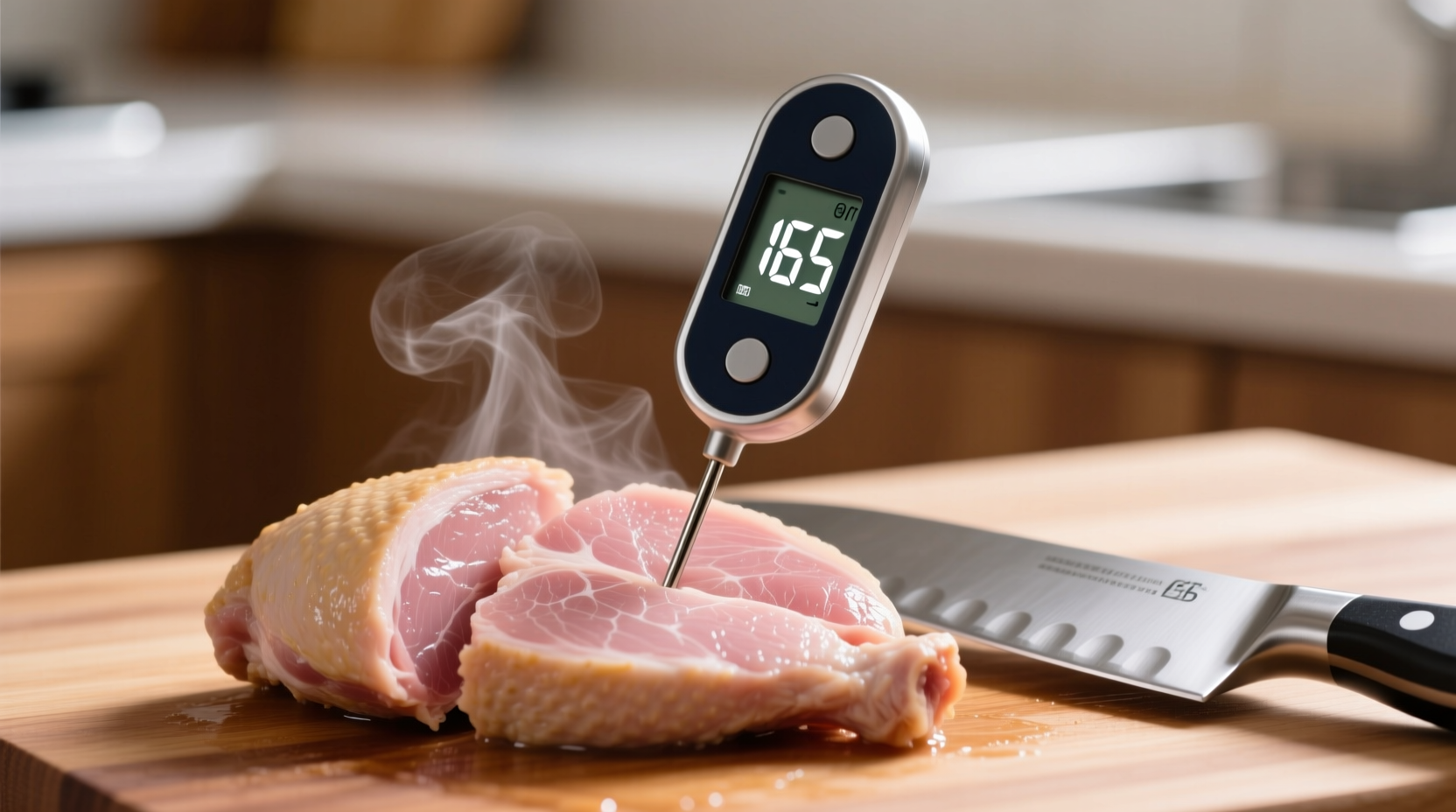
Thermometer Essentials for Perfect Chicken
Don't guess - measure accurately with these thermometer guidelines:
- Instant-read thermometers provide readings in 2-5 seconds (Thermoworks Mk4 recommended)
- Leave-in probes work best for oven cooking with wireless monitoring
- Avoid cheap dial thermometers - they're often inaccurate by 10°F or more
- Calibrate monthly using ice water (32°F) or boiling water (212°F) tests
Professional chefs consistently emphasize that visual cues alone can't determine doneness. The American Institute of Baking confirms that color isn't a reliable indicator - properly cooked chicken can appear pink near bones while unsafe chicken may look white.
Troubleshooting Common Chicken Problems
Dry chicken despite hitting 165°F? You're likely removing it from heat too late. Pull chicken at 160°F to account for 5°F carryover cooking during the essential 5-10 minute rest period. This rest time allows proteins to reabsorb moisture that would otherwise leak out when sliced.
Uneven cooking? Pound thicker portions to uniform ¾-inch thickness before cooking. This simple technique, used in professional kitchens worldwide, ensures even heat distribution. The CIA's culinary research shows that uniform thickness reduces cooking time variance by up to 40%.
Undercooked in spots? Check your thermometer placement. Many home cooks insert thermometers too close to the surface. The thickest part - usually near the breast's center - must register 165°F for safety.
Advanced Temperature Techniques
For truly exceptional results, understand how cooking method affects temperature management:
- Grilling: Use two-zone cooking - sear over direct heat, finish over indirect until 160°F
- Baking: Start at 425°F for 15 minutes, reduce to 375°F until reaching target temperature
- Pan-searing: Sear 5-6 minutes per side, finish in 400°F oven if thick
The FDA Food Code specifies that commercial kitchens must verify poultry temperatures with calibrated thermometers. While home cooks have more flexibility, following these professional standards ensures consistently safe, delicious results.
Frequently Asked Questions
Can chicken be safe at 160 degrees instead of 165?
Chicken reaches safety at 160°F only if held at that temperature for 15 seconds. The USDA recommends 165°F because it provides instant pathogen destruction without requiring precise timing. For practical home cooking, 165°F is the reliable standard that guarantees safety.
Why is my chicken dry even at 165 degrees?
Dry chicken typically results from skipping the essential 5-10 minute resting period after cooking. During this time, the internal temperature remains high enough for safety while proteins reabsorb moisture. Removing chicken from heat at 160°F (allowing carryover to 165°F) and proper resting prevents moisture loss when slicing.
How do I check chicken temperature without a thermometer?
Without a thermometer, check by cutting into the thickest part - juices should run clear with no pink color. However, the USDA emphasizes that visual inspection alone isn't reliable. Many food safety organizations strongly recommend using a calibrated thermometer as the only accurate method for verifying poultry doneness.
Does carryover cooking really raise chicken temperature?
Yes, carryover cooking typically raises chicken's internal temperature 5-10°F after removal from heat. This is why professional chefs remove chicken at 160°F, allowing it to reach the safe 165°F during the mandatory resting period. The thicker the cut, the more significant the carryover effect.
Can I trust color to determine if chicken is cooked?
No. The USDA explicitly states that color isn't a reliable indicator of doneness. Properly cooked chicken can appear pink near bones due to myoglobin reactions, while undercooked chicken may look white. Only a properly inserted thermometer verifying 165°F guarantees safety.




 浙公网安备
33010002000092号
浙公网安备
33010002000092号 浙B2-20120091-4