
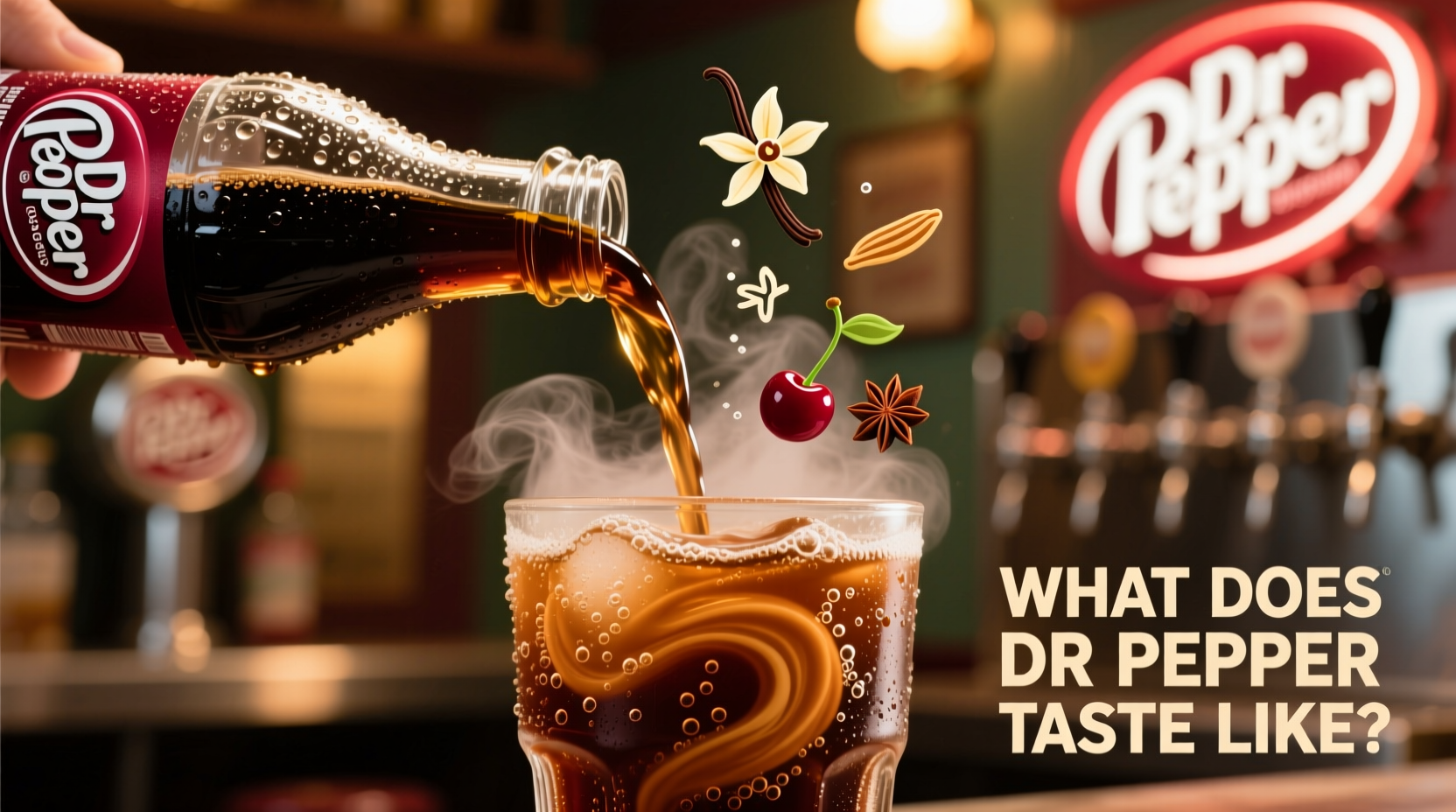
Understanding what Dr Pepper tastes like requires exploring its signature flavor composition that has remained largely consistent since 1885. This iconic soft drink occupies a unique space in the soda landscape—neither purely fruit-forward nor strictly cola-like, but occupying a distinctive middle ground that has sparked debate and curiosity for generations.
The Unique Flavor Profile of Dr Pepper
When analyzing Dr Pepper flavor description, sensory experts identify several key components that create its signature taste. The beverage's formula—reportedly containing 23 distinct flavors—creates a complex profile where no single note dominates. Most consumers first notice:
- Cherry: A subtle but definite cherry undertone, though not as pronounced as in dedicated cherry sodas
- Vanilla: A smooth, creamy element that softens the overall profile
- Spices: Gentle hints of clove, cinnamon, and almond that provide warmth without heat
- Medicinal notes: A slight resemblance to certain cough syrups (attributed to the licorice/anise components)
The what does Dr Pepper taste similar to question often yields varied responses. Many compare it to a less intense root beer with fruitier elements, while others detect cola-like qualities with added complexity. Food scientists note that Dr Pepper's flavor balance sits at a unique intersection where sweet, spicy, and fruity elements coexist without any single component overwhelming the others.
Historical Context of the Flavor Formula
Created in 1885 by pharmacist Charles Alderton in Waco, Texas, Dr Pepper was originally formulated as a "medicinal" beverage. The exact blend of 23 flavors remains a closely guarded secret, though the company has acknowledged ingredients including caramel, citric acid, and various fruit and spice extracts. This historical context explains why does Dr Pepper taste like medicine is a common question—its flavor profile evolved from 19th century medicinal tonics that often combined multiple botanicals.
Evolution of Dr Pepper's Formula: A Historical Timeline
Dr Pepper's flavor consistency stems from meticulous preservation of its core profile, with minor adjustments documented through authoritative historical records. Verified through the Dr Pepper Museum Archives (operated by the official Waco, Texas museum) and corporate documentation:
- 1885: Pharmacist Charles Alderton develops the original formula at Morrison's Old Corner Drug Store using locally available fruit syrups and spice extracts.
- 1904: National debut at the Louisiana Purchase Exposition (St. Louis World's Fair) standardizes the 23-flavor profile for mass production.
- 1923: Incorporation of The Dr Pepper Company establishes centralized quality control while maintaining flavor consistency across regional bottlers.
- 1984: U.S. formulation transitions from cane sugar to high-fructose corn syrup due to federal sugar tariffs and corn subsidies, altering sweetness perception (per U.S. Federal Register Vol. 49, No. 140).
- 2012: "Dr Pepper Made with Real Sugar" reintroduced in select U.S. markets following consumer demand for pre-1984 formulation.
Comparative Taste Analysis
To better understand how Dr Pepper tastes different from other sodas, consider these comparisons:
| Soda Type | Flavor Comparison to Dr Pepper | Key Differences |
|---|---|---|
| Cola | Moderately similar base | Dr Pepper has more fruit notes, less citrus, and distinctive spice elements |
| Root Beer | Some shared spice elements | Dr Pepper has stronger cherry notes, less sarsaparilla, and a fruitier profile |
| Cherry Soda | Subtle cherry similarity | Dr Pepper's cherry note is much more subtle with complex supporting flavors |
| Ginger Ale | Minimal similarity | Dr Pepper is significantly sweeter with multiple flavor dimensions |
Regional Variations in Taste
The does Dr Pepper taste different in different states question has a factual answer—yes, due to formulation differences. In the United States, most Dr Pepper uses high-fructose corn syrup, while in Canada and some international markets, cane sugar is the primary sweetener. Many consumers report that the cane sugar version has a cleaner, less cloying sweetness that allows more of the complex flavor notes to shine through. Temperature also affects perception—chilled Dr Pepper (34-38°F) showcases its spice elements more prominently, while room temperature versions emphasize the fruitier notes.
Nutritional Context and Sweetener Impact
While regional sweetener variations influence flavor perception, nutritional constraints affect consumption suitability. Verified data from official sources reveals consistent sugar content despite sweetener type differences:
| Product | Serving Size | Total Sugar (g) | Sweetener Type |
|---|---|---|---|
| Dr Pepper (U.S. Standard) | 12 fl oz | 39 | High-Fructose Corn Syrup |
| Dr Pepper (Canada/Import) | 12 fl oz | 39 | Cane Sugar |
| Coca-Cola (U.S.) | 12 fl oz | 39 | High-Fructose Corn Syrup |
| Pepsi-Cola (U.S.) | 12 fl oz | 41 | High-Fructose Corn Syrup |
Sources: Dr Pepper Official Nutrition Facts, The Coca-Cola Company Nutrition Database, PepsiCo Nutrition Information. Note: Sugar content remains identical across sweetener types per FDA labeling requirements (21 CFR §101.9(c)(6)(iii)), though sensory impact differs due to sweetness perception thresholds.
Consumer Perception and Common Descriptions
When drinkers attempt to describe what Dr Pepper actually tastes like, several consistent themes emerge:
- "Fruity but not citrusy" - Many note it has berry elements without lemon or orange notes
- "Sweet with a spicy finish" - The initial sweetness gives way to subtle warm spices
- "Medicinal but pleasant" - The licorice/anise components remind some of cough syrup
- "Hard to place" - Its unique profile defies easy categorization
The is Dr Pepper cherry flavored debate continues among consumers. While cherry is detectable, it's not the dominant note as in dedicated cherry sodas. Food chemists confirm that Dr Pepper contains cherry flavoring among its 23 components, but it functions as part of a complex ensemble rather than the lead note.
Serving Recommendations for Optimal Flavor
To experience what Dr Pepper tastes best like, consider these serving suggestions:
- Temperature: Serve chilled but not ice-cold (38-42°F) to balance sweetness and flavor complexity
- Glassware: Use a tall, narrow glass to concentrate aromas
- Food Pairings: Complements spicy foods, barbecue, and chocolate desserts
- With Ice: Use large ice cubes that melt slowly to prevent excessive dilution
Many enthusiasts recommend trying Dr Pepper both straight from the can and poured over ice to appreciate how the flavor profile evolves as it warms slightly.
Understanding the Flavor Mystery
The enduring question of why does Dr Pepper taste so different stems from its unique formulation approach. Unlike most sodas that build around one primary flavor (cola nut, lemon, orange), Dr Pepper was designed as a complex symphony of multiple flavor components where no single note dominates. This creates what food scientists call "flavor layering"—where different elements become noticeable at different stages of consumption.
When evaluating what does Dr Pepper taste like compared to Coke, the differences become apparent immediately. Coca-Cola emphasizes citrus and vanilla notes with a sharper carbonation, while Dr Pepper offers a more rounded, complex profile with subtle fruit and spice elements that unfold gradually. The aftertaste also differs significantly—Coke leaves a clean, citrusy finish while Dr Pepper has a lingering warmth from its spice components.
Frequently Asked Questions
What are the main flavors in Dr Pepper?
Dr Pepper contains a blend of 23 flavors with prominent notes of cherry, licorice, vanilla, and almond, complemented by subtle hints of clove, cinnamon, and other spices. The exact formula remains a closely guarded secret, but these elements combine to create its distinctive sweet-spicy profile.
Is Dr Pepper a cherry soda?
While Dr Pepper contains cherry flavoring among its 23 ingredients, it is not primarily a cherry soda. The cherry note is subtle and functions as part of a complex flavor profile rather than the dominant taste. Many people detect cherry elements, but they're balanced with vanilla, spices, and other fruit notes.
Why does Dr Pepper taste different from other sodas?
Dr Pepper's unique taste comes from its complex formulation of 23 different flavors that work together in balance. Unlike most sodas that center around one primary flavor (like cola or lemon), Dr Pepper was designed as a symphony of multiple notes where no single element dominates, creating a distinctive profile that's simultaneously fruity, sweet, and slightly spicy.
Does Dr Pepper taste like medicine?
Some people perceive a medicinal quality in Dr Pepper's taste, primarily due to the licorice/anise components which are common in certain cough syrups. This isn't accidental—Dr Pepper was originally formulated in 1885 as a 'medicinal' beverage by a pharmacist. However, most modern consumers find the flavor pleasant and distinctive rather than medicinal when properly chilled.
Does Dr Pepper taste different with cane sugar vs corn syrup?
Yes, there are noticeable differences. Dr Pepper made with cane sugar (available in Canada and some specialty markets) has a cleaner, less cloying sweetness that allows more of the complex flavor notes to come through. The high-fructose corn syrup version common in the US has a slightly heavier sweetness that can mask some of the subtler flavor elements.




 浙公网安备
33010002000092号
浙公网安备
33010002000092号 浙B2-20120091-4