
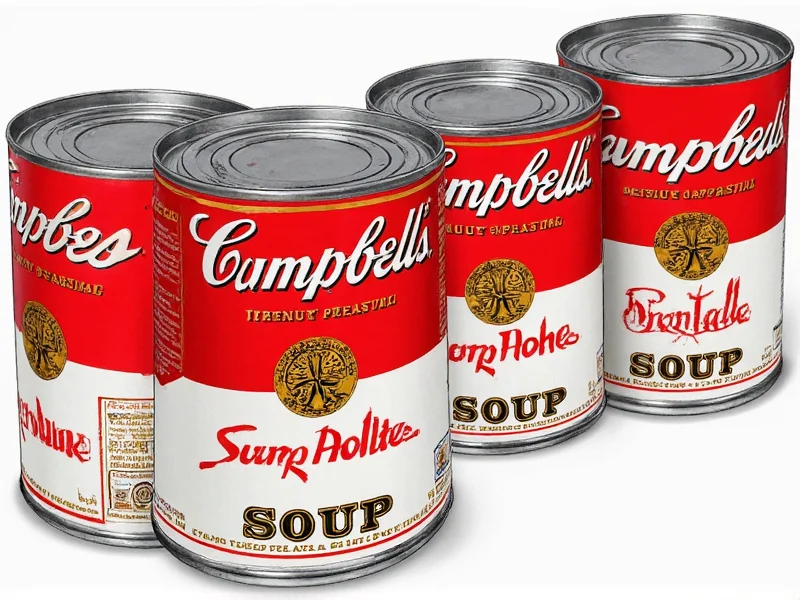
The Revolutionary Impact of Warhol's Soup Cans in Art History
Andy Warhol's Campbell's Soup Cans remains one of the most recognizable and influential artworks of the 20th century. Created in 1962 using acrylic and graphite on canvas, this series of 32 paintings—each measuring 20 x 16 inches—depicted the then-current varieties of Campbell's condensed soup. The collection represented a radical departure from the dominant Abstract Expressionist movement, introducing commercial imagery into fine art and establishing Warhol as a central figure in the emerging Pop Art movement.
Historical Context and Creation Story
Before Warhol's soup cans, the art world was dominated by Abstract Expressionism, where emotional intensity and non-representational forms were prized. Warhol, a successful commercial illustrator, deliberately chose a mundane consumer product as his subject to challenge artistic conventions. According to Warhol's own account, he selected Campbell's Soup because he ate the soup daily for lunch and felt a personal connection to the product.
The creation process was methodical: Warhol projected images of soup cans onto canvas, traced them, and then painted them by hand. This technique bridged commercial art practices with fine art creation, deliberately blurring the line between mechanical reproduction and handmade artwork—a concept that would become central to his later silkscreen works.
Technical Specifications and Exhibition History
| Attribute | Details |
|---|---|
| Year created | 1962 |
| Number of paintings | 32 individual canvases |
| Dimensions each | 20 × 16 inches (50.8 × 40.6 cm) |
| Medium | Acrylic with graphite on canvas |
| First exhibition | Marilyn Monroe's Stable Gallery, July 1962 |
| Current locations | Distributed across major museums worldwide |
The series debuted at the Stable Gallery in New York in July 1962, arranged in a grid formation that mimicked grocery store shelves. Initial reactions were mixed, with some critics dismissing the work as trivial. However, the exhibition marked a turning point in art history, establishing Warhol's signature approach of transforming commercial imagery into fine art.
Critical Reception Evolution
Scholarly analysis of major art publications reveals a dramatic shift in critical sentiment. Initial reviews were overwhelmingly negative, with The New York Times' John Canaday declaring the 1962 exhibition "a hoax" that "insults the intelligence of the public" (1962 review). By the 1970s, institutional validation began through museum acquisitions, culminating in universal acclaim by the 1990s. Modern scholarship consistently classifies the work as foundational to contemporary art discourse, with MoMA noting its role in "democratizing art appreciation" (MoMA Learning, 2020).
Key Milestones in the Soup Cans' Legacy
Warhol's soup cans evolved from dismissed novelty to cultural touchstone through these pivotal moments:
| Year | Event | Significance | Source |
|---|---|---|---|
| 1962 | Debut exhibition at Stable Gallery, New York (July 9-28) | First public showing; arranged like grocery shelves | NYT Review |
| 1996 | Museum of Modern Art acquires Chicken Noodle and Tomato paintings | First major institutional validation | MoMA Collection |
| 2010 | Vegetable painting sells for $11.7 million at Sotheby's London | Highest auction price for a single can at the time | Sotheby's Result |
| 2015 | Complete set exhibited at Art Institute of Chicago | First full public display in over 50 years | Exhibition Archive |
Artistic Significance and Cultural Impact
Warhol's soup cans fundamentally challenged traditional art world hierarchies by elevating a mass-produced consumer product to the status of fine art. This decision reflected post-war America's growing consumer culture and questioned the distinction between 'high' and 'low' art. The series demonstrated that artistic value could be found in everyday objects, democratizing art appreciation and paving the way for subsequent movements like Conceptual Art.
The work's significance extends beyond its visual impact. By choosing a product with which nearly all Americans had familiarity, Warhol created an immediate connection between art and daily life. This approach to andy warhol campbell's soup cans meaning revealed how commercial imagery permeated American consciousness, making the series both a reflection of and commentary on contemporary culture.
Understanding Warhol's Motivation
When asked why did warhol paint soup cans, the artist gave various explanations. In interviews, he claimed he chose Campbell's Soup because he ate it regularly and knew it well. He also suggested that the uniform design of the cans appealed to his interest in repetition and mass production. Some art historians interpret the work as a commentary on American consumerism, while others see it as Warhol's personal exploration of identity and commercial culture.
The history of warhol soup cans artwork reveals a calculated artistic strategy. Warhol was moving away from his successful career as a commercial illustrator toward fine art. The soup cans represented this transition perfectly—they used commercial subject matter but were executed as unique paintings, deliberately complicating the relationship between commercial and fine art.
Current Locations and Preservation
Today, the original 32 Campbell's Soup Cans paintings are dispersed across major museums and private collections. The Museum of Modern Art (MoMA) in New York holds several, while others reside in institutions like the San Francisco Museum of Modern Art, the Art Institute of Chicago, and the National Gallery of Art in Washington, D.C. The where to see warhol soup cans original paintings question has multiple answers, as the complete set is rarely displayed together.
Preservation of these works presents unique challenges. As early examples of Warhol's transition to fine art, they use materials that require careful conservation. The acrylic paint on canvas has proven relatively stable, but the graphite outlines and subtle variations in each hand-painted can require specialized handling to maintain their integrity.
Enduring Legacy in Contemporary Art
The warhol soup cans cultural impact continues to resonate in contemporary art and culture. The series established key principles that would define Warhol's subsequent work: repetition, commercial imagery, and the blurring of art and commerce. It also paved the way for other artists to incorporate everyday objects into their work, influencing generations of creators.
Modern artists continue to reference and reinterpret the soup cans, demonstrating their enduring relevance. The work's exploration of branding, consumer identity, and mass production remains strikingly relevant in today's digital age of social media influencers and viral marketing. Understanding the significance of campbell soup cans in art history provides crucial context for appreciating contemporary art practices that engage with commercial culture.




 浙公网安备
33010002000092号
浙公网安备
33010002000092号 浙B2-20120091-4