
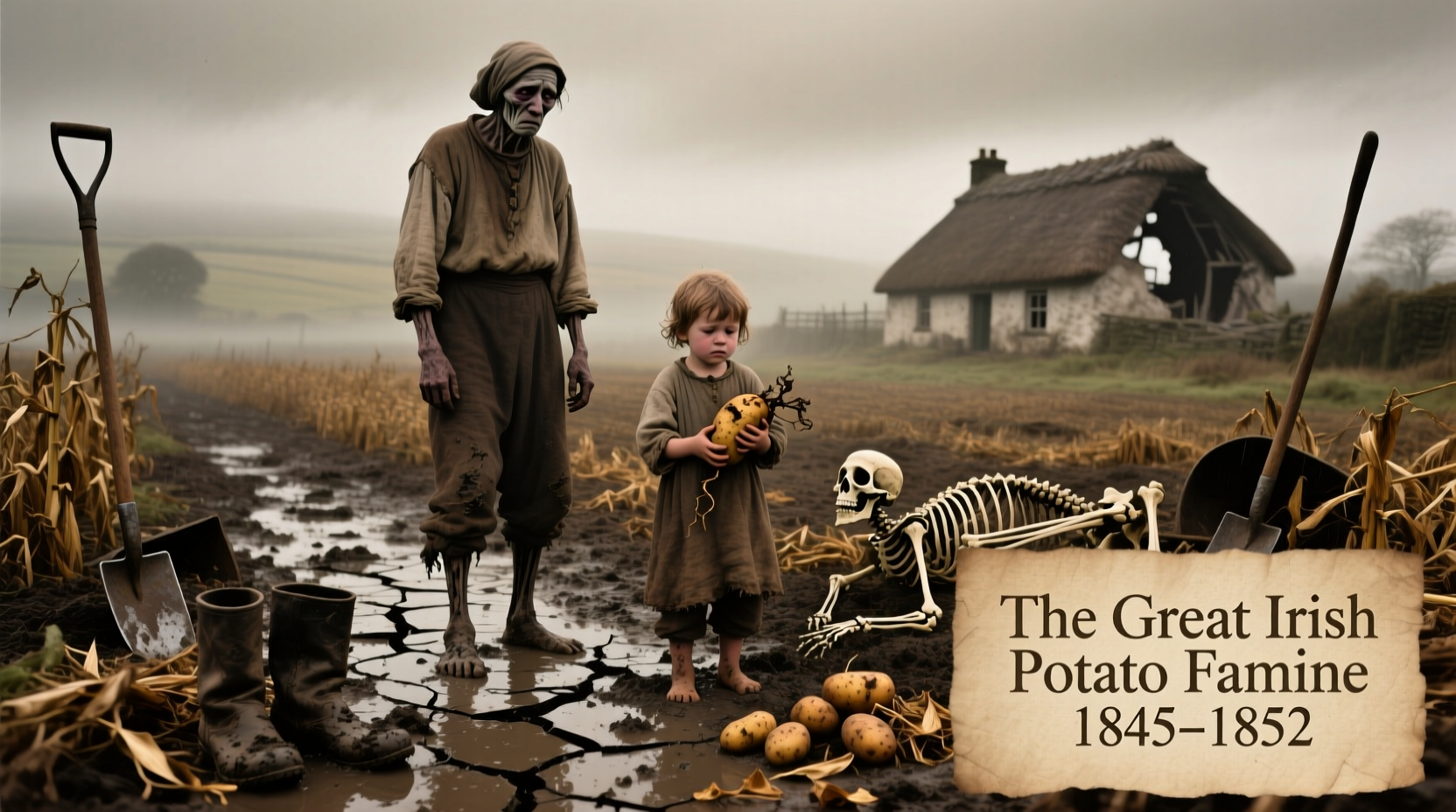
The Great Irish Potato Famine, also known as the Great Hunger (An Gorta Mór in Irish), was a period of mass starvation and disease in Ireland between 1845 and 1852. Approximately one million people died from starvation and related diseases, while another 1-2 million emigrated, causing Ireland's population to decline by 20-25%. This catastrophic event resulted from a combination of potato blight (Phytophthora infestans), colonial policies, and economic vulnerability that left Ireland's poor overwhelmingly dependent on the potato crop.
What Caused the Great Irish Potato Famine?
Ireland's dependence on the potato created perfect conditions for disaster. By the 1840s, nearly half of Ireland's population relied almost exclusively on potatoes for sustenance. The Lumper potato variety, while highly productive, was particularly vulnerable to disease. When Phytophthora infestans arrived in Ireland in 1845, it rapidly destroyed crops across the island.
However, the famine wasn't merely a natural disaster. British colonial policies significantly worsened the crisis:
- England maintained control over Ireland's agricultural exports during the famine
- British land ownership patterns created tenant farmer vulnerability
- Relief efforts were inadequate and often counterproductive
- The Corn Laws (repealed in 1846) had previously restricted grain imports
Great Irish Potato Famine Timeline: Key Events
| Year | Key Events | Impact |
|---|---|---|
| 1845 | Potato blight first detected in Ireland (September) | One-third of potato crop destroyed |
| 1846 | Complete crop failure; Peel's government imports maize | Widespread starvation begins; "Black '47" approaches |
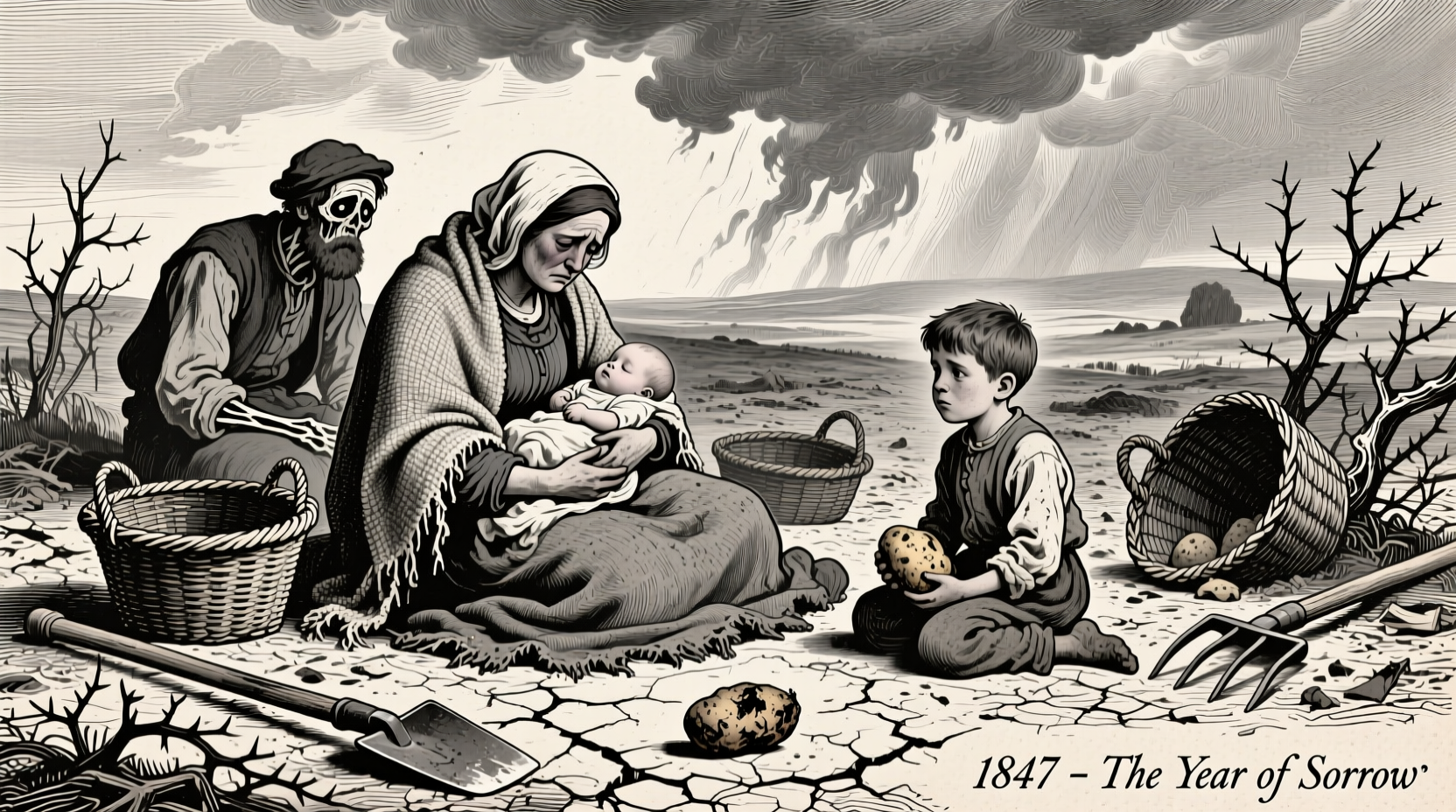
| 1847 | "Black '47" - worst famine year; Soup kitchens established | Peak mortality; mass evictions begin |
| 1848-1850 | Partial crop recoveries; continued emigration | Population decline accelerates; disease outbreaks continue |
| 1851-1852 | Famine officially ends; long-term consequences emerge | Ireland's population permanently reduced; diaspora established |
Human Cost: Death Toll and Emigration Statistics
The demographic impact of the Great Irish Potato Famine was staggering. According to Ireland's Central Statistics Office and census records:
- 1 million deaths from starvation and related diseases (1845-1852)
- 1-2 million people emigrated, primarily to North America and Britain
- Ireland's population declined from 8.2 million in 1841 to 6.6 million in 1851
- By 1901, Ireland's population had fallen to 4.5 million, never recovering to pre-famine levels
These figures represent one of the most severe population collapses in 19th century Europe. The National Famine Museum at Strokestown Park (irishfamine.ie) documents how certain regions experienced even more devastating losses, with some western counties losing up to 40% of their population.
British Government Response: Policies That Worsened the Crisis
Understanding the British government's response is crucial to comprehending the full scope of the Great Irish Potato Famine. Despite Ireland being part of the United Kingdom, relief efforts were inadequate and often counterproductive:
- Export paradox: Ireland continued exporting substantial quantities of food to Britain during the famine years
- Workhouse system: Overcrowded and disease-ridden, workhouses became death traps rather than relief centers
- Public works programs: Required backbreaking labor for minimal food rations
- Relief committee limitations: The Temporary Relief Act of 1847 provided only short-term assistance
As documented in the National Archives of Ireland (nationalarchives.ie), British Prime Minister Sir Robert Peel initially responded with some relief measures, but his successor Lord John Russell implemented more laissez-faire policies that worsened the crisis. The belief in laissez-faire economics prevented more direct government intervention that might have saved lives.
Long-Term Consequences of the Great Hunger
The Great Irish Potato Famine reshaped Ireland and the world in profound ways that continue to resonate today:
Demographic Transformation
Ireland became one of the few countries in modern history to experience sustained population decline. The famine accelerated trends toward smaller family sizes and delayed marriage that continued for generations. According to research from University College Cork (ucc.ie), Ireland's population didn't begin recovering until the late 20th century.
The Irish Diaspora
The mass emigration created the Irish diaspora that now numbers over 80 million people worldwide. This diaspora:
- Transformed American politics, particularly in cities like Boston and New York
- Established Irish communities across Canada, Australia, and Britain
- Created cultural connections that persist through organizations like the Ancient Order of Hibernians
Political Repercussions
The famine fueled Irish nationalism and anti-British sentiment that eventually led to:
- The Land League movement of the 1870s-1880s
- Increased support for Irish Home Rule
- Ultimately contributing to the Irish War of Independence (1919-1921)
Modern Understanding and Commemoration
Today, historians recognize the Great Irish Potato Famine as a complex event resulting from both natural disaster and political failure. Ireland officially commemorates the famine through:
- National Famine Commemoration Day (May)
- Memorials worldwide, including the Irish Hunger Memorial in New York City
- Educational programs in Irish schools
Scholarly research continues to refine our understanding of this pivotal event. Recent studies have examined the famine's impact on women, children, and specific regional communities, providing a more nuanced picture than earlier historical accounts.
Frequently Asked Questions About the Great Irish Potato Famine
How long did the Great Irish Potato Famine last?
The Great Irish Potato Famine lasted approximately seven years, from 1845 to 1852. The most severe period, known as "Black '47," occurred in 1847 when mortality rates peaked. While potato crops showed some recovery in later years, the famine's effects continued through 1852 as the population struggled with disease, malnutrition, and displacement.
Why did the British government's response worsen the Irish famine?
The British government's response worsened the Irish famine due to several factors: adherence to laissez-faire economic policies that limited direct food aid, continuation of food exports from Ireland to Britain during the crisis, inadequate relief programs that required excessive labor for minimal food, and political attitudes that viewed the famine as divine intervention or punishment. Historical records show Ireland exported substantial quantities of grain, meat, and dairy throughout the famine years.
How did the potato blight cause the Irish famine?
The potato blight (Phytophthora infestans) caused the Irish famine by destroying Ireland's primary food source. Nearly half of Ireland's population depended almost exclusively on potatoes, particularly the Lumper variety which was highly vulnerable to the fungus. When the blight arrived in 1845, it rapidly destroyed crops across the island. Unlike other European countries affected by the same blight, Ireland lacked alternative food sources for its poor tenant farmers, creating the conditions for mass starvation.
What was the population impact of the Great Irish Famine?
The Great Irish Famine caused Ireland's population to decline by 20-25%. Approximately one million people died from starvation and related diseases between 1845 and 1852, while another 1-2 million emigrated. Ireland's population fell from 8.2 million in 1841 to 6.6 million in 1851, and continued declining to 4.5 million by 1901. This represents one of the most severe population collapses in 19th century Europe, with some western counties losing up to 40% of their residents.
How is the Great Irish Famine remembered today?
The Great Irish Famine is remembered through national commemorations, memorials worldwide, and educational programs. Ireland observes National Famine Commemoration Day each May. Memorials exist in locations with significant Irish diaspora populations, including the Irish Hunger Memorial in New York City and the Famine Memorial sculptures in Dublin. Academic research continues to refine our understanding, while cultural expressions in literature, music, and film keep the memory alive. The National Famine Museum at Strokestown Park serves as a major educational resource.




 浙公网安备
33010002000092号
浙公网安备
33010002000092号 浙B2-20120091-4