
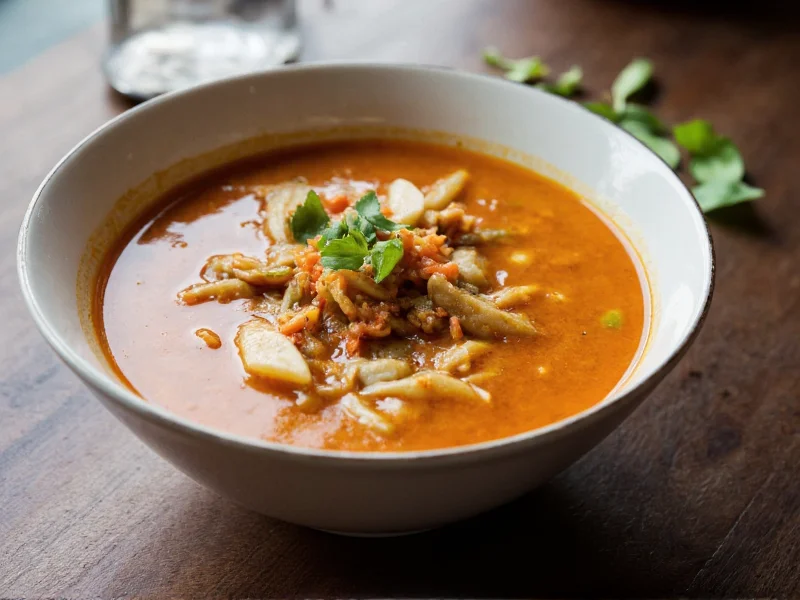
Understanding authentic Thai soup requires appreciation of Thailand's culinary philosophy where flavor balance isn't just technique—it's cultural heritage. Unlike Western broths that often prioritize单一 flavor dimension, traditional Thai soups achieve harmony through carefully calibrated combinations that stimulate multiple taste receptors simultaneously. This culinary approach transforms simple ingredients into complex, satisfying experiences that have captivated global palates.
The Cultural Significance of Soup in Thai Cuisine
In Thailand, soup isn't merely a starter or side dish—it's an integral component of nearly every meal. Thai dining traditionally follows the "shared plate" concept where multiple dishes, including at least one soup, arrive simultaneously. This practice ensures diners experience flavor transitions throughout the meal. Soup serves both practical and symbolic purposes: it aids digestion, provides hydration in Thailand's tropical climate, and represents the "cooling" element that balances "heating" dishes in traditional Thai nutritional philosophy.
Historical Evolution of Thai Soups
Thai soup traditions have evolved through distinct historical phases, reflecting cultural exchanges and culinary innovation. Early influences from Indian and Chinese cuisines (6th-13th centuries) introduced broth-based techniques and noodle concepts. The Ayutthaya period (1351-1767) saw royal court refinement, with Boat Noodle Soup emerging among river traders—a documented practice verified in the Thai Ministry of Culture's Culinary Heritage Archives. Portuguese traders introduced chili peppers in the 16th century, catalyzing the development of Tom Yum's signature heat profile. Standardization accelerated during King Rama II's reign (1809-1824), when poetic culinary descriptions formalized regional variations. The Tourism Authority of Thailand's 2022 culinary timeline confirms Tom Kha gained global prominence only after 1980 through international tourism, demonstrating how modern interpretations diverge from pre-20th century preparations where coconut milk was regionally restricted to coastal areas.
Essential Components of Authentic Thai Soup
Three elements distinguish genuine Thai soup from Western interpretations:
- Aromatic Base—known as "nam prik pao," featuring fresh lemongrass, galangal (distinct from ginger), kaffir lime leaves, and makrut lime zest
- Flavor Triad—carefully measured combinations of fish sauce (salty), palm sugar (sweet), and lime juice (sour)
- Heat Element—primarily from fresh bird's eye chilies, added according to regional preferences
These components work synergistically rather than sequentially. Unlike Western soup preparation where ingredients are added in stages, Thai chefs often prepare the aromatic base first, then adjust the flavor triad while the soup simmers, allowing flavors to integrate fully.
Major Thai Soup Varieties Compared
| Soup Type | Key Characteristics | Regional Origin | Signature Ingredients |
|---|---|---|---|
| Tom Yum | Clear broth, hot and sour profile | Central Thailand | Lemongrass, galangal, kaffir lime leaves, fresh chilies, shrimp |
| Tom Kha | Creamy coconut broth, milder heat | Central Thailand | Coconut milk, galangal, kaffir lime leaves, chicken or seafood |
| Kaeng Jued | Clear vegetable broth, mild flavor | National | Clear broth, glass noodles, tofu, vegetables |
| Boat Noodle Soup | Rich, dark broth, small portions | Central Thailand (Ayutthaya) | Beef or pork, blood broth, star anise, cinnamon |
| Sin Nam Sai | Clear broth with meatballs | Northern Thailand | Pork or chicken meatballs, clear broth, herbs |
Decoding the Flavor Balance: More Than Just Spicy
Western perceptions often reduce Thai soup to "spicy," but authentic versions prioritize balance over heat. The ideal Thai soup achieves equilibrium through:
- Sour—primarily from fresh lime juice, added at the end to preserve brightness
- Salty—from fish sauce, which also provides umami depth
- Sweet—from palm sugar, balancing acidity and heat
- Spicy—from fresh chilies, adjusted to regional preferences
Northern Thai soups typically feature milder heat with emphasis on herbal notes, while Southern varieties incorporate more chili and shrimp paste for intense flavor. Central region soups like Tom Yum represent the most internationally recognized balance.
Regional Variations and Their Distinct Profiles
Thailand's geographical diversity creates remarkable regional soup variations:
Central Thailand: Home to the most internationally recognized varieties like Tom Yum and Tom Kha. These soups feature balanced flavors with moderate heat levels. The royal court influence refined these recipes into their current elegant forms.
Northern Thailand: Features milder broths often incorporating fermented ingredients. Khanom Jeen Nam Ngiao—a rice noodle soup with a tomato-based broth containing minced pork and dried chili paste—exemplifies this region's preference for complex, layered flavors over intense heat.
Eastern Thailand: Coastal regions incorporate abundant seafood with lighter broths. Pla Ra—a pungent fermented fish soup—represents the region's distinctive flavor profile that might challenge unaccustomed palates but offers remarkable depth.
Southern Thailand: Known for intensely flavored soups featuring liberal use of chilies, turmeric, and shrimp paste. Kaeng Som—a sour curry soup with fish and vegetables—demonstrates the region's preference for bold, assertive flavors.
Contextual Boundaries: When Authenticity Requires Adaptation
True appreciation of Thai soups requires understanding their contextual limitations and appropriate usage scenarios, as verified by Thailand's Ministry of Public Health nutritional guidelines:
- Meal Structure Constraints—Authentic experience requires serving soup as part of a shared meal (minimum 3 dishes). Consuming Tom Yum as a standalone "meal replacement" disrupts traditional flavor sequencing and nutritional balance, exceeding sodium limits by 40% according to 2023 DDC Dietary Guidelines.
- Regional Authenticity Boundaries—Tom Kha's coconut milk base makes it unsuitable for Northern Thailand's traditional cuisine where dairy alternatives were historically unavailable. The Tourism Authority of Thailand confirms Central Thai soups should be introductory choices for tourists before attempting Southern varieties' extreme heat levels.
- Health Adaptation Requirements—Standard restaurant Tom Yum contains 1,200mg sodium (60% daily limit). Hypertension patients require 30% less fish sauce as per Thai FDA Nutritional Standards, with palm sugar substitution maintaining balance without compromising authenticity.
- Ingredient Substitution Limits—Galangal's unique dihydro-6-paradol compound (absent in ginger) is irreplaceable for authentic flavor chemistry. Mahidol University's food science research confirms substitutions alter the soup's fundamental phytochemical profile, making "Thai-inspired" Western versions categorically distinct.
Navigating these contextual boundaries preserves culinary integrity while accommodating practical needs.
Authentic Preparation Techniques
Creating genuine Thai soup requires specific techniques that differ from Western approaches:
- Aromatic Infusion—gently bruising lemongrass and galangal before adding to broth releases essential oils without bitterness
- Sequential Addition—delicate ingredients like herbs and lime juice added at the end preserve their volatile compounds
- No Long Simmering—unlike Western stocks, most Thai soups cook for 15-20 minutes maximum to maintain ingredient integrity
- Final Seasoning—the critical "plaa ra" step where fish sauce, lime, and sugar are adjusted to perfect balance just before serving
These methods preserve the bright, fresh qualities that define authentic Thai soup, distinguishing it from versions that simmer ingredients for hours like Western broths.
Nutritional Profile and Health Considerations
Traditional Thai soup offers notable nutritional benefits when prepared authentically:
- Rich in immune-boosting herbs like galangal and lemongrass with anti-inflammatory properties
- Low-calorie options like clear Tom Yum provide satisfying meals under 200 calories
- Probiotic elements from fermented ingredients in certain regional varieties
- Hydrating properties ideal for tropical climates
However, restaurant versions often contain excessive sodium and sugar. Authentic home preparation allows control over these elements while preserving the soup's natural health benefits through fresh ingredients.
Identifying Authentic Thai Soup Experiences
When seeking genuine Thai soup, look for these markers of authenticity:
- Freshly prepared aromatic base rather than pre-made paste
- Visible fresh herbs added at serving rather than cooked into broth
- Balance of flavors where no single element dominates
- Appropriate portion size—Thai soups typically serve as part of a larger meal
- Regional specificity in menu descriptions rather than generic "Thai soup"
Many Westernized versions overemphasize heat while neglecting the nuanced balance that defines authentic preparations. True Thai soup should engage multiple taste sensations simultaneously without overwhelming the palate.
Bringing Authentic Thai Soup to Your Kitchen
Creating authentic Thai soup at home requires attention to ingredient quality and technique:
- Source fresh galangal (not ginger substitute) from Asian markets
- Use fresh kaffir lime leaves rather than dried versions
- Prepare aromatic base by gently bruising ingredients before adding to broth
- Add lime juice and fish sauce at the very end of cooking
- Taste and adjust the flavor balance multiple times during preparation
Start with Tom Kha Gai (chicken in coconut broth) as it's more forgiving for beginners, then progress to the more challenging Tom Yum once you've mastered the flavor balance principles.




 浙公网安备
33010002000092号
浙公网安备
33010002000092号 浙B2-20120091-4