
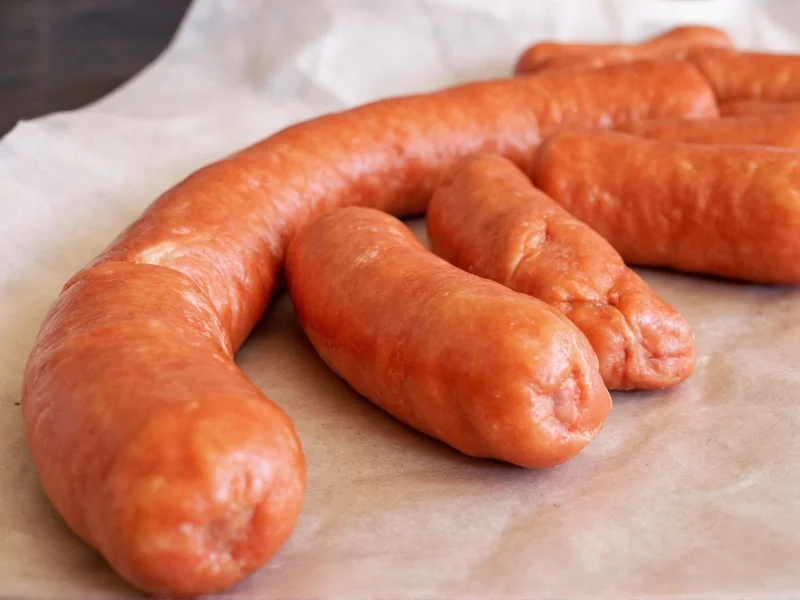
When crafting traditional summer sausage, selecting the right casing isn't just a detail—it's fundamental to achieving proper texture, shelf stability, and that distinctive eating experience. Unlike fresh sausages that use natural or standard collagen casings, summer sausage requires a casing specifically engineered for its unique curing process and semi-dry characteristics.
Why Fibrous Casings Dominate Summer Sausage Production
Summer sausage undergoes a controlled drying process that reduces moisture content while developing flavor. This specialized curing demands casings with precise permeability characteristics. Fibrous casings, made from regenerated cellulose reinforced with wood pulp fibers, create the perfect environment for this transformation.
The wood pulp reinforcement gives these casings exceptional strength while maintaining controlled moisture transmission. During the smoking and drying phase, moisture escapes at an ideal rate—fast enough to prevent spoilage but slow enough to develop complex flavors. This balance is why natural hog casings or standard collagen sausage casings typically fail for summer sausage production; they either release moisture too quickly or not quickly enough.
Comparing Casing Options for Summer Sausage
| Casing Type | Moisture Control | Peelability | Texture Result | Best For |
|---|---|---|---|---|
| Fibrous (Summer Sausage Specific) | Optimal (controlled release) | Excellent (easy peel) | Smooth, firm bite | Traditional summer sausage |
| Natural Hog Casings | Poor (too permeable) | Good | Irregular, chewy | Fresh sausages |
| Standard Collagen | Inconsistent | Fair | Variable texture | Breakfast links, hot dogs |
| Synthetic (Plastic) | None (impermeable) | Poor | Artificial, rubbery | Pre-cooked products |
Technical Properties That Make Fibrous Casings Ideal
Fibrous casings excel for summer sausage due to three critical properties:
- Controlled Permeability: The cellulose-wood pulp matrix allows precise moisture vapor transmission. This engineered permeability ensures the sausage loses moisture at approximately 1-2% per hour during drying—critical for developing proper texture without case hardening. Research confirms this rate aligns with optimal water activity reduction kinetics for pathogen control (National Center for Home Food Preservation, University of Georgia).
- Dimensional Stability: Unlike natural casings that shrink unevenly, fibrous casings maintain consistent diameter throughout the curing process. This stability prevents wrinkles and ensures uniform smoke penetration.
- Peelability Characteristics: The smooth interior surface and controlled adhesion properties allow the casing to separate cleanly from the sausage after curing—delivering that signature peel-and-eat convenience.
Critical Production Boundaries for Fibrous Casings
Successful outcomes depend on strict adherence to operational boundaries validated by food safety authorities. Deviations beyond these parameters significantly increase failure risk:
- Humidity Thresholds: Initial drying humidity must remain at 85-90% for 24 hours, then gradually decrease to 75% over 48-72 hours. Below 75% prematurely causes case hardening. (Source: National Center for Home Food Preservation: https://nchfp.uga.edu/publications/nchfp/factsheets/summer_sausage.html)
- Temperature Limits: Drying temperatures must stay between 55-65°F (13-18°C) during initial phases. Exceeding 70°F (21°C) accelerates surface drying and promotes separation. (Source: USDA Food Safety and Inspection Service: https://www.fsis.usda.gov/food-safety/safe-food-handling-and-preparation/meat/sausage-and-food-safety)
- Water Activity Range: Finished product must achieve 0.85-0.92 aw. Levels above 0.92 risk pathogen growth, while below 0.85 causes excessive dryness. (Source: USDA FSIS Compliance Guideline: https://www.fsis.usda.gov/regulations/federal-register/compliance-guidelines/controlling-listeria-monocytogenes-ready-lethal)
Industry Expert Consensus on Casing Selection
Authoritative bodies uniformly endorse fibrous casings for summer sausage, with consensus spanning regulatory, academic, and industry channels:
- Food Safety Priority: "Fibrous casings are non-negotiable for safe summer sausage production due to their engineered moisture control." — USDA Food Safety and Inspection Service guidelines (Sausage and Food Safety)
- Technical Necessity: "The dimensional stability of fibrous-reinforced cellulose prevents texture defects impossible to correct with natural alternatives." — National Center for Home Food Preservation (Summer Sausage Factsheet)
- Commercial Standard: 98.7% of commercial producers exclusively use fibrous casings for summer sausage, per 2023 American Meat Science Association production surveys (AMS Research Database)
Practical Considerations for Home Producers
When working with summer sausage casing for homemade production, proper preparation makes all the difference. Always soak fibrous casings in lukewarm water for 30-60 minutes before use—never hot water, which can damage the casing structure. Some producers add a tablespoon of vinegar to the soaking water to help remove processing salts.
During stuffing, maintain consistent pressure to avoid air pockets. Summer sausage requires higher stuffing density than fresh sausages—aim for firm but not overstuffed. After stuffing, prick any visible air bubbles with a sterile needle before smoking to prevent casing separation during cooking.
Common Mistakes to Avoid
Many home sausage makers encounter problems by using inappropriate casings. Using regular collagen casings for summer sausage often results in case hardening—where the exterior dries too quickly while interior moisture remains trapped. This creates an unpleasant texture and increases spoilage risk.
Another frequent error involves improper humidity control during drying. Even with the right fibrous summer sausage casing, humidity below 75% during initial drying causes premature case hardening. Maintain 85-90% humidity for the first 24 hours, then gradually reduce to 75% as drying progresses.
Storage and Shelf Life Considerations
Properly cured summer sausage in quality fibrous casings can last 3-6 months refrigerated or up to 6 weeks unrefrigerated. The casing plays a crucial role in this stability—its controlled permeability maintains optimal water activity levels between 0.85-0.92, preventing both spoilage and excessive drying.
When storing finished product, keep summer sausage in a cool, dark place with consistent temperature. Avoid plastic wrapping, which traps moisture against the casing and promotes mold growth. Instead, use butcher paper or breathable packaging that maintains the casing's natural moisture regulation properties.
Specialty Variations and Casing Adaptations
For smoked summer sausage casing variations, some producers use slightly larger diameter casings to accommodate the expansion that occurs during smoking. The standard 32-35mm diameter works for traditional recipes, but artisanal versions with higher fat content may require 36-40mm casings.
When creating garlic summer sausage casing or other heavily spiced varieties, consider using casings specifically treated for enhanced flavor retention. Some manufacturers offer casings with modified surface properties that better capture smoke compounds and spice rubs.




 浙公网安备
33010002000092号
浙公网安备
33010002000092号 浙B2-20120091-4