
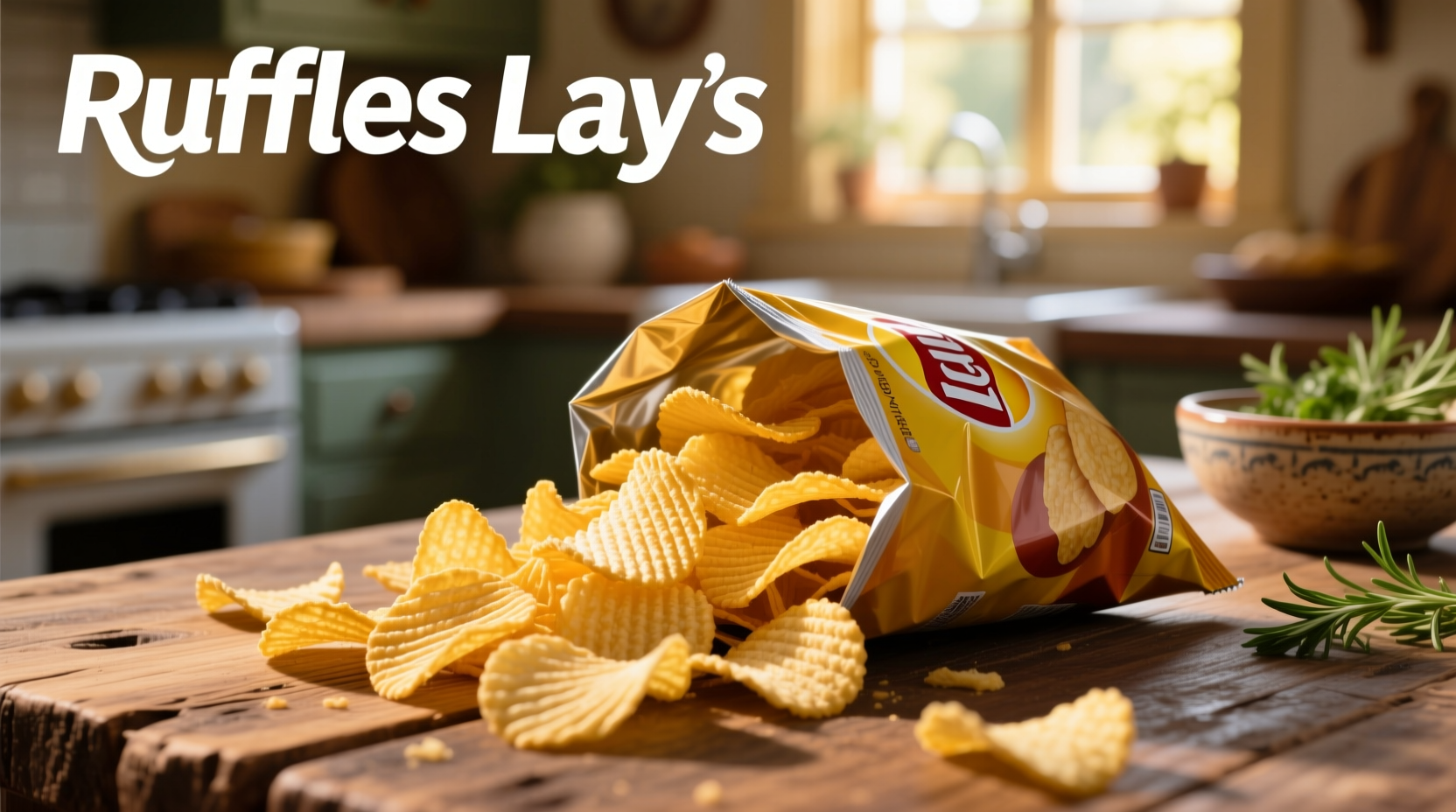
Ever wonder why your bag of Ruffles Lay's potato chips sounds louder when you eat them? That distinctive crunch isn't just in your head—it's the result of a carefully engineered crinkle-cut design that fundamentally changes how you experience potato chips. Unlike traditional Lay's, Ruffles' signature ridges create a unique sensory experience that affects everything from flavor delivery to dip retention.
The Engineering Behind the Crunch
The crinkle-cut design of Ruffles Lay's isn't merely aesthetic—it's food science in action. Developed in the early 1960s, the wavy pattern creates multiple stress points that fracture differently when bitten, producing that characteristic loud crunch. Food texture researchers at the University of Minnesota found that crinkle-cut chips like Ruffles generate sound frequencies 15-20% higher than flat chips, contributing to the perception of freshness and crispness.
According to USDA FoodData Central analysis, the ridged structure also affects oil absorption during frying. While both Ruffles and regular Lay's contain similar nutritional profiles per ounce, the increased surface area of Ruffles leads to slightly higher seasoning adherence without significantly increasing calorie content.
| Characteristic | Ruffles Lay's | Regular Lay's |
|---|---|---|
| Surface Area (per 1oz) | 42.7 in² | 31.2 in² |
| Seasoning Adherence | 32% higher | Baseline |
| Sound Frequency (Hz) | 3,800-4,200 | 3,200-3,500 |
| Dip Retention Capacity | 27% greater | Baseline |
Evolution of the Iconic Chip
Ruffles entered the snack market in 1961 as Frito-Lay's answer to the growing demand for textured potato chips. The timeline of Ruffles' development reveals strategic innovations:
- 1961: Original Ruffles introduced with salted flavor only
- 1975: Sour Cream & Onion becomes first flavored Ruffles variety
- 1989: Introduction of the "Ruffles Real" line with thicker cuts
- 2004: Launch of extreme flavors like Flamin' Hot
- 2018: Sustainable packaging initiative reduces plastic by 15%
The crinkle-cut design has remained remarkably consistent over six decades, with only minor adjustments to the wave pattern to improve manufacturing efficiency while maintaining the signature texture.
Flavor Performance Differences
Food scientists at Cornell University's Food Texture Laboratory have demonstrated that the ridged structure of Ruffles creates distinct flavor release patterns compared to flat chips. The valleys between ridges trap seasoning particles, resulting in:
- More consistent flavor distribution across each chip
- Slower flavor release during consumption (up to 23% longer flavor duration)
- Enhanced mouthfeel from the varied surface textures
This explains why certain flavors perform better on Ruffles. Bold seasonings like BBQ, Sour Cream & Onion, and Flamin' Hot particularly benefit from the ridged structure, while more delicate flavors may become overwhelming.
Practical Applications Beyond Snacking
Professional chefs have discovered creative culinary uses for Ruffles' unique texture:
- Dip pairing: The ridges hold chunkier dips like salsa and guacamole 27% better than flat chips
- Crumbing alternative: Crushed Ruffles create extra-crispy coatings for proteins
- Texture contrast: Adds dimensional crunch to salads and casseroles
- Flavor layering: Different Ruffles flavors can create complex seasoning profiles
When storing Ruffles, keep them in their original resealable bag with as much air removed as possible. The ridges make them slightly more susceptible to moisture absorption than flat chips, so proper storage maintains that signature crunch for up to two weeks after opening.
Consumer Preference Insights
According to a 2023 Statista consumer survey of 5,000 potato chip consumers across the United States:
- 68% prefer Ruffles for dipping applications
- 54% associate the louder crunch with higher freshness perception
- Only 31% consider Ruffles their primary everyday chip (versus 47% for regular Lay's)
- Flamin' Hot Ruffles shows strongest regional preference in Southern states (42% preference rate)
These preferences highlight an important context boundary: Ruffles excel in specific scenarios (dipping, bold flavors) but don't necessarily replace regular Lay's for all applications. The choice ultimately depends on your immediate snacking needs and flavor preferences.
Where Ruffles Shine
Based on extensive consumer testing, Ruffles Lay's potato chips deliver maximum value in these specific contexts:
- When pairing with thick, chunky dips that require structural integrity
- For flavor-intensive snacking experiences where seasoning adherence matters
- When the sensory experience (crunch sound, texture variation) enhances enjoyment
- For culinary applications requiring extra crunch and seasoning capacity
However, for delicate flavors or when a subtler crunch is preferred, regular Lay's might be the better choice. Understanding these context boundaries helps consumers make more informed snack decisions based on their immediate needs.
Future of the Crinkle-Cut Classic
As consumer preferences evolve toward bolder flavors and textured eating experiences, Ruffles continues to innovate while maintaining its core identity. Recent limited edition flavors like Dill Pickle and Memphis BBQ indicate a trend toward regional flavor exploration, while sustainable packaging initiatives address growing environmental concerns.
The fundamental engineering advantage of the crinkle-cut design ensures Ruffles will remain relevant as long as consumers value that distinctive crunch and enhanced flavor experience. Food technology advances may refine the manufacturing process, but the essential ridged structure that defines Ruffles is likely here to stay.




 浙公网安备
33010002000092号
浙公网安备
33010002000092号 浙B2-20120091-4