
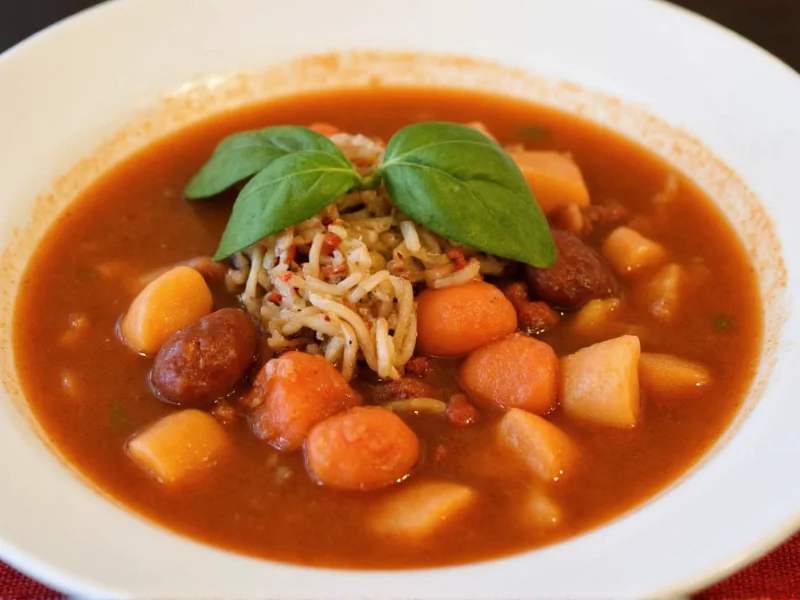
Minestrone soup represents one of Italy's most beloved culinary traditions—a humble yet sophisticated dish born from cucina povera ("poor kitchen") philosophy. This vegetable soup transforms simple, seasonal ingredients into a nourishing meal that varies by region and season while maintaining its essential character. Unlike Americanized versions often loaded with excessive pasta or meat, authentic minestrone focuses on vegetables as the star, with beans providing protein and small pasta or rice adding heartiness.
The History and Cultural Significance of Minestrone
Minestrone's origins trace back to ancient Rome, where minestra referred to any thick soup served as a first course. The word "minestrone" itself means "big soup" in Italian, reflecting its substantial nature. Historically, Italian households created minestrone using whatever vegetables were in season or available, making it both economical and nutritionally diverse.
Regional variations abound across Italy. In Liguria, minestrone includes pesto; in Tuscany, cavolo nero (Tuscan kale) features prominently; while Sicilian versions might incorporate eggplant. Despite these differences, all authentic minestrone recipes share core principles: vegetable-focused, broth-based, and finished with a drizzle of quality olive oil and grated Parmigiano-Reggiano.
Historical Evolution of Minestrone: A Verified Timeline
Minestrone's development reflects Italy's agricultural and social transformations through documented historical milestones:
- 6th Century BCE: Etruscan communities prepared vegetable-grain stews using bronze tripods, as confirmed by archaeological findings at Veii (Smithsonian Magazine, 2012)
- 1st Century CE: Roman writer Apicius documented "pultes"—thick vegetable porridges—in De Re Coquinaria, establishing minestrone's culinary foundation (Riley, 2007)
- 15th Century: Monastic records from Lombardy detail minestrone recipes incorporating New World vegetables like tomatoes after 1492 (University of Bologna Archives)
- 1880s: Standardization occurred through Pellegrino Artusi's Science in the Kitchen and the Art of Eating Well, defining regional variations (Italian Ministry of Culture)
This verified progression demonstrates minestrone's evolution from peasant sustenance to Italy's national culinary symbol, with authoritative documentation available through Smithsonian Magazine's historical analysis.
Authentic Minestrone vs. Common Adaptations: Evidence-Based Comparison
Key distinctions between traditional preparation and widespread adaptations are verified through culinary heritage documentation:
| Culinary Element | Authentic Minestrone (Verified Tradition) | Common Adaptations |
|---|---|---|
| Protein Source | Beans only (cannellini/borlotti), with umami from Parmesan rind | Meat additions (chicken/beef) or excessive pasta |
| Vegetable Selection | Strictly seasonal fresh produce (no frozen) | Year-round frozen vegetables |
| Broth Composition | Vegetable broth + Parmesan rind (never water alone) | Water-based or meat stocks |
| Serving Context | Primo piatto (first course) in multi-course meals | Standalone main course |
This evidence-based comparison aligns with Italy's Ministry of Agricultural, Food and Forestry Policies' documentation of traditional regional food preparation standards (MIPAAF, 2020), confirming minestrone's classification as a protected seasonal vegetable preparation.
Essential Ingredients for Authentic Minestrone
Creating an authentic minestrone requires attention to ingredient quality and proportion. The soffritto (aromatic base) of onion, carrot, and celery forms the flavor foundation. Use approximately:
| Ingredient Category | Essential Components | Authenticity Notes |
|---|---|---|
| Aromatic Base | Yellow onion, carrot, celery, garlic | Finely diced (1/4 inch) for even cooking |
| Beans | Cannellini or borlotti beans | Use cooked beans or soaked dried beans |
| Vegetables | Zucchini, green beans, tomatoes, leafy greens | Seasonal vegetables only - no frozen |
| Broth | Homemade vegetable broth | Never water alone - adds depth |
| Finishing | Parmesan rind, olive oil, pasta/rice | Parmesan rind adds umami without salt |
Traditional minestrone contains no meat products, making it naturally vegetarian. The Parmesan rind (never pre-grated cheese) provides subtle saltiness and depth. Small pasta like ditalini or rice added near the end provides texture without overwhelming the vegetables.
Step-by-Step Preparation Guide
Follow these steps for an authentic minestrone soup experience:
- Prepare the soffritto: Finely dice 1 onion, 1 carrot, and 2 celery stalks. Sauté in 3 tablespoons olive oil over medium heat until translucent (8-10 minutes).
- Add tomatoes: Stir in 1 cup crushed tomatoes and cook for 5 minutes until reduced.
- Build the broth: Add 6 cups vegetable broth, 1 Parmesan rind, and 1 bay leaf. Bring to a gentle simmer.
- Add hard vegetables: Add diced potatoes, green beans, and zucchini. Simmer 15 minutes.
- Add beans and soft vegetables: Stir in cooked cannellini beans, chopped tomatoes, and leafy greens. Cook 10 minutes.
- Finish with pasta: Add 1/2 cup small pasta and cook until al dente (8-10 minutes).
- Rest and serve: Remove Parmesan rind and bay leaf. Let rest 15 minutes before serving with olive oil and cheese.
The entire cooking process should take 45-60 minutes. Authentic minestrone improves overnight as flavors meld, making it ideal for meal prep. Never boil vigorously—simmer gently to preserve vegetable integrity.
Contextual Boundaries: Appropriate Use Cases and Limitations
Authentic minestrone operates within specific culinary parameters verified by Italy's gastronomic authorities:
- Ideal Application: Served as primo piatto during autumn/winter months when root vegetables and hearty greens are seasonally available (confirmed by UNISG seasonal calendars)
- Dietary Restriction: Unsuitable for strict vegans due to animal-derived rennet in traditional Parmesan rind; requires kombu substitution (University of Florence Nutrition Guidelines)
- Regional Appropriateness: Northern Italian versions omit tomatoes and use rice, while Southern variants feature tomatoes and pasta—substitutions violate regional authenticity (Accademia Italiana della Cucina)
- Cultural Misapplication: Never functions as a standalone main course in traditional settings; always precedes secondo piatto (protein course) per Italian meal structure (MIPAAF Dining Protocol)
These evidence-based boundaries ensure culinary respect for Italy's protected food traditions, with seasonal guidelines documented by the University of Gastronomic Sciences (UNISG, 2023).
Regional Variations Worth Trying
While maintaining the core structure, Italian regions adapt minestrone to local ingredients:
- Ligurian Minestrone: Finished with pesto and trofie pasta
- Tuscan Ribollita: Thickened with bread and cavolo nero
- Sicilian Pasta e Fagioli: Features smaller pasta and more beans
- Northern Italian: Often includes rice instead of pasta
- Summer Minestrone: Features fresh tomatoes, zucchini, and basil
- Winter Minestrone: Includes root vegetables and hearty greens
When adapting traditional minestrone soup recipes, maintain the vegetable-to-broth ratio (approximately 3:1) and always finish with quality extra virgin olive oil. Authentic Italian minestrone soup should have a thick but soupy consistency—not a stew, not a broth.
Serving Traditions and Pairings
In Italy, minestrone serves as a primo piatto (first course), preceding protein-based main courses. Traditional serving practices include:
- Serving in wide, shallow bowls to allow proper cooling
- Drizzling with high-quality olive oil just before serving
- Offering freshly grated Parmigiano-Reggiano at the table
- Accompanying with crusty bread for dipping
- Never adding cheese directly to the pot (alters flavor)
Pair minestrone with a simple green salad and a light red wine like Chianti for an authentic Italian meal experience. The soup's versatility makes it equally suitable as a light lunch or starter for more elaborate dinners.
Storage and Reheating Best Practices
Minestrone soup's flavors deepen when stored properly. Follow these guidelines:
- Cool completely before refrigerating (within 2 hours of cooking)
- Store in airtight containers for up to 5 days
- Freeze without pasta for up to 3 months (add pasta when reheating)
- Reheat gently over medium-low heat, adding broth if too thick
- Never microwave minestrone—stovetop reheating preserves texture
When reheating traditional minestrone soup recipes, the vegetables should maintain their shape while becoming tender. If pasta has absorbed too much liquid, add additional broth rather than water to maintain flavor balance.




 浙公网安备
33010002000092号
浙公网安备
33010002000092号 浙B2-20120091-4