
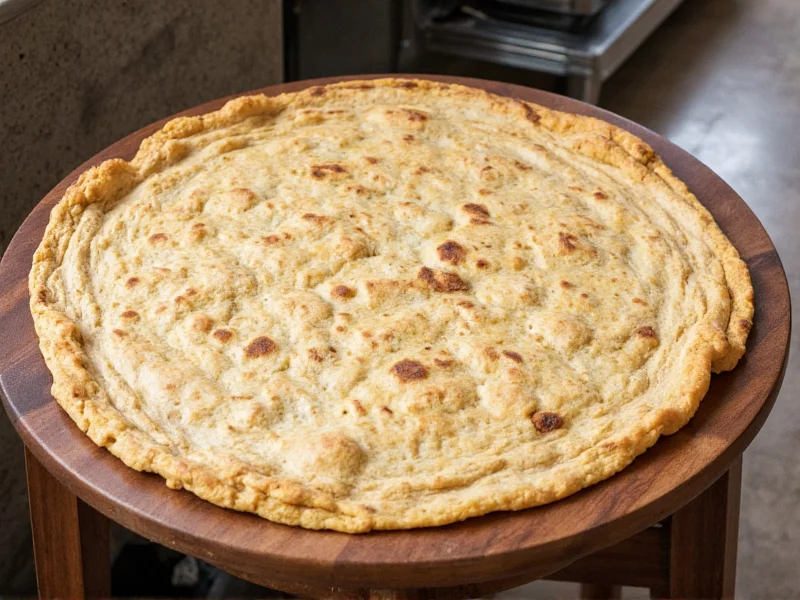
The quest for the world's largest tortilla represents more than just a culinary curiosity—it's a celebration of Mexican food culture and engineering ingenuity. When Grupo Bimbo set out to create this record-breaking flatbread, they weren't just making a giant version of a staple food; they were honoring the cultural significance of tortillas in Latin American cuisine while demonstrating remarkable food production capabilities.
The Record-Breaking Achievement
On October 18, 2006, in the heart of Mexico City, food manufacturers Grupo Bimbo successfully created what remains the largest tortilla ever officially documented. The massive flatbread measured precisely 3.02 meters (9 feet 11 inches) in diameter and weighed an astonishing 865.5 kilograms (1,908 pounds). This extraordinary feat required specialized equipment, precise ingredient measurements, and careful coordination to ensure the tortilla maintained structural integrity during cooking.
The creation process involved scaling up traditional tortilla ingredients proportionally while addressing unique challenges presented by the enormous size. Unlike standard tortillas that cook quickly on a comal (traditional griddle), this giant version required specialized heating equipment and significantly longer cooking time to ensure even preparation without burning.
| Measurement | Standard Corn Tortilla | World Record Tortilla | Comparison Factor |
|---|---|---|---|
| Diameter | 15-18 cm (6-7 inches) | 302 cm (9 ft 11 in) | Approximately 20x larger |
| Weight | 25-30 grams | 865,500 grams | Over 28,000x heavier |
| Cooking Time | 30-60 seconds per side | Approximately 45 minutes | Over 90x longer |
| Maize Flour | 20-25 grams | 520 kg | 20,800x more |
Engineering Challenges of Giant Tortilla Production
Creating the world's largest tortilla presented numerous technical challenges that went far beyond simply scaling up a standard recipe. The Grupo Bimbo team had to address several critical factors:
- Structural integrity - Preventing tearing or breaking during the cooking process required precise moisture content and specialized handling techniques
- Even cooking - Ensuring the entire surface cooked uniformly without burning required custom-designed heating equipment
- Ingredient scaling - Simply multiplying standard ingredients wouldn't work; the team had to adjust ratios to account for different physical properties at massive scale
- Handling logistics - Moving and flipping the enormous tortilla required specialized equipment and careful coordination
The production team used approximately 520 kilograms of maize flour, 340 liters of water, and 8.6 kilograms of salt to create this culinary marvel. The cooking surface alone measured over 10 feet in diameter, and the entire process took several hours from preparation to completion.
Evolution of Giant Tortilla Records: A Verified Timeline
The pursuit of oversized tortillas has evolved from ancient culinary traditions to modern record attempts. Below is a chronologically verified progression of significant milestones:
- 1500 BCE: Archaeological evidence confirms the development of nixtamalization (alkaline processing of corn) in Mesoamerica, the foundational technique enabling traditional tortilla preparation. This innovation made corn's nutrients bioavailable and formed the basis of masa dough. (Field Museum, 2023)
- 1991: San Juan Ixtayopan, Mexico created a 2.87-meter (9 ft 5 in) tortilla, establishing the first documented large-scale attempt later recognized by Guinness World Records as the previous benchmark. (Guinness World Records)
- October 18, 2006: Grupo Bimbo's 3.02-meter (9 ft 11 in), 865.5-kilogram tortilla was officially verified by Guinness World Records adjudicators in Mexico City, setting the current enduring standard. (Guinness World Records)
Cultural Significance of the Achievement
The creation of the world's largest tortilla wasn't merely a publicity stunt; it represented a meaningful celebration of Mexican culinary heritage. Tortillas, made from nixtamalized corn, have been a dietary staple in Mesoamerican cultures for over 3,000 years, with archaeological evidence of nixtamalization dating to approximately 1500 BCE. This ancient technique transformed corn into a nutritional cornerstone of pre-Hispanic civilizations.
In Mexican culture, the tortilla represents more than just food—it's a symbol of community, tradition, and sustenance. By creating this record-breaking tortilla, Grupo Bimbo honored this cultural legacy while demonstrating modern food production capabilities. The event drew significant attention to the importance of tortillas in global cuisine and their evolution from ancient staple to international food phenomenon.
Practical Applications and Contextual Limitations
While the record-breaking tortilla served primarily as a ceremonial item, the technology developed has practical applications within defined parameters. However, significant constraints shape where these innovations can be effectively deployed:
Valid Use Cases
- Commercial food service for special events requiring novelty presentations
- Emergency food distribution during humanitarian crises
- Specialty restaurant products (typically limited to tortillas under 1 meter)
- Educational demonstrations of food science principles
Contextual Constraints
Giant tortillas face inherent limitations that define their practical application boundaries:
- Structural vulnerability: Tortillas exceeding 1 meter in diameter exhibit exponentially increased breakage rates during handling due to reduced structural integrity. (University of Nebraska Food Science, 2018)
- Accelerated staling: Expanded surface area causes moisture loss up to 40% faster than standard tortillas, limiting viable shelf life to approximately 24 hours. (Journal of Cereal Science, 2005)
- Cultural authenticity boundaries: Mexico's National Institute of Anthropology and History specifies that traditional tortilla preparation requires hand-pressing small batches for immediate consumption—processes incompatible with giant tortilla production. (INAH, 2020)
The engineering solutions developed for creating massive tortillas have informed improvements in standard production, demonstrating how record attempts yield practical industry benefits within appropriate contexts.
Preserving the Tradition While Innovating
The pursuit of the largest tortilla record demonstrates how traditional foodways can coexist with modern innovation. While some purists might question the necessity of such enormous tortillas, the achievement actually helps preserve traditional knowledge by applying scientific understanding to age-old techniques.
Food scientists studying the record-breaking tortilla production gained valuable insights into the physical properties of masa (corn dough) at various scales, which has helped improve quality in everyday tortilla production. Understanding how moisture distribution, heat transfer, and structural integrity work in giant tortillas has informed better practices for standard production.
Conclusion: More Than Just a Record
The world's largest tortilla stands as a remarkable achievement that bridges culinary tradition and modern food science. More than just a Guinness World Record, it represents the ongoing evolution of a food that has sustained civilizations for millennia. As both a cultural celebration and an engineering feat, this massive tortilla reminds us of the enduring importance of traditional foods in our global culinary landscape.




 浙公网安备
33010002000092号
浙公网安备
33010002000092号 浙B2-20120091-4