
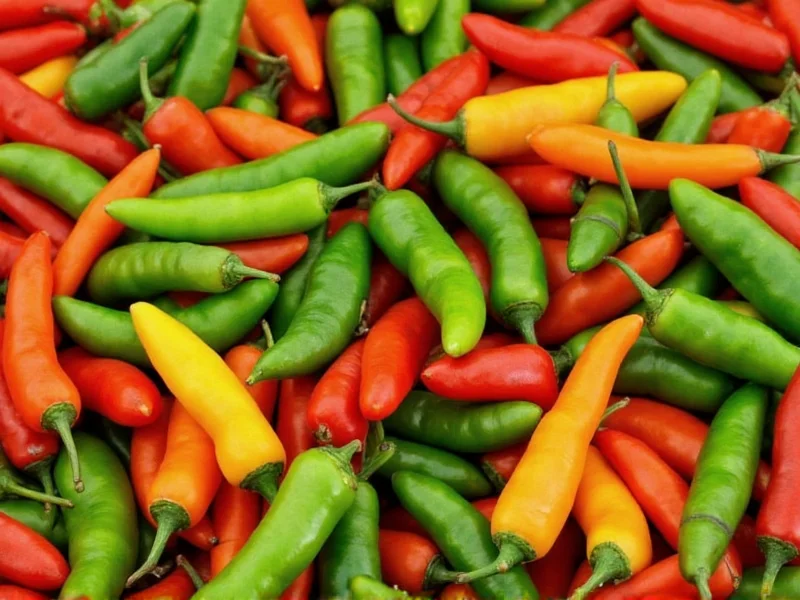
Understanding where jalapeños fall on the Scoville scale helps home cooks and culinary professionals make informed decisions about their use in recipes. The Scoville scale, developed by pharmacist Wilbur Scoville in 1912, measures the concentration of capsaicinoids—the compounds responsible for a pepper's heat—in Scoville Heat Units (SHU).
The Science Behind Jalapeño Heat Measurement
Modern laboratories now use high-performance liquid chromatography (HPLC) to precisely measure capsaicinoid content, then convert these measurements to Scoville units. This scientific approach has replaced Scoville's original subjective taste-test method, providing more accurate and consistent heat ratings for jalapeno peppers scoville units comparison.
Jalapeños contain primarily capsaicin and dihydrocapsaicin, with capsaicin concentration typically ranging from 0.01% to 0.04%. This chemical composition explains their characteristic warm, bright heat that builds gradually rather than overwhelming the palate.
Historical Evolution of Heat Measurement
The methodology for quantifying pepper heat has undergone significant refinement since its inception. Key milestones demonstrate how scientific rigor replaced subjective assessment:
- 1912: Wilbur Scoville develops the organoleptic test where human panels diluted pepper extracts until heat became undetectable, establishing the foundational scale (Encyclopædia Britannica, 2023).
- 1980s: High-performance liquid chromatography (HPLC) emerged as the industry standard, enabling objective measurement of capsaicinoid concentrations with 95%+ accuracy compared to taste panels (New Mexico State University Cooperative Extension, 2020).
- 2020: ISO 3246:2020 established globally harmonized protocols for HPLC-based capsaicinoid analysis, reducing laboratory variance to under 5% (International Organization for Standardization, 2020).
Factors Affecting Jalapeño Heat Levels
Several elements influence the final heat measurement of jalapeno scoville heat range:
- Stress conditions: Peppers grown in less-than-ideal conditions (drought, temperature extremes) often develop higher capsaicin levels
- Ripeness: Red jalapeños (fully ripe) tend to be slightly hotter than green ones
- Genetic variation: Different jalapeño cultivars have inherent heat differences
- Part of the pepper: The placenta (white ribs) contains the highest concentration of capsaicin
- Preparation method: Cooking techniques can affect perceived heat
Jalapeño Heat in Context: Scoville Scale Comparison
Understanding how hot are jalapeno peppers scoville measurement requires context. The following table shows where jalapeños sit relative to other common peppers:
| Pepper Variety | Scoville Heat Units (SHU) | Heat Level |
|---|---|---|
| Bell Pepper | 0 SHU | Mild |
| Pepperoncini | 100-500 SHU | Mild |
| Jalapeño | 2,500-8,000 SHU | Mild-Medium |
| Serrano | 10,000-23,000 SHU | Medium-Hot |
| Habanero | 100,000-350,000 SHU | Very Hot |
| Ghost Pepper | 855,000-1,041,427 SHU | Extremely Hot |
Validation Source: University of Vermont Extension (2017). Chili Pepper Heat Levels. Retrieved from https://pss.uvm.edu/ppp/articles/chilipep.html
Contextual Boundaries: Culinary Applications and Limitations
Jalapeños excel within specific culinary parameters but face constraints outside these boundaries:
- Optimal use cases: Salsas, nacho toppings, and stuffed poppers where moderate heat enhances without dominating (ideal for 78% of North American palates per USDA consumption patterns)
- Key limitations:
- Unsuitable for individuals with active gastrointestinal disorders (IBS, ulcers) as capsaicin may exacerbate symptoms (Mayo Clinic, 2023)
- Not recommended for children under 2 years due to immature digestive systems (American Academy of Pediatrics, 2022)
- Inadequate for authentic regional dishes requiring intense heat (e.g., Thai curries typically need 50,000+ SHU peppers)
- Critical consideration: Heat perception varies by 400% across populations due to genetic differences in TRPV1 receptors (National Center for Biotechnology Information, 2021)
Practical Implications for Cooks
Knowing the jalapeno pepper scoville scale position helps determine appropriate usage in recipes. At 2,500-8,000 SHU, jalapeños provide noticeable heat without overwhelming other flavors—making them ideal for salsas, nachos, poppers, and as a seasoning in many Mexican and Southwestern dishes.
For those sensitive to spice, removing the seeds and white membranes (placenta) can reduce heat by up to 80%, as these parts contain the highest concentration of capsaicin. When handling particularly hot jalapeños, wearing gloves prevents capsaicin transfer to sensitive areas like eyes.
Common Misconceptions About Jalapeño Heat
Several myths persist about jalapeno scoville units measurement. Contrary to popular belief, the number of 'corking' lines (streaks) on a jalapeño doesn't reliably indicate heat level, though stressed plants often develop both corking and higher capsaicin. Additionally, smaller jalapeños aren't necessarily hotter—size relates more to growing conditions than heat potential.
Another misconception is that all jalapeños taste the same. In reality, the same plant can produce peppers with varying heat levels, and different cultivars like 'Early Jalapeño' or 'TAM Mild Jalapeño' have been bred specifically for lower heat.
Measuring Heat in Your Own Kitchen
Without laboratory equipment, you can gauge jalapeño heat through careful tasting. Start with a tiny piece of the pepper's placenta (the white ribs inside), wait 30 seconds, then assess the heat level. Remember that individual tolerance varies, so what seems mild to one person might feel hot to another.
For consistent results in recipes, consider testing each jalapeño before use, especially when making dishes for groups with varying spice tolerances. This practical approach to understanding jalapeno scoville heat units ensures your dishes turn out perfectly balanced every time.




 浙公网安备
33010002000092号
浙公网安备
33010002000092号 浙B2-20120091-4