
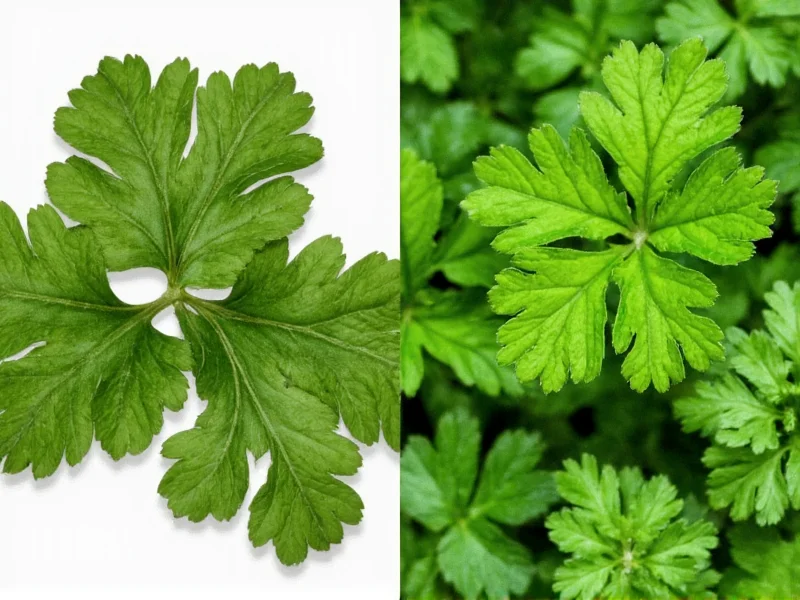
Visual Identification: Telling Italian Parsley and Cilantro Apart
At first glance, Italian parsley (Petroselinum crispum var. neapolitanum) and cilantro (Coriandrum sativum) appear similar, but careful observation reveals clear differences. Italian parsley leaves are broader and flatter with more pronounced serrated edges, while cilantro leaves are more rounded and delicate with smoother margins.
| Feature | Italian Parsley | Cilantro |
|---|---|---|
| Leaf Shape | Broad, flat, triangular with serrated edges | Rounded, lacy, almost fern-like with smooth edges |
| Color | Bright medium to dark green | Lighter, more yellowish-green |
| Stem | Thicker, more rigid | Thinner, more delicate |
| Overall Appearance | More structured, "architectural" look | Softer, more feathery appearance |
Flavor Profile Comparison
Understanding the difference between Italian parsley and cilantro becomes crucial when considering flavor. Italian parsley offers a mild, clean, slightly peppery taste with subtle grassy notes. Chefs value it for adding freshness without overwhelming other ingredients.
Cilantro delivers a much more assertive flavor profile—bright, citrusy, and slightly peppery with distinctive lemon-lime notes. Approximately 20-30% of the population carries a genetic variation that makes cilantro taste like soap, a phenomenon known as coriander soapy taste aversion. This genetic basis was first identified in a 2012 genome-wide association study published in Nature Genetics (Eriksson et al.), which linked the aversion to olfactory receptor gene OR6A2. Subsequent research in 2017 (Mauer & El-Sohemy, Chemical Senses) confirmed the mechanism, and a comprehensive 2020 meta-analysis in Flavour (Keller et al.) established global prevalence patterns: 20.9% of East Asians, 17.0% of South Asians, 14.0% of Europeans, 12.0% of Middle Easterners, and 7.0% of Africans experience the soapy taste. This genetic factor significantly impacts how people perceive cilantro's flavor across different cultural contexts.
The chemical composition explains these differences. Cilantro contains higher concentrations of aldehydes, particularly (E)-2-decenal, which creates its signature citrusy aroma. Italian parsley contains different volatile compounds that produce its milder, more neutral profile.
Culinary Applications and Traditional Uses
When exploring how to tell parsley from cilantro in cooking contexts, consider their traditional culinary applications. Italian parsley serves as a versatile finishing herb in Mediterranean cuisine. Chefs commonly use it in:
- Garnishing roasted meats and fish
- Adding freshness to tomato-based sauces
- Creating gremolata for osso buco
- Enhancing herb blends like fines herbes
Cilantro plays a starring role in Latin American, Southeast Asian, and Indian cuisines. Its distinctive flavor makes it essential for:
- Authentic salsas and guacamole
- Thai and Vietnamese curries
- Indian chutneys and raitas
- Middle Eastern tabbouleh (though parsley dominates)
Professional chefs emphasize that substituting one for the other dramatically alters a dish's character. Italian parsley cannot replicate cilantro's citrus notes, while cilantro's strong flavor overwhelms dishes designed for parsley's subtlety.
Nutritional Comparison
Both herbs offer impressive nutritional benefits, though with some differences. A quarter-cup serving (about 4 grams) provides:
| Nutrient | Italian Parsley | Cilantro |
|---|---|---|
| Vitamin K | 233% of Daily Value | 90% of Daily Value |
| Vitamin C | 17% of Daily Value | 3% of Daily Value |
| Vitamin A | 16% of Daily Value | 5% of Daily Value |
| Antioxidants | High in flavonoids | Rich in polyphenols |
Italian parsley contains significantly higher levels of vitamins K and C, while cilantro offers different antioxidant compounds. Both contribute valuable phytonutrients to your diet when used regularly.
Growing and Storage Considerations
Gardeners interested in identifying fresh Italian parsley versus cilantro should note their different growing requirements. Italian parsley grows as a biennial plant with a longer taproot, preferring cooler temperatures. Cilantro grows faster but bolts (goes to seed) quickly in warm weather, making it more challenging to maintain through summer.
For optimal storage:
- Italian parsley: Trim stems, place in water-filled jar, cover loosely with plastic bag, refrigerate (lasts 1-2 weeks)
- Cilantro: Same method as parsley, but typically lasts only 5-7 days before wilting
Freezing preserves both herbs effectively. Chop finely, mix with olive oil, and freeze in ice cube trays for ready-to-use portions in cooking.
Substitution Guidance: When Can You Swap Them?
The question "can I substitute cilantro for Italian parsley" requires careful consideration. In most cases, direct substitution creates disappointing results due to their contrasting flavor profiles. However, some alternatives exist:
- For Italian parsley: Use celery leaves, chervil, or a small amount of fresh dill
- For cilantro: Try a combination of parsley plus a squeeze of lime juice, or use culantro (a stronger relative)
When substituting in recipes, consider the dish's cultural context. Mediterranean recipes designed for parsley won't achieve authenticity with cilantro, while Mexican dishes requiring cilantro lose essential character with parsley substitution. The exception occurs in dishes where herbs play a minor supporting role rather than a defining one.
Common Questions About Italian Parsley and Cilantro
Understanding these herbs helps home cooks make informed decisions in the kitchen. Here are answers to frequently asked questions about Italian parsley vs cilantro taste and usage:




 浙公网安备
33010002000092号
浙公网安备
33010002000092号 浙B2-20120091-4