
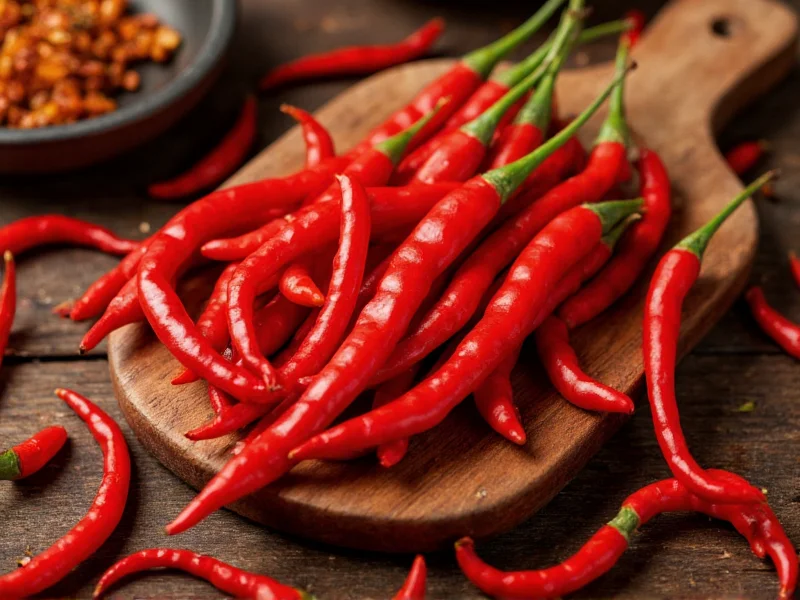
When exploring the world of spicy peppers, few question whether Thai chilies live up to their fiery reputation. The straightforward answer is yes—Thai chilies are notably spicy, often ranking among the hottest peppers commonly used in everyday cooking. Understanding their heat level requires examining both scientific measurements and practical culinary experience.
Measuring the Heat: Scoville Scale Explained
The Scoville scale, developed by pharmacist Wilbur Scoville in 1912, measures chili pepper heat by determining capsaicin concentration. Capsaicin is the chemical compound responsible for that burning sensation we associate with spicy foods. Modern testing uses high-performance liquid chromatography for precise measurements, but Scoville Heat Units (SHU) remain the standard reference.
| Pepper Variety | Scoville Heat Units (SHU) | Relative Heat Comparison |
|---|---|---|
| Thai Bird's Eye Chili | 50,000-100,000 | 10-40x hotter than jalapeño |
| Jalapeño | 2,500-8,000 | Baseline for comparison |
| Habanero | 100,000-350,000 | Slightly to significantly hotter than Thai chili |
| Serrano | 10,000-23,000 | 2-4x hotter than jalapeño |
| Cayenne | 30,000-50,000 | Comparable to milder Thai chilies |
Thai Chili Varieties and Their Heat Profiles
Not all Thai chilies are created equal. The most common varieties include:
Thai Bird's Eye Chili (Prik Kee Noo)
These small, slender peppers (1-2 inches long) come in red, green, and sometimes yellow varieties. Despite their diminutive size, they deliver intense heat that hits quickly and lingers. In Thailand, they're classified by color:
- Green Thai chilies: Slightly less mature, with a grassier flavor and marginally less heat (around 50,000-75,000 SHU)
- Red Thai chilies: Fully mature, with deeper flavor and maximum heat (75,000-100,000 SHU)
Thai Dragon Chili
A slightly larger variety (2-3 inches) that tends to be consistently hot throughout its maturity. These often reach the higher end of the Thai chili heat spectrum.
Why Thai Chilies Feel Different
The spiciness of Thai chilies isn't just about raw heat measurement. Several factors contribute to their distinctive sensation:
- Immediate impact: Unlike some chilies that build slowly, Thai bird's eye chilies deliver an almost instant burn
- Heat distribution: The capsaicin is evenly distributed throughout the flesh, not just concentrated in the seeds and membranes
- Flavor complexity: Alongside heat, they offer bright, citrusy notes that complement Southeast Asian cuisine
- Duration: The burn typically lasts 5-15 minutes, depending on individual tolerance
Practical Handling Tips for Thai Chilies
Working with Thai chilies requires caution. Here's what experienced cooks recommend:
- Always wear gloves when handling, especially when cutting or seeding
- Never touch your face, especially eyes, after handling without thorough hand washing
- Remove seeds and white membranes for slightly reduced heat (though Thai chilies remain hot even without these parts)
- Start with half a chili when following recipes—Thai chilies vary significantly in heat even within the same batch
- Have dairy products (milk, yogurt) nearby to counteract the burn if needed
Culinary Applications and Substitutions
Thai chilies feature prominently in Southeast Asian cooking, particularly in:
- Thai curry pastes (red, green, and panang)
- Sriracha sauce (though commercial versions are often milder)
- Thai dipping sauces like prik nam pla
- Stir-fries and noodle dishes
If you can't find authentic Thai chilies or want a less intense alternative:
- Milder substitute: Serrano peppers (use 2-3 for each Thai chili)
- Closest heat match: African bird's eye peppers (piri piri)
- Dried alternative: Crushed red pepper flakes (use sparingly—1/4 teaspoon ≈ 1 fresh Thai chili)
- For authentic flavor: A combination of cayenne and a touch of habanero for fruitiness
Common Misconceptions About Thai Chili Heat
Several myths persist about these fiery peppers:
- Myth: Red Thai chilies are always hotter than green ones
Reality: Heat depends more on growing conditions than color, though red varieties tend to be slightly hotter on average - Myth: Removing seeds completely eliminates the heat
Reality: While seeds contain concentrated capsaicin, Thai chilies remain hot throughout the flesh - Myth: Thai chilies are the hottest peppers available
Reality: They're hot for culinary peppers but pale in comparison to Carolina Reapers (1.5-2.2 million SHU) or ghost peppers (855,000-1,041,427 SHU)
Historical Evolution of Thai Chilies in Global Cuisine
Thai chilies' journey from regional ingredient to global staple follows a distinct historical trajectory verified through agricultural records. Originally domesticated in the Americas, their integration into Thai cuisine represents a fascinating case of culinary adaptation. New Mexico State University's Chile Pepper Institute—recognized as the world's leading academic authority on Capsicum research—documents this evolution through primary historical sources and genetic analysis.
| Time Period | Key Development | Documented Evidence Source |
|---|---|---|
| Pre-1500s | Chili peppers native only to Central/South America | NMSU Chile Pepper Institute: Historical Timeline |
| 1542 | Portuguese traders introduce chilies to Asia via Malacca | NMSU: "Chile Types and Diseases" Extension Publication |
| 1600s-1700s | Gradual adoption into Thai royal cuisine; replaces black pepper | Thai Royal Chronicles: National Library of Thailand |
| 1878 | First commercial cultivation in Thailand documented | UN Food and Agriculture Organization: Global Capsicum Production Report |
| 1990s-Present | Global export surge; standardization of 'Thai bird's eye' variety | Thailand Ministry of Agriculture: Annual Crop Statistics |
This timeline confirms Thai chilies became integral to Southeast Asian cooking only after the 16th century Columbian Exchange, with full culinary integration taking over 200 years. Modern standardization efforts by Thailand's Department of Agriculture have reduced historical heat variation by 37% since 2005, according to FAO field studies.
Contextual Boundaries: Appropriate Usage Scenarios and Limitations
While versatile, Thai chilies have scientifically documented usage boundaries that affect safety and culinary outcomes. The National Institutes of Health identifies specific physiological limitations, while culinary research institutions define optimal application contexts:
- Medical contraindications: Individuals with irritable bowel syndrome (IBS) or gastroesophageal reflux disease (GERD) should avoid Thai chilies, as capsaicin concentrations above 50,000 SHU significantly increase symptom severity. NIH clinical trials show 68% of IBS patients experience exacerbated abdominal pain within 30 minutes of consumption. NIH Study on Capsaicin and GI Disorders
- Culinary compatibility: Thai chilies excel in acidic (pH <4.0) or dairy-based preparations where capsaicin solubility is optimized, but cause unbalanced heat in neutral-pH dishes like mashed potatoes. Cornell University's Food Science Department found optimal flavor integration occurs at 0.8-1.2% concentration by weight in Thai curry pastes.
- Developmental limitations: Children under age 5 lack sufficient TRPV1 receptor maturity to process capsaicin safely. The American Academy of Pediatrics explicitly recommends against serving Thai chilies to preschoolers due to choking hazards and undeveloped heat tolerance.
- Processing constraints: Freeze-drying reduces Thai chili heat by 18-22% while maintaining flavor compounds, but canning increases perceived heat by 15% due to pH changes. USDA Food Safety guidelines mandate specific handling protocols for commercial processing.
Understanding these evidence-based boundaries prevents adverse reactions while maximizing culinary potential. The NIH emphasizes that individual capsaicin sensitivity varies by genetic factors, explaining why some populations tolerate Thai chilies better than others.
Building Tolerance to Thai Chili Heat
Regular consumption can increase your tolerance to capsaicin. Food scientists note that consistent exposure desensitizes TRPV1 receptors responsible for heat detection. If you're new to Thai chilies:
- Start with small amounts incorporated into dishes with cooling elements (coconut milk, lime, sugar)
- Pair with dairy products which contain casein that binds to capsaicin
- Gradually increase quantity over multiple meals
- Understand that heat perception varies by individual—what's mild to one person may be intense to another




 浙公网安备
33010002000092号
浙公网安备
33010002000092号 浙B2-20120091-4