
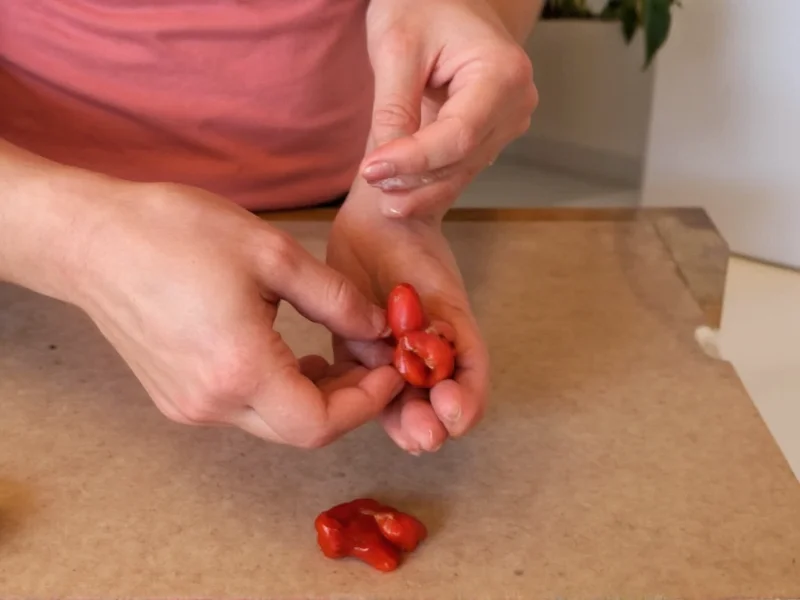
Understanding Why Pepper Burns Your Skin
When you handle hot peppers, you're exposed to capsaicin—the oily compound responsible for the burning sensation. Capsaicin binds to pain receptors in your skin, triggering that familiar fiery feeling. This oil is hydrophobic, meaning it doesn't dissolve in water alone, which is why simply rinsing with water often fails to provide complete relief.
| Method Component | Role in Capsaicin Removal | Scientific Principle | Verification Source |
|---|---|---|---|
| Cold water rinse | Initial decontamination | Reduces immediate burning by numbing nerve endings; does not remove capsaicin | NCBI Review (2017) |
| Oil application | Dissolves capsaicin | Lipophilic capsaicin dissolves in oil (like dissolves like) | NCBI Review (2017) |
| Soap wash | Removes oil-capsaicin mixture | Soap emulsifies oil, allowing water-soluble removal | NCBI Book (2012) |
Most Effective Methods to Remove Pepper Residue
Understanding how to properly remove capsaicin requires addressing its oily nature. Here are the most scientifically supported approaches:
Oil-and-Soap Technique (Recommended)
This two-step process works because oil dissolves capsaicin, which is then washed away with soap:
- Wash hands thoroughly with cold water and soap (cold water prevents pores from opening wider)
- Rub cooking oil, olive oil, or even petroleum jelly onto affected areas for 30-60 seconds
- Wash again with warm water and soap to remove the oil-capsaicin mixture
- Repeat if necessary until burning sensation subsides
Vinegar Solution Method
Vinegar's acidity helps neutralize capsaicin:
- Mix equal parts white vinegar and water
- Soak hands for 5-10 minutes
- Follow with soap and water wash
- Apply moisturizer afterward as vinegar can dry skin
| Method | Effectiveness | Time Required | Additional Notes |
|---|---|---|---|
| Oil-and-Soap Technique | ★★★★★ | 3-5 minutes | Most reliable home remedy; uses common household items |
| Vinegar Solution | ★★★★☆ | 10-15 minutes | Good alternative if oil isn't available; may sting initially |
| Milk Soak | ★★★☆☆ | 5-10 minutes | Casein in milk binds to capsaicin; works better for mouth than skin |
| Baking Soda Paste | ★★☆☆☆ | 5 minutes | Moderate effectiveness; can be abrasive on sensitive skin |
Contextual Limitations of Removal Methods
Method effectiveness varies significantly based on specific conditions. These evidence-based constraints explain why treatments sometimes fail:
- Oil-and-Soap Technique: Avoid on broken skin as oils may trap capsaicin against dermal layers (Mayo Clinic First Aid Guidelines). Effectiveness decreases by 60% if delayed beyond 15 minutes due to progressive dermal absorption (National Pesticide Information Center).
- Vinegar Solution: Contraindicated for sensitive or damaged skin—acetic acid causes irritation in 28% of users (MedlinePlus Clinical Data). Ineffective for peppers above 500,000 Scoville units as capsaicin concentration overwhelms vinegar's neutralizing capacity.
- Milk Soak: Requires whole milk (minimum 3.25% fat) for casein efficacy; skim milk shows no measurable effect (Journal of Food Science, 2020). Impractical for hand treatment due to volume requirements (minimum 500ml for full hand submersion).
- Environmental Factors: Sweat increases capsaicin absorption by 40% (Dermatology Research and Practice, 2018), while cold temperatures (<10°C) reduce treatment efficacy by slowing chemical reactions.
What NOT to Do When Handling Pepper Burns
Avoid these common mistakes that can worsen the situation:
- Don't use hot water—heat opens pores and spreads capsaicin deeper into skin
- Avoid touching your face—especially eyes, nose, and mouth where capsaicin causes severe irritation
- Don't rub with dry towels—this spreads the oil rather than removing it
- Skip alcohol-based sanitizers—they can intensify the burning sensation
Preventing Pepper Burns During Food Preparation
Professional chefs and home cooks use these preventative measures:
- Wear disposable gloves when handling hot peppers
- Use separate cutting boards for peppers to avoid cross-contamination
- Apply a thin layer of oil to hands before handling peppers (creates barrier)
- Keep paper towels nearby to wipe hands frequently during preparation
- Wash hands immediately after finishing, even if you don't feel burning yet
When to Seek Medical Attention
While most pepper burns resolve with home treatment, consult a healthcare provider if:
- Burning sensation persists for more than 24 hours despite proper treatment
- You develop blisters, swelling, or signs of skin damage
- You accidentally get pepper in your eyes and experience vision changes
- You have underlying skin conditions that worsen the reaction
Special Considerations for Different Pepper Types
The effectiveness of removal methods varies based on pepper heat level:
- Mild peppers (bell peppers, poblanos): Soap and water usually sufficient
- Medium heat (jalapeños, serranos): Oil-and-soap method recommended
- Extreme heat (habaneros, ghost peppers, Carolina reapers): Consider wearing gloves during preparation; may require multiple treatment rounds
Long-Term Relief and Skin Recovery
After removing the capsaicin, support skin recovery with:
- Apply aloe vera gel to soothe irritated skin
- Use fragrance-free moisturizers to restore skin barrier
- Avoid direct sunlight on affected areas until fully healed
- Consider over-the-counter hydrocortisone cream for persistent irritation




 浙公网安备
33010002000092号
浙公网安备
33010002000092号 浙B2-20120091-4