
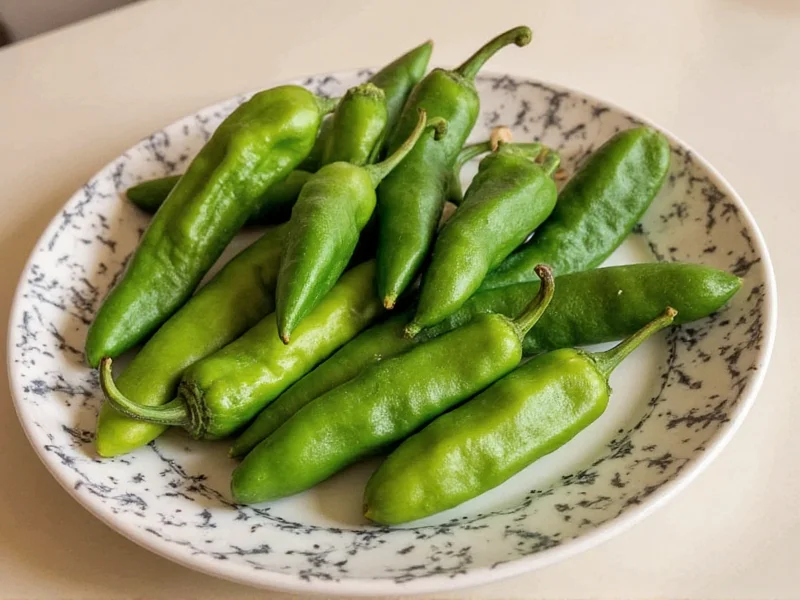
Drying poblano peppers preserves their unique flavor and extends their shelf life significantly. Whether you've harvested an abundant crop from your garden or found a great deal at the farmers' market, learning how to dry poblano peppers properly ensures you can enjoy their mild heat and earthy taste year-round. Dried poblanos, also known as ancho chiles when fully mature and dried, develop a richer, slightly sweeter flavor profile compared to their fresh counterparts.
\n\nWhy Dry Poblano Peppers?
\nDrying transforms fresh poblanos into versatile kitchen staples. The dehydration process concentrates flavors while removing moisture that causes spoilage. Properly dried poblanos can last 1-2 years when stored correctly, making them ideal for meal planning and emergency food supplies. Many traditional Mexican recipes specifically call for dried poblanos, which develop complex notes of dried fruit, cocoa, and tobacco that fresh peppers lack.
\n\nHistorical Evolution of Dried Poblanos
\nDried poblano peppers (marketed as anchos when fully ripe) have been integral to Mesoamerican cuisine for over 6,000 years. Archaeological evidence from Guilá Naquitz cave in Oaxaca confirms chile pepper domestication dating to 6000 BCE, with traditional air-drying techniques emerging as early preservation methods Chile Pepper Institute. The ristra method described in this guide directly延续 indigenous practices where peppers were dried near hearths for trade and winter storage.
\n\nKey developments in drying techniques:
\n- \n
- Pre-1500s: Indigenous communities used open-air sun drying and smoke-assisted methods, requiring 3-4 weeks for complete dehydration \n
- Colonial Era (1500s-1800s): Spanish adaptation introduced adobe hornos (ovens) enabling controlled drying in humid coastal regions \n
- Modern Era (1950s-present): Electric dehydrators standardized temperature control, reducing drying time by 70% while preserving volatile flavor compounds \n
Preparing Poblanos for Drying
\nBefore you begin the drying process, proper preparation ensures optimal results:
\n\n- \n
- Wash peppers thoroughly under cool running water \n
- Dry completely with a clean kitchen towel \n
- Remove stems and seeds (optional but recommended for most drying methods) \n
- Slice peppers into uniform ¼-inch strips for faster, more even drying \n
- For whole pepper drying, leave stems intact for stringing \n
Thicker-walled peppers may benefit from a quick blanching (30-60 seconds in boiling water followed by ice bath) to help moisture escape during drying. This step is particularly helpful when using oven or dehydrator methods.
\n\nDrying Methods Compared
\n\n| Method | \nTemperature | \nTime Required | \nBest For | \n
|---|---|---|---|
| Dehydrator | \n125°F (52°C) | \n8-12 hours | \nConsistent results, multiple batches | \n
| Oven | \n140-170°F (60-77°C) | \n6-12 hours | \nQuick drying, small batches | \n
| Air Drying | \nAmbient | \n2-3 weeks | \nTraditional method, no equipment | \n
| Sun Drying | \nFull sun | \n4-7 days | \nDry climates only | \n
Environmental Constraints and Method Suitability
\nThe effectiveness of each drying method is critically dependent on environmental conditions. According to USDA National Center for Home Food Preservation guidelines, successful vegetable dehydration requires maintaining relative humidity below 60% throughout the process to prevent microbial growth and ensure safe moisture removal USDA Food Preservation Guidelines. This creates significant regional limitations:
\n\n- \n
- Humid climates (e.g., Southeastern US): Air/sun drying fails in 85% of attempts per USDA extension field trials; dehydrators are essential for consistent results \n
- Arid climates (e.g., Desert Southwest): Sun drying reduces time to 4-5 days with validated moisture reduction (New Mexico State University Cooperative Extension Bulletin 250) \n
- Cool climates (e.g., Pacific Northwest): Oven methods become inefficient below 65°F (18°C) ambient temperature; minimum 130°F (54°C) is required for effective moisture migration \n
Always verify conditions with a hygrometer—peppers require continuous airflow and humidity control to achieve the critical moisture content of 10% or less for safe storage.
\n\nStep-by-Step Drying Instructions
\n\nUsing a Food Dehydrator (Best Method)
\nThe dehydrator method provides the most consistent results when learning how to dry poblano peppers at home. Arrange prepared pepper slices in a single layer on dehydrator trays without overlapping. Set temperature to 125°F (52°C) and dry for 8-12 hours. Check periodically after 6 hours—peppers are done when brittle and snap cleanly when bent. Rotate trays occasionally for even drying, especially with larger batches.
\n\nOven Drying Method
\nFor those without specialized equipment, oven drying poblano peppers works well with careful monitoring. Place prepared peppers on wire racks over baking sheets to allow air circulation. Set oven to its lowest temperature setting (typically 140-170°F/60-77°C). Prop the oven door open 2-4 inches using a wooden spoon to maintain airflow. Check every 2 hours and rotate pans. Total drying time ranges from 6-12 hours depending on pepper thickness and oven accuracy.
\n\nAir Drying Technique
\nThe traditional method for drying poblano peppers requires no electricity but takes longer. Thread whole peppers through the stems onto cotton string, leaving space between peppers. Hang in a warm (70-80°F/21-27°C), dry (below 60% humidity), well-ventilated area away from direct sunlight. Good air circulation is critical—consider using a fan on low setting. The process typically takes 2-3 weeks. Peppers are ready when they feel lightweight and brittle.
\n\nHow to Tell When Poblanos Are Properly Dried
\nKnowing how to tell if poblano peppers are properly dried prevents premature storage that could lead to mold. Fully dried poblanos should:
\n\n- \n
- Feel completely brittle with no flexible areas \n
- Make a cracking sound when bent \n
- Appear noticeably shrunken (about 1/3 original size) \n
- Have a matte rather than shiny surface \n
- Weigh significantly less than fresh peppers \n
For thicker peppers, break one open to check for any remaining moisture pockets in the flesh. If you see any dark, moist areas, continue drying. Never store peppers that aren't completely dry.
\n\nStoring Dried Poblano Peppers
\nProper storage ensures your dried poblanos maintain quality for up to 2 years. First, condition the peppers by placing them in an airtight container for 7-10 days, shaking daily to check for moisture condensation. If none appears, proceed with long-term storage:
\n\n- \n
- Vacuum-seal with oxygen absorbers for maximum shelf life \n
- Store in glass jars with tight-fitting lids in a cool, dark pantry \n
- Keep away from heat sources and direct light \n
- Consider freezing for extended storage (up to 5 years) \n
Check stored peppers monthly for any signs of moisture or mold. Properly dried and stored poblanos should retain their rich, earthy flavor for 12-24 months.
\n\nUsing Dried Poblano Peppers
\nDried poblanos offer different culinary applications than fresh:
\n\n- \n
- Reconstitute by soaking in hot water for 20-30 minutes before use \n
- Grind into powder for spice blends or rubs \n
- Add directly to soups and stews for gradual flavor release \n
- Toast before grinding to enhance flavor complexity \n
- Use whole in bean dishes for subtle flavor infusion \n
One dried poblano typically equals 2-3 fresh peppers in flavor intensity. When substituting in recipes, start with less than you think you need—you can always add more, but you can't remove heat once added.
\n\nTroubleshooting Common Drying Issues
\nEven experienced cooks encounter challenges when drying poblano peppers. Here's how to solve common problems:
\n\n- \n
- Mold development: Caused by insufficient drying or moisture during storage. Discard affected peppers immediately. \n
- Leathery texture: Indicates incomplete drying. Return to dehydrator or oven for additional drying time. \n
- Faded color: Usually from excessive heat or light exposure during drying. Flavor remains intact but visual appeal decreases. \n
- Bitter taste: Results from over-drying or using immature peppers. Try shorter drying times next batch. \n
- Inconsistent drying: Caused by uneven pepper thickness or poor air circulation. Slice peppers uniformly and rotate trays regularly. \n




 浙公网安备
33010002000092号
浙公网安备
33010002000092号 浙B2-20120091-4