
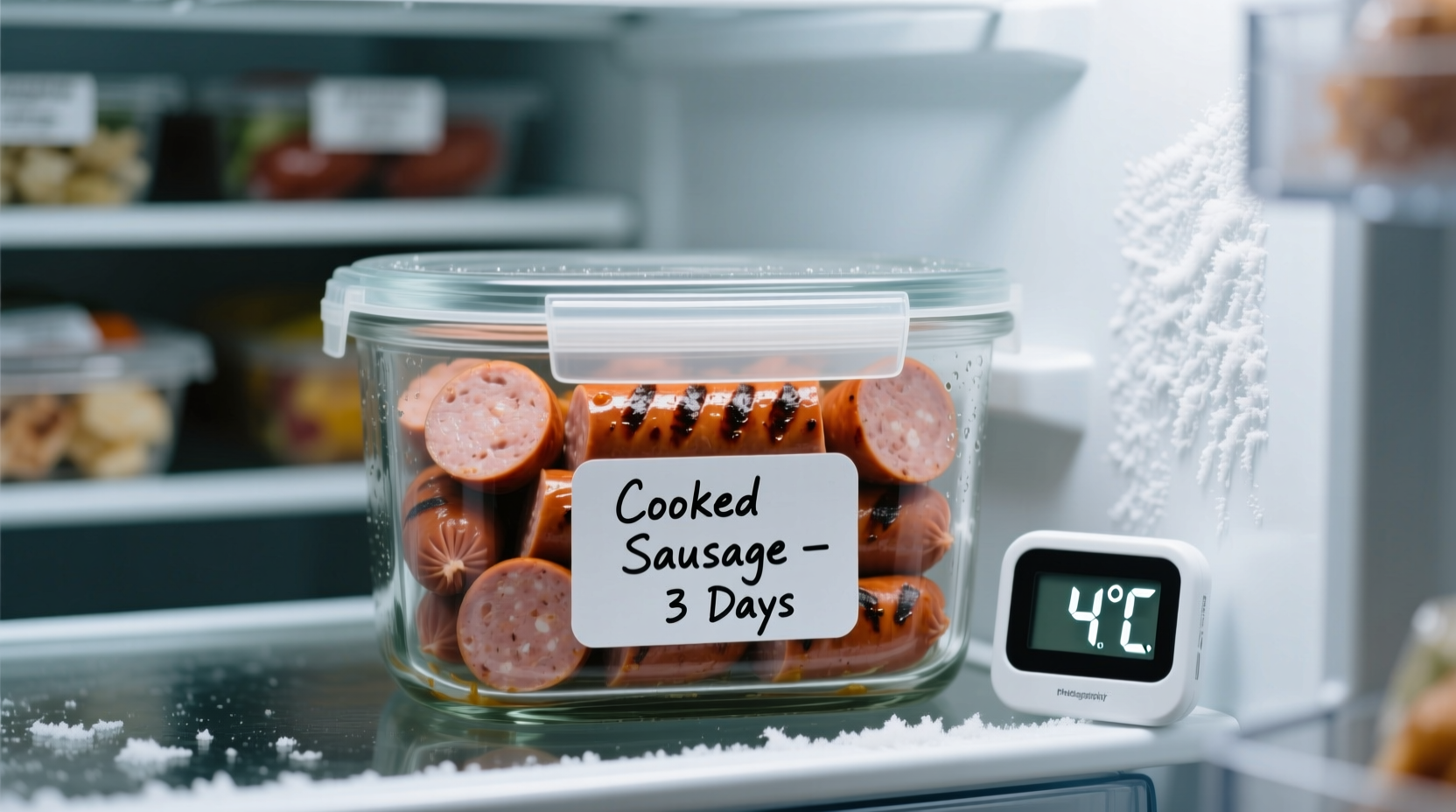
Cooked sausage remains safe to eat for 3-4 days when stored properly in the refrigerator at or below 40°F (4°C). This timeframe applies to most types of cooked sausages including pork, chicken, turkey, and beef varieties when stored in airtight containers or properly wrapped.
Understanding Cooked Sausage Refrigeration Guidelines
Food safety experts consistently recommend consuming cooked sausage within 3-4 days of preparation when stored in the refrigerator. This critical timeframe isn't arbitrary—it's based on scientific understanding of bacterial growth rates in the temperature danger zone (40°F to 140°F or 4°C to 60°C). Beyond this window, even refrigerated cooked sausage becomes increasingly susceptible to harmful bacteria like Salmonella and Listeria that can cause serious foodborne illness.
Many home cooks wonder how long is cooked sausage good for in the refrigerator when they've prepared a large batch. The consistent answer from food safety authorities remains 3-4 days, though several factors can influence this timeline.
Factors That Affect Cooked Sausage Shelf Life
While the standard recommendation is 3-4 days, several variables impact how long your cooked sausage remains safe:
| Factor | Impact on Shelf Life | Recommendation |
|---|---|---|
| Refrigerator temperature | Every degree above 40°F accelerates spoilage | Maintain 35-38°F (1.7-3.3°C) for optimal safety |
| Storage method | Air exposure speeds bacterial growth | Use airtight containers or vacuum sealing |
| Sausage ingredients | Fat content and preservatives affect stability | Pork sausage typically lasts slightly longer than poultry varieties |
| Initial cooking temperature | Undercooked sausage has higher bacterial load | Cook to minimum internal temperature of 160°F (71°C) |
Context-Specific Limitations to Standard Guidelines
While the 3-4 day rule provides a general framework, these specific scenarios require adjusted timelines due to accelerated spoilage risks:
| Scenario | Modified Shelf Life | Critical Consideration |
|---|---|---|
| Refrigerator temperature above 40°F (e.g., 42-45°F) | Reduce to 2-3 days | Every 5°F increase above 40°F doubles spoilage rate (FDA Food Code) |
| Improper cooling (left at room temperature >2 hours) | Count storage time from when properly refrigerated | Initial 2-hour danger zone exposure accelerates spoilage |
| High-humidity environments | May reduce by 1 day | Moisture promotes bacterial growth even in refrigeration |
| Power outages exceeding 4 hours | Discard if temperature exceeded 40°F for >2 hours | Perishables enter danger zone during outage |
These context boundaries highlight why strict adherence to standard guidelines isn't always sufficient. Always verify your specific storage conditions against these parameters. Source: USDA Refrigeration and Food Safety; FDA Food Code 2022.
The Science Behind Sausage Spoilage
Understanding safe storage time for cooked sausage requires knowing what happens at the microbial level. When cooked sausage enters the refrigerator, bacteria don't die—they merely slow their reproduction. The USDA explains that pathogenic bacteria can double in number every 20 minutes in the danger zone. Even in proper refrigeration, certain bacteria continue multiplying slowly.
Research from food safety laboratories shows that after day 3 in the refrigerator, cooked sausage begins accumulating histamine and other spoilage compounds that aren't always detectable by sight or smell. This explains why can you eat cooked sausage after 5 days is a question with a definitive "no" answer from food safety professionals.
Timeline of Cooked Sausage Spoilage in Refrigeration
Understanding the progression of spoilage helps recognize why the 3-4 day rule exists. Based on USDA bacterial growth models and food safety research, here's what occurs during refrigerated storage:
| Time Period | Microbial Development | Safety Status |
|---|---|---|
| Day 0 (properly cooled) | Minimal bacterial presence | Safest consumption window |
| Day 1-2 | Bacterial growth begins but remains below illness thresholds | Safe for consumption; optimal quality |
| Day 3 | Bacterial counts approach levels that may cause illness in vulnerable individuals; early spoilage compounds form | Consume with caution; inspect carefully |
| Day 4+ | Pathogenic bacteria likely at dangerous levels; spoilage compounds accumulate | Discard immediately - high foodborne illness risk |
This timeline illustrates why consuming cooked sausage beyond day 4 poses significant health risks, as pathogenic bacteria may reach dangerous levels even without obvious spoilage signs. Source: USDA Food Safety and Inspection Service (2023). Leftovers and Food Safety.
Proper Storage Techniques for Maximum Freshness
To maximize the 3-4 day window for your cooked sausage, follow these evidence-based storage methods:
- Cool rapidly: Divide large batches into smaller portions to cool faster (within 2 hours of cooking)
- Airtight containment: Use glass containers with tight seals or vacuum-sealed bags
- Strategic placement: Store on middle refrigerator shelves, not in the door where temperatures fluctuate
- Label everything: Note cooking date with permanent marker directly on packaging
Many consumers ask about the proper way to store cooked sausage when they've purchased pre-cooked varieties. The same principles apply—treat store-bought cooked sausage as if you prepared it yourself, counting the 3-4 day window from when you opened the package.
Recognizing Spoilage: Beyond the Clock
While the 3-4 day rule provides a safety baseline, always inspect cooked sausage before consumption. Trust these sensory indicators over calendar dates:
- Visual changes: Grayish color, mold spots (white, green, or black), or slimy film
- Odor indicators: Sour, ammonia-like, or generally "off" smell (even if within 4 days)
- Texture alterations: Sticky or slippery surface when properly refrigerated
When in doubt about how to tell if cooked sausage has gone bad, follow the food safety maxim: "When you're not sure, throw it out." Consuming questionable sausage risks serious gastrointestinal illness that outweighs any potential food waste.
Extending Shelf Life Through Freezing
If you won't consume cooked sausage within 3-4 days, freezing provides a safe alternative. Properly frozen cooked sausage maintains quality for 2-3 months. For best results:
- Portion into meal-sized servings before freezing
- Use freezer-safe containers or heavy-duty freezer bags
- Remove as much air as possible to prevent freezer burn
- Thaw overnight in the refrigerator, not at room temperature
Freezing effectively pauses bacterial growth, making it the only reliable method to extend beyond the standard cooked sausage shelf life guidelines. Never refreeze sausage that has been thawed at room temperature.
Special Considerations for Different Sausage Types
While the 3-4 day rule applies broadly, certain sausage varieties have specific considerations:
- Pork sausage: Typically maintains quality slightly longer than poultry varieties
- Poultry sausage (chicken/turkey): More perishable; consider using within 3 days
- Smoked sausage: The smoking process adds some preservation, but still follows standard guidelines
- Vegetarian sausage: Often contains soy or other ingredients that may spoil faster
Regardless of type, always follow the same food safety protocols. The question how long does cooked sausage keep in the fridge has the same fundamental answer across varieties, though subtle differences exist in quality degradation rates.
Food Safety Authority Recommendations
Multiple food safety organizations align on cooked sausage refrigeration guidelines:
- USDA Food Safety and Inspection Service: "Use cooked sausage within 3 to 4 days when refrigerated at 40°F or below." (2023)
- FDA Food Code: Specifies 72 hours as the maximum for cooked meat products under proper refrigeration
- CDC Food Safety Guidelines: Emphasizes that "when in doubt, throw it out" applies particularly to cooked meats
These agencies consistently warn against consuming cooked sausage beyond the 4-day mark, regardless of apparent condition. Pathogenic bacteria that cause foodborne illness often don't produce noticeable changes in food appearance or odor.




 浙公网安备
33010002000092号
浙公网安备
33010002000092号 浙B2-20120091-4