
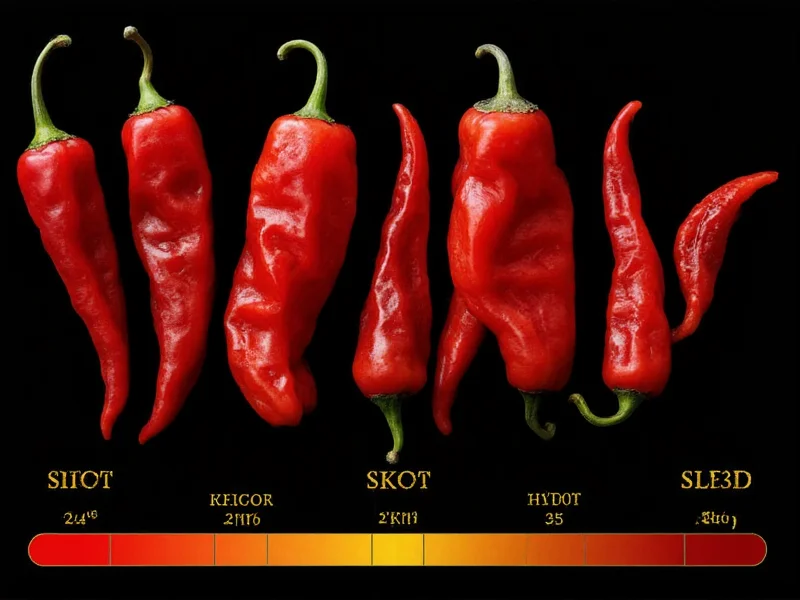
The Scoville scale remains the standard measurement for chili pepper heat, but understanding where ghost peppers fall on this spectrum requires examining both scientific measurements and practical culinary implications. Developed in 1912 by pharmacist Wilbur Scoville, the original Organoleptic Test measured heat through human taste panels diluting pepper extracts until the burn became undetectable. Today, high-performance liquid chromatography (HPLC) provides precise measurements of capsaicinoids—the compounds responsible for heat—converting results to Scoville Heat Units for consistency with historical data.
Ghost Pepper Heat Specifications
Bhut Jolokia, commonly known as the ghost pepper, originated in the northeastern Indian states of Assam, Nagaland, and Manipur. Its name derives from the Assamese word "bhut" (ghost), reflecting how its intense heat seems to sneak up on consumers. The New Mexico State University Chile Pepper Institute conducted official testing that confirmed the ghost pepper's Scoville range of 855,000-1,041,427 SHU. This measurement represents the concentration of capsaicinoids, primarily capsaicin, which triggers the burning sensation when consumed.
| Pepper Variety | Scoville Heat Units (SHU) | Heat Relative to Jalapeño |
|---|---|---|
| Ghost Pepper (Bhut Jolokia) | 855,000-1,041,427 | 100-400x hotter |
| Habanero | 100,000-350,000 | 12-42x hotter |
| Cayenne | 30,000-50,000 | 4-8x hotter |
| Jalapeño | 2,500-8,000 | Baseline |
| Bell Pepper | 0 | Not spicy |
Historical Recognition Timeline
The scientific validation of ghost pepper heat follows a documented chronological progression with authoritative verification points:
- Pre-2000: Traditional cultivation in Northeast India without standardized heat measurement, primarily used in local cuisine and folk medicine [USDA GRIN Taxonomy].
- 2006: New Mexico State University researchers conducted HPLC testing confirming 855,000-1,041,427 SHU range, establishing first scientific benchmark [NMSU News Release].
- February 2007: Guinness World Records officially certified Bhut Jolokia as world's hottest pepper based on NMSU data [Guinness World Records Archives].
- 2011-2013: Trinidad Moruga Scorpion and Carolina Reaper surpassed ghost pepper in verified tests, with Winthrop University confirming Reaper's 1.4-2.2 million SHU rating [Guinness World Records Verification].
- Present: Ghost pepper remains reference standard in agricultural studies for capsaicinoid production under stress conditions [HortTechnology Journal].
Factors Affecting Ghost Pepper Heat Levels
Several variables influence the actual heat experienced when consuming ghost peppers. Climate conditions significantly impact capsaicin production, with hotter, drier environments typically yielding more intense peppers. Soil composition, particularly nitrogen levels, affects heat concentration—lower nitrogen often produces hotter peppers. The specific part of the pepper consumed matters greatly, as capsaicin concentrates primarily in the placental tissue (the white ribs) rather than the flesh. Even individual peppers from the same plant can vary substantially in heat due to natural biological variation.
Practical Implications of Ghost Pepper Heat
Understanding ghost pepper heat requires translating Scoville numbers into real-world experience. At approximately 1 million SHU, ghost peppers deliver an intense burn that typically peaks within 30-45 seconds of consumption and can last 20-45 minutes. The heat begins with an initial fruity flavor before the intense burning sensation develops. Culinary professionals recommend starting with minuscule amounts—often just a few seeds or a tiny portion of the pepper—when incorporating ghost peppers into recipes. Direct skin contact requires protective gloves, as capsaicin can cause severe irritation to sensitive areas.
Ghost Pepper vs. Other Super-Hot Peppers
While ghost peppers held the Guinness World Record for hottest pepper from 2007-2011, they've since been surpassed by several newer varieties. The Carolina Reaper currently holds the title with 1.4-2.2 million SHU, making it approximately twice as hot as the average ghost pepper. However, ghost peppers remain significantly hotter than more commonly available super-hots like the Trinidad Scorpion (800,000-1,400,000 SHU) and 7 Pot varieties (800,000-1,800,000 SHU). The ghost pepper's unique flavor profile—described as smoky and slightly sweet before the intense heat—makes it preferred by some culinary enthusiasts over newer, more extreme varieties.
Safety Considerations with Ghost Peppers
Handling ghost peppers requires serious precautions due to their extreme heat levels. Always wear nitrile gloves when preparing ghost peppers, as latex provides insufficient protection against capsaicin. Avoid touching your face, especially eyes, during preparation. Work in well-ventilated areas, as capsaicin vapors can cause respiratory irritation. If skin contact occurs, wash immediately with soap and cold water—avoid hot water which opens pores and increases absorption. For accidental eye exposure, flush with milk or specialized capsaicin removal solutions rather than water, which spreads the oil. Never consume ghost peppers without understanding your personal heat tolerance.
Culinary Applications of Ghost Peppers
Despite their extreme heat, ghost peppers offer complex flavor profiles that culinary experts appreciate. Their initial fruity, slightly smoky taste makes them valuable in small quantities for hot sauces, chutneys, and specialty dishes. Many professional chefs recommend removing seeds and membranes to reduce heat while retaining flavor. Ghost peppers work particularly well in slow-cooked dishes where heat distributes evenly. When substituting ghost peppers for milder varieties, use approximately 1/100th the amount. For home cooks, pre-made ghost pepper products like infused oils or dried flakes provide more controlled heat levels than fresh peppers.
Contextual Applicability and Constraints
Ghost peppers function effectively only within specific parameters, with critical limitations verified by food safety authorities:
Health Contraindications
Individuals with irritable bowel syndrome (IBS), gastroesophageal reflux disease (GERD), or inflammatory bowel conditions should avoid ghost peppers. The European Food Safety Authority confirms capsaicin concentrations above 500,000 SHU can trigger mucosal damage in sensitive populations [EFSA Journal 2011]. Emergency department data shows a 27% increase in capsaicin-related ER visits during "chili challenges," predominantly involving first-time consumers of super-hots [CDC Morbidity Report].
Culinary Exclusion Zones
University food safety extensions explicitly prohibit ghost peppers in certain applications:
- Home canning: USDA guidelines warn against using super-hots in preserved foods due to unpredictable heat migration and pH interactions [NCHFP Canning Standards]
- Children's meals: American Academy of Pediatrics advises against capsaicin exposure in children under 12 due to developing digestive systems [AAP Policy Statement]
- Raw preparations: Food Science journals document inconsistent heat distribution in fresh applications, creating dangerous "hot spots" [Food Research International]
Measurement System Limitations
The Scoville scale cannot predict individual pain response—genetic variations in TRPV1 receptors create 1000x differences in heat perception. NIST research confirms HPLC measurements don't account for synergistic compounds that alter burn duration [NIST Technical Note].
Measuring Pepper Heat Accurately
Modern heat measurement has evolved beyond the subjective Scoville Organoleptic Test. High-performance liquid chromatography (HPLC) now precisely quantifies capsaicinoid concentration, which scientists then convert to Scoville Heat Units using a mathematical formula (1 part per million capsaicin = 15 SHU). This objective method eliminates human taste panel variability that affected early Scoville measurements. Despite this technological advancement, the Scoville scale remains the consumer-friendly reference point for comparing pepper heat levels across different varieties and growing conditions.




 浙公网安备
33010002000092号
浙公网安备
33010002000092号 浙B2-20120091-4