
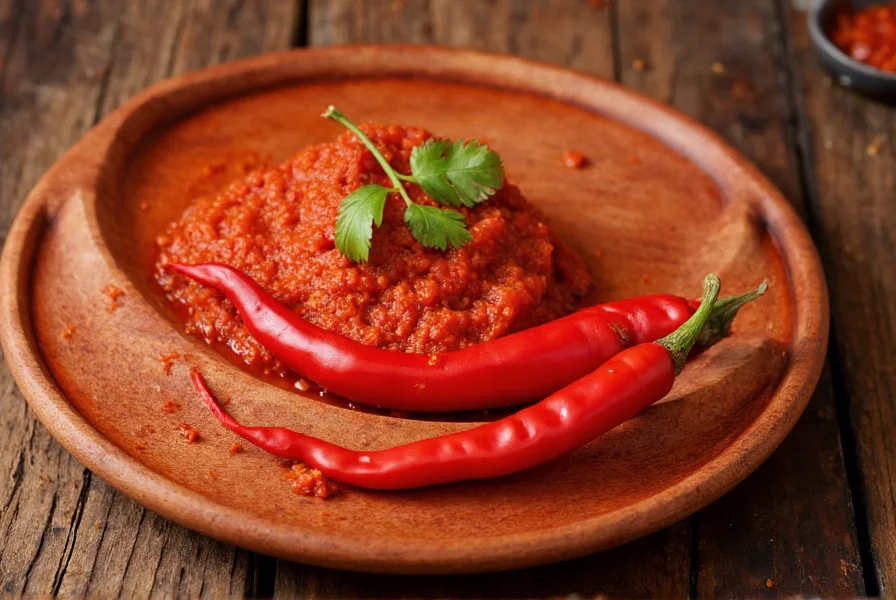
Hot Pepper Paste Isn’t a Flavor Anchor—It’s a Timing Switch
Most people treat hot pepper paste like a spice blend: something to add early, adjust for intensity, then move on. That assumption comes from seeing it used in restaurant videos—where mise en place is rigid, timing is choreographed, and paste is pre-toasted or pre-mixed into base sauces. At home, though, the reality is messier: a child interrupts mid-stir, the stove burner fluctuates, the same jar sits open for three weeks in a humid pantry. The consequence? A stew that tastes vaguely ‘off’—not burnt, not bland, but emotionally flat, like the flavor arrived late to its own party. It’s rarely the paste itself that fails. It’s the mismatch between when the paste’s volatile compounds activate and when the rest of the dish reaches thermal readiness.
Hot pepper paste stops being a critical variable the moment your cooking window exceeds 20 minutes and you’re using it solely for background warmth—not upfront punch. That includes slow-simmered stews, braised meats with long collagen breakdown, or any dish where aromatics are sautéed separately and folded in later. In those cases, the paste’s capsaicin and fermented notes integrate passively; its exact origin (Korean gochujang vs. Turkish biber salçası) or age (6-month-old vs. freshly opened) rarely shifts the outcome. What matters instead is whether it’s added before or after the liquid hits simmer—and even that distinction blurs if the pot spends more than 45 minutes covered at low heat.
First invalid fixation: whether the paste is ‘fermented enough’. Home cooks scan labels for ‘aged 12 months’ or check for visible mold bloom, assuming fermentation depth dictates depth of flavor. But in practice, fermentation maturity only affects raw-taste nuance—not how the paste behaves once heated past 140°F. Second invalid fixation: stirring technique—whether to ‘bloom’ it in oil for exactly 90 seconds. That ritual makes sense in a wok over 30,000 BTU, but in a standard electric stove with uneven heating, the difference between 70 and 110 seconds is undetectable in the final dish. Both fixations consume mental bandwidth without altering texture, aroma persistence, or family acceptance.
The real constraint isn’t heat control or shelf life—it’s fridge real estate. Most households store hot pepper paste in the door, where temperature swings between 38°F and 45°F daily. That variation doesn’t spoil it, but it destabilizes the emulsion of chili solids, oil, and starch—causing separation that looks like spoilage but is actually just phase drift. When scooped and stirred back in, it performs fine. But if you’re already juggling picky eaters, a tight budget, and a single working burner, that visual ‘offness’ triggers doubt—and doubt leads to discarding half the jar. That’s where actual waste happens, not from under-toasting or mis-timing.
In a weeknight stir-fry with frozen vegetables: add paste in the last 90 seconds—no blooming, no oil prep. Its brightness cuts through freezer taste, and delay prevents scorching. In a Sunday lentil soup made ahead: stir it in cold, off-heat, just before serving—fermentation byproducts stay volatile, aroma lifts the whole bowl. In a marinade for grilled chicken: mix it with acid (vinegar or citrus) at least 2 hours before cooking—acid halts enzymatic degradation, so heat exposure later doesn’t mute fruitiness. None of these choices depend on ‘authenticity’, brand, or fermentation age. They depend only on how much thermal buffer exists between addition and serving.
Here’s the quieter truth: if your kitchen has one reliable burner, no sous-vide setup, and meals are served within 25 minutes of starting, hot pepper paste functions less like an ingredient and more like a tempo marker. You’re not seasoning food—you’re calibrating arrival time for pungency. That means the ‘right’ choice isn’t the most complex paste, but the one whose viscosity lets you control release: thicker pastes (like gochujang) hold back heat until fully dispersed; thinner ones (like harissa) broadcast immediately. That physical behavior—not origin, not Scoville, not fermentation length—is what actually moves the needle in daily use.
| What people fixate on | What it affects | When it matters | When it doesn't |
|---|---|---|---|
| Fermentation age (e.g., '6-month aged') | Raw aroma complexity | When used uncooked (e.g., dipping sauce) | When heated above 160°F for >2 min |
| Exact brand origin (Korean vs. Middle Eastern) | Regional flavor expectation | When replicating a specific dish from memory | When adapting a recipe to pantry staples |
| Oil-blooming duration | Initial fragrance burst | In high-BTU wok cooking with dry aromatics | In electric stovetop sautés with onions & garlic |
| Viscosity (thick vs. runny) | Heat dispersion speed | In fast-cooked dishes (<8 min total) | In slow-simmered soups (>45 min) |
Quick verdicts for home cooks
- If dinner must be ready in 15 minutes and you’re using frozen protein, skip blooming—add paste at the very end to preserve brightness.
- If you’re making soup for leftovers, stir paste in cold, right before serving—heat stability matters less than aromatic lift.
- If your fridge door is warm and the paste separates, stir it back in—phase drift isn’t spoilage, and it performs fine.
- If two kids refuse spice but one loves heat, use a milder paste and add extra at the table—uniformity isn’t required in home service.
- If you’re marinating meat overnight, mix paste with vinegar first—acid protects fruit notes from heat degradation later.
- If your only pot has uneven heating, choose a thinner paste—it disperses faster and avoids localized scorching.
FAQ
Why do people think fermentation age determines cooking performance?
Because tasting raw paste reveals layered sweetness and funk—but those compounds break down rapidly above 160°F. What survives heat is mostly capsaicin and Maillard-ready sugars, not fermentation markers.
Is it actually necessary to bloom hot pepper paste in oil before adding other ingredients?
No—unless you’re wok-cooking over professional heat. On standard stoves, blooming adds negligible flavor gain but increases risk of scorching and cleanup friction.
What happens if you ignore viscosity differences between pastes?
In fast dishes, thick paste clumps and burns before dispersing; thin paste floods the pan too early, muting other aromatics. In slow dishes, viscosity evens out—no practical effect.
Lately, home cooks have stopped asking “Which hot pepper paste is best?” and started asking “When does this paste *stop* being useful?” That shift—from identity to function—signals the real turning point. It’s not about upgrading your jar. It’s about recognizing that hot pepper paste isn’t a static ingredient. It’s a thermal relay: it waits, it releases, it adapts—or it doesn’t. Your job isn’t to master it. It’s to know when to let it wait.




 浙公网安备
33010002000092号
浙公网安备
33010002000092号 浙B2-20120091-4