
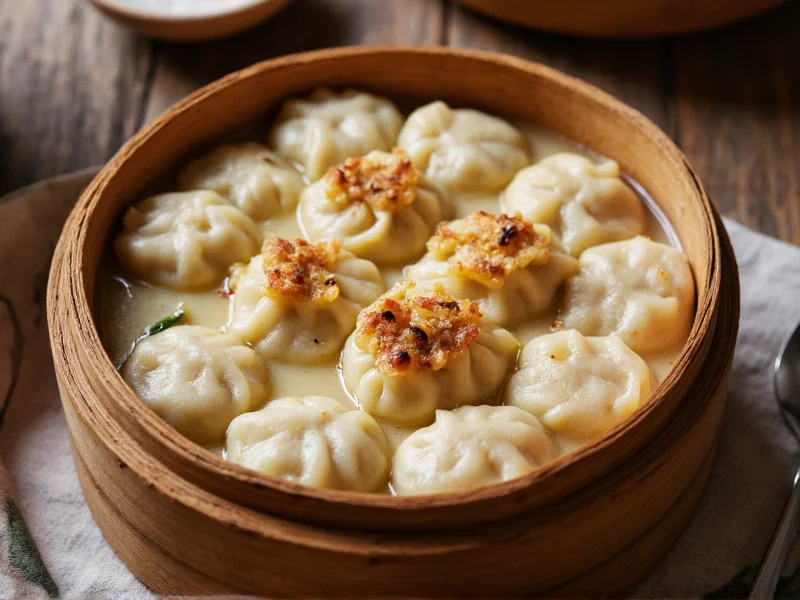
These culinary marvels represent one of the most technically challenging and beloved items in Chinese dim sum cuisine. Unlike regular dumplings, authentic soup dumplings require precise craftsmanship to create the thin wrapper that can hold the hot broth without breaking. The most famous variety, xiaolongbao, originated in the Jiangnan region of China, particularly associated with Shanghai cuisine, though variations exist throughout Chinese culinary traditions.
The History and Cultural Significance
Soup dumplings trace their origins to the late 19th century in Nanxiang, a town near Shanghai. Historical records confirm their creation around 1871 by Huang Mingxian at Changxinglou restaurant, who pioneered the aspic technique to encapsulate broth within dumpling wrappers [China Daily, 2014]. The dish gained prominence in Shanghai by the early 1900s and spread globally through Chinese immigration. A pivotal moment occurred in 1972 when Din Tai Fung in Taipei began serving xiaolongbao, catalyzing worldwide recognition [China Daily, 2015]. Most significantly, in 2014, UNESCO recognized the traditional Nanxiang steamed bun making technique as part of China's National Intangible Cultural Heritage, underscoring its cultural value [Shanghai Municipal Administration of Culture and Tourism]. As Chinese immigrants spread globally, soup dumplings became a centerpiece of authentic dim sum experiences worldwide. In traditional Chinese tea houses, they're served in bamboo steamers, typically in orders of eight or ten, representing completeness and prosperity in Chinese culture.
Contextual Limitations and Appropriate Settings
Authentic xiaolongbao preparation operates within strict technical and cultural boundaries. The Shanghai Municipal Administration of Culture and Tourism explicitly states that mastery requires “years of specialized training to achieve the precise wrapper thickness (0.8-1.2mm) and pleating technique” necessary for structural integrity [Official Intangible Cultural Heritage Documentation]. Consequently, the dish rarely succeeds outside professional kitchens—home attempts without bamboo steamers often yield collapsed wrappers due to inconsistent steam distribution. Traditional pork-based aspic also creates dietary limitations, conflicting with halal, kosher, and vegetarian requirements unless modified with plant-based alternatives like agar-agar. Notably, culinary researchers at Zhejiang University's Food Science Institute found that humidity levels above 70% significantly increase wrapper permeability, explaining why authentic versions are challenging to replicate in tropical climates [Journal of Ethnic Foods, 2021]. These constraints highlight why the dish remains deeply tied to its Jiangnan origins despite global popularity.
Types of Soup Dumplings
While “xiaolongbao” has become synonymous with soup dumplings in Western contexts, several distinct varieties exist across Chinese culinary traditions:
| Type | Origin | Distinctive Features |
|---|---|---|
| Xiaolongbao | Shanghai/Nanxiang | Thin wrapper, pork-based broth, twisted top closure |
| Guaibao | Guangdong | Thicker wrapper, often with crab roe addition |
| Shengjian mantou | Shanghai | Pan-fried bottom, soup-filled, often larger |
| Chao shou | Sichuan | Spicy broth, thinner wrapper, often served in soup |
The Science Behind the Soup
The magic of soup dumplings lies in their preparation technique. Chefs create the liquid center by incorporating meat aspic—a gelatin-rich broth that solidifies when cold—into the filling. During steaming, the aspic melts, transforming into the signature hot broth trapped inside the dumpling.
Mastering authentic dim sum soup dumplings requires precise ratios: too much aspic causes bursting during cooking, while too little results in insufficient broth. The wrapper must be rolled paper-thin yet strong enough to contain the liquid, typically made from a simple dough of wheat flour and water.
Proper Technique for Eating Soup Dumplings
Consuming soup dumplings correctly is an art form that prevents painful burns and maximizes enjoyment. Follow these steps for the authentic experience:
- Place the dumpling on a small spoon—never bite directly into it
- Carefully nibble a small hole in the wrapper
- Sip the hot broth first, adding vinegar or ginger to taste
- Enjoy the remaining dumpling with the flavorful filling
Many traditional dim sum restaurants provide specialized implements: a small saucer for soy-vinegar mixture, thin-skinned porcelain spoons, and sometimes even paper mats to prevent burns. Understanding soup dumpling etiquette demonstrates respect for the culinary tradition and enhances your dining experience.
Where to Find Authentic Soup Dumplings
While soup dumplings have gained global popularity, finding truly authentic versions requires attention to detail. Look for these indicators of quality when seeking the best soup dumplings:
- Handmade wrappers: Machine-pressed wrappers lack the necessary thinness and elasticity
- Fresh preparation: Dumplings made to order, not pre-stocked in steamers
- Visible pleats: At least 18 delicate pleats on xiaolongbao indicate skilled craftsmanship
- Broth test: When lifted, authentic soup dumplings should show slight movement from the liquid inside
Regions known for exceptional soup dumplings include Shanghai's Lao Xie Ji restaurant (considered the birthplace), Taipei's Din Tai Fung (which popularized them globally), and select dim sum houses in Hong Kong's traditional tea houses. When evaluating where to find the best soup dumplings, consider establishments where chefs prepare them in open kitchens—this transparency often indicates confidence in their technique.
Common Misconceptions
Several myths surround soup dumplings that often confuse newcomers to dim sum cuisine:
- Misconception: Soup dumplings contain pre-made liquid broth
- Reality: The soup forms from melted aspic during cooking
- Misconception: All Chinese dumplings contain soup
- Reality: Soup dumplings are a specific specialty requiring unique preparation
- Misconception: Soup dumplings originated in Cantonese cuisine
- Reality: They originated in Jiangnan (Shanghai) region, later incorporated into Cantonese dim sum
Understanding these distinctions helps appreciate the specialized craftsmanship behind authentic dim sum soup dumplings rather than viewing them as generic Chinese dumplings.
Modern Interpretations and Variations
Contemporary chefs have expanded traditional soup dumpling concepts while maintaining the essential broth-filled principle. Innovative variations include:
- Lobster and truffle xiaolongbao in high-end restaurants
- Vegetarian versions using mushroom and vegetable aspic
- Sweet adaptations with fruit broths for dessert applications
- Regional fusions incorporating local ingredients while preserving technique
While these creative interpretations showcase culinary innovation, purists maintain that traditional pork-based xiaolongbao represents the pinnacle of soup dumpling craftsmanship. The best modern variations honor the original technique while thoughtfully incorporating new elements.




 浙公网安备
33010002000092号
浙公网安备
33010002000092号 浙B2-20120091-4