
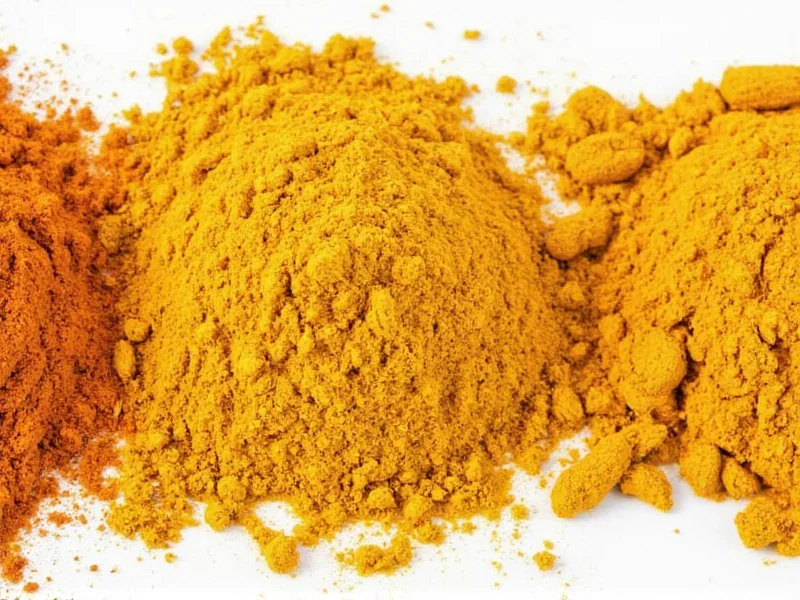
When exploring the world of spices, many home cooks and health-conscious individuals find themselves confused about the relationship between curry powder and turmeric. Despite their visual similarities and frequent association in Indian cuisine, these two ingredients serve distinctly different purposes in both cooking and wellness applications. Understanding their unique properties helps maximize their culinary potential and health benefits.
What Exactly Is Turmeric?
Turmeric (Curcuma longa) is a flowering plant in the ginger family, native to Southeast Asia and the Indian subcontinent. The part used as a spice comes from the plant's rhizome, which is boiled, dried, and ground into a deep orange-yellow powder. This vibrant spice contains curcuminoids, with curcumin being the most active compound responsible for turmeric's potent anti-inflammatory and antioxidant properties.
Unlike what many believe, turmeric itself has a relatively mild, earthy flavor with subtle bitter notes and a slight peppery warmth. Its primary culinary contribution is color rather than dominant flavor. Fresh turmeric root resembles ginger but with bright orange flesh, while the dried powder delivers that signature golden hue to dishes.
Understanding Curry Powder Composition
Curry powder isn't a single spice but rather a Western-created blend designed to approximate the complex flavors found in various Indian and Southeast Asian curry dishes. The exact composition varies significantly by brand and region, but typically includes:
- Turmeric (providing color)
- Coriander (citrusy, nutty notes)
- Cumin (earthy warmth)
- Fenugreek (slightly sweet, maple-like)
- Chili powder or cayenne (heat)
- Black pepper (enhances curcumin absorption)
- Additional spices like cardamom, cloves, or mustard seed
Historically, the term "curry powder" emerged during British colonial rule in India as a convenient way to bottle the complex spice mixtures used in regional Indian cooking. No traditional Indian kitchen actually uses "curry powder" as a standard ingredient—instead, cooks create fresh blends for specific dishes.
Historical Evolution: From Colonial Adaptation to Global Staple
Curry powder's development reflects colonial culinary adaptation with distinct evolutionary phases:
- Pre-18th Century: Indian cuisine relied on region-specific fresh spice blends; no standardized "curry powder" existed in traditional cooking practices
- 1780s: British entrepreneurs like Crosse & Blackwell began commercial production in London to replicate Indian flavors for colonial administrators returning home
- 19th Century: Became a British pantry staple, with recipes appearing in cookbooks like Mrs. Beeton's (1861); Indian cooks in Britain modified blends for local palates
- 20th Century: Global variations emerged—Japanese curry powder (sweeter, with apple) developed in the 1950s, while Thai curry pastes maintained distinct fresh-herb formulations
This trajectory is well-documented in historical archives such as the British Library's examination of curry's journey through the British Empire (British Library, Empire Stories).
Key Differences Between Curry Powder and Turmeric
The most fundamental distinction lies in their composition: turmeric is a single spice, while curry powder is a multi-spice blend containing turmeric as one component. This difference creates several practical implications for cooking and health applications.
| Characteristic | Turmeric | Curry Powder |
|---|---|---|
| Composition | Single spice (ground rhizome) | Blend of 5-20+ spices |
| Primary Flavor Profile | Earthy, slightly bitter, mild | Complex, warm, often spicy |
| Color Contribution | Vibrant yellow-orange | Yellow-orange (less intense) |
| Curcumin Content | 2-8% (varies by source) | Approximately 15-25% of blend |
| Typical Culinary Use | Coloring agent, subtle flavor | Primary flavor base for dishes |
Nutritional and Health Benefits Comparison
Both ingredients offer health benefits, but their profiles differ significantly due to composition. Turmeric contains the highest concentration of curcumin, the compound studied for its anti-inflammatory effects. Clinical evidence indicates curcumin may reduce inflammatory markers; a 2017 meta-analysis of randomized trials found significant decreases in biomarkers like TNF-α and IL-6 (Daily et al., 2017). However, curcumin's effectiveness is limited by poor bioavailability, which can be improved 20-fold when combined with piperine from black pepper (Shoba et al., 1998).
Curry powder provides a broader spectrum of beneficial compounds from its various spices. For example:
- Cumin in curry powder contains cuminaldehyde, which may support digestion
- Coriander offers linalool, potentially beneficial for blood sugar regulation
- Black pepper (often included) contains piperine, which enhances curcumin absorption by approximately 20-fold (Shoba et al., 1998)
When evaluating turmeric versus curry powder for inflammation reduction, pure turmeric generally provides more concentrated curcumin. However, the complete spice profile in curry powder offers synergistic health benefits through the combination of multiple bioactive compounds—a concept known as the "entourage effect" in phytochemistry.
Culinary Applications and Contextual Guidelines
Understanding contextual boundaries prevents common cooking mistakes. Turmeric functions best as a coloring agent with minimal flavor impact, making it ideal for:
- Golden milk or smoothies (where color and mild earthiness are desired)
- Rice dishes like biryani (for color without overpowering)
- Mustard preparation (traditional yellow hue)
However, turmeric alone cannot replicate curry flavor and excessive use may impart bitterness. Its health benefits are also limited without proper formulation—curcumin requires fat and black pepper for absorption, as confirmed by pharmacokinetic studies.
Curry powder serves as a complete flavor base but has inherent constraints:
- Authentic regional Indian dishes typically use fresh spice blends, not pre-mixed curry powder
- Flavor profiles vary widely by brand (e.g., Madras curry powder is spicier than mild Anglo-Indian blends)
- Not suitable for dishes requiring fresh herb notes (e.g., Thai green curry uses cilantro and kaffir lime)
As emphasized by food scientists at Purdue University, "curry powder is a Western convenience product that simplifies but cannot fully replicate the complexity of regionally-specific Indian spice mixtures" (Purdue University, Spices and Herbs).
When following recipes:
- Never substitute equal amounts of turmeric for curry powder (you'll get overwhelming color with minimal flavor)
- For curry powder substitution, use 1 teaspoon turmeric plus 1 teaspoon each of cumin and coriander plus a pinch of cayenne
- When a recipe calls specifically for turmeric, don't replace it with curry powder (you'll alter the intended flavor profile)
Professional chefs often recommend toasting curry powder in oil before adding liquids to release its essential oils and deepen the flavor—a technique unnecessary with pure turmeric due to its simpler composition.
Storage Recommendations for Maximum Freshness
Both spices lose potency over time, but their storage requirements differ slightly due to composition. Turmeric maintains quality for 2-3 years when stored properly in an airtight container away from light and heat. Its single-compound nature makes it slightly more stable than complex blends.
Curry powder, with its multiple components, typically remains fresh for 1-2 years. The volatile oils in spices like coriander and cumin degrade faster than turmeric's curcuminoids. For optimal flavor preservation:
- Store both in dark glass containers rather than plastic
- Keep away from stovetops and other heat sources
- Consider freezing turmeric in small portions for long-term storage
- Buy curry powder in smaller quantities more frequently due to faster degradation
When evaluating freshness, rub a small amount between your fingers—fresh spices should leave a strong aroma on your skin. Stale turmeric loses its vibrant color, while old curry powder develops a flat, one-dimensional flavor.
Addressing Common Misconceptions
Several myths persist about these ingredients that affect how people use them. Many believe that "curry" refers to a specific spice rather than a category of dishes—this misunderstanding leads to incorrect substitutions. Others assume turmeric and curry powder offer identical health benefits, overlooking how the additional spices in curry powder create different physiological effects.
Another common error involves using turmeric medicinally without proper formulation. While turmeric contains curcumin, the compound has poor bioavailability on its own. Traditional preparations often combine turmeric with black pepper and fats to enhance absorption—a principle reflected in authentic curry preparations but missing when using plain turmeric powder alone.




 浙公网安备
33010002000092号
浙公网安备
33010002000092号 浙B2-20120091-4