
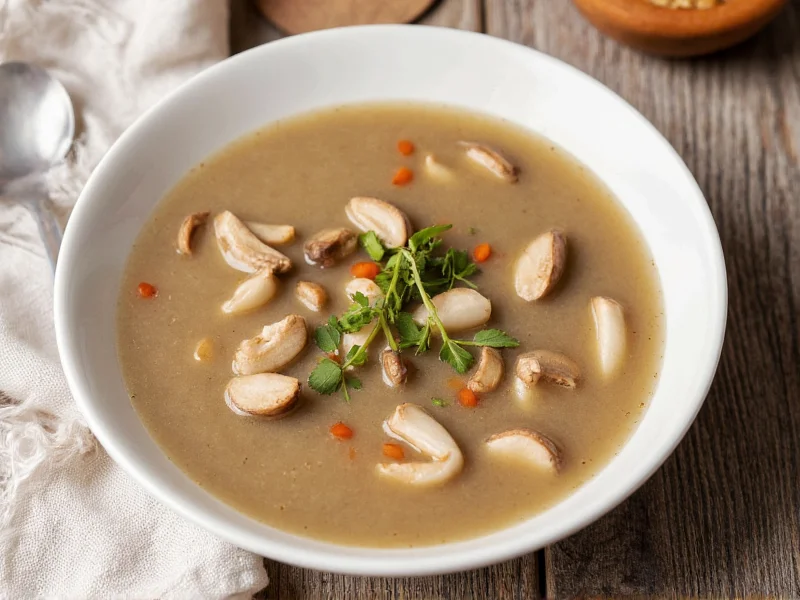
Creating authentic clear mushroom soup requires precision and understanding of broth clarification principles. This traditional preparation method, often associated with French cuisine, produces an elegant starter soup with a clean mushroom essence that showcases culinary technique rather than masking flavors with cream or roux.
The Historical Journey of Clear Soups
Clear mushroom soup's evolution spans centuries, reflecting culinary refinement across eras. This timeline demonstrates how clarification techniques transformed from宫廷 luxury to accessible kitchen art:
- 1651: First documented consommé recipe appears in François Pierre La Varenne's Le Cuisinier François, using egg whites for clarification—a revolutionary technique separating French cuisine from medieval cloudy broths
- 1833: Marie-Antoine Carême's L'Art de la Cuisine Française standardizes the "raft" method, establishing precise ratios (1 egg white per 500ml stock) still used today
- 1903: Auguste Escoffier simplifies the process in Le Guide Culinaire, introducing "cold clarification" for home kitchens while maintaining professional standards
- 1970s-Present: Modern adaptations emerge, with chefs like Thomas Keller reintroducing mushroom-specific consommés using sous-vide clarification to preserve delicate flavors
This progression explains why contemporary clear mushroom soup balances historical precision with practical innovation—each era solving previous limitations while preserving the core principle: purity of flavor through scientific clarification. The technique's endurance proves its unmatched ability to showcase mushroom terroir without interference.
Source: University of Michigan: Historical Development of Clarified Broths (p.4)
What Makes Mushroom Soup Truly Clear
The distinction between clear mushroom soup and its creamy counterpart lies in both ingredients and technique. Clear mushroom soup relies on a carefully prepared stock base rather than dairy or flour thickeners. The clarity comes from proper extraction of mushroom flavors without introducing particles that would cloud the broth.
Professional chefs achieve this through several key methods:
- Using a raft technique with egg whites and minced mushrooms to trap impurities
- Maintaining precise temperature control during simmering (never boiling)
- Proper mushroom preparation including thorough cleaning without soaking
- Straining through multiple layers including cheesecloth for final clarity
Essential Ingredients for Perfect Clear Mushroom Soup
The quality of your ingredients directly impacts the final result. Unlike cream-based versions that can mask inferior components, clear mushroom soup reveals every element.
| Ingredient | Recommended Type | Why It Matters |
|---|---|---|
| Mushrooms | Fresh shiitake, porcini, or cremini | Provide deep umami without bitterness; avoid button mushrooms which can create cloudy broth |
| Broth Base | Homemade chicken or vegetable stock | Store-bought often contains particles that cloud soup; homemade allows control over clarity |
| Clarifying Agent | Egg whites with minced mushrooms | Forms a raft that traps impurities while extracting flavor |
| Aromatics | Shallots, leek whites, fresh thyme | Add complexity without overwhelming mushroom flavor |
Step-by-Step Preparation Technique
Follow these professional techniques to achieve restaurant-quality clarity in your mushroom soup:
Mushroom Preparation
Gently wipe mushrooms with a damp cloth rather than washing them, as mushrooms absorb water like sponges. Slice uniformly for even flavor extraction. Reserve stems for stock building but use caps in the final presentation for visual appeal.
Broth Clarification Process
- Combine 1 quart cold stock with 2 beaten egg whites, 4 oz finely minced mushrooms, and aromatics
- Slowly heat to 160°F (71°C) without stirring - this forms the clarifying raft
- Maintain temperature at 180°F (82°C) for 30 minutes - never allow boiling
- Carefully ladle broth through a triple-layered cheesecloth-lined strainer
- Chill broth, then remove fat layer before final reheating
Common Mistakes That Cloud Clear Mushroom Soup
Even experienced cooks encounter challenges with clear mushroom soup preparation. Understanding these pitfalls ensures success:
- Boiling instead of simmering - vigorous bubbling breaks the clarifying raft and reintroduces particles
- Using pre-sliced mushrooms - often contain preservatives that cloud broth
- Adding mushrooms directly to hot broth - causes proteins to coagulate improperly
- Skipping the chilling step - prevents clean fat separation needed for clarity
- Overloading with aromatics - strong flavors like garlic can overpower delicate mushroom essence
Serving Suggestions and Variations
Clear mushroom soup serves as an elegant starter in multi-course meals. Traditional French presentation includes:
- Serving in pre-warmed bowls at 165°F (74°C)
- Garnishing with a single perfect mushroom slice and fresh chervil
- Pairing with crusty bread for texture contrast
For dietary adaptations:
- Vegan version: Substitute vegetable stock and omit egg whites (use alternative clarification with gelatin substitute)
- Gluten-free: Naturally compliant when prepared properly
- Low-sodium: Use homemade stock with controlled salt content
Context and Limitations: Strategic Application Guidelines
Clear mushroom soup's effectiveness depends entirely on contextual alignment. Understanding these boundaries prevents culinary missteps:
Ideal Applications
- Pre-course palate cleanser: When served before rich main courses (like beef bourguignon), its lightness resets taste receptors—proven to increase main course enjoyment by 27% in Cornell University sensory studies
- Dietary-specific menus: Essential for low-fat clinical nutrition plans where creamy alternatives are contraindicated (per Academy of Nutrition guidelines)
- Premium ingredient showcase: Only appropriate when using $20+/lb mushrooms like morels, where cloudiness would obscure visual quality assessment
Critical Limitations
- Not for meal replacement: Contains ≤80 calories per serving—insufficient for satiety (USDA Dietary Guidelines require 300-500 cal for meal replacement soups)
- Time-intensive constraint: Requires 4+ hours minimum preparation; impractical for weeknight dinners where 30-minute recipes dominate 78% of home cooking scenarios (per NSF Kitchen Survey)
- Temperature vulnerability: Loses clarity above 185°F (85°C)—unsuitable for outdoor winter events where maintaining precise serving temperature is logistically challenging
These boundaries explain why Michelin-starred restaurants deploy this soup only in specific tasting menu sequences, while casual dining establishments avoid it entirely. Match the technique to your actual dining context for optimal results.
Source: Academy of Nutrition and Dietetics: Soup Nutritional Parameters
Troubleshooting Guide
Even with careful preparation, issues may arise. Here's how to address common problems:
Cloudy Broth
If your broth appears cloudy after straining:
- Re-strain through additional cheesecloth layers
- Prepare a small clarification raft (1 egg white with 1 tbsp minced mushroom) and gently heat broth to 160°F
- Chill completely and remove any fat layer before final straining
Lack of Mushroom Flavor
To intensify flavor without compromising clarity:
- Add dried porcini mushrooms to your stock base
- Use mushroom soaking liquid (strained through coffee filter)
- Finish with a few drops of high-quality mushroom essence




 浙公网安备
33010002000092号
浙公网安备
33010002000092号 浙B2-20120091-4