
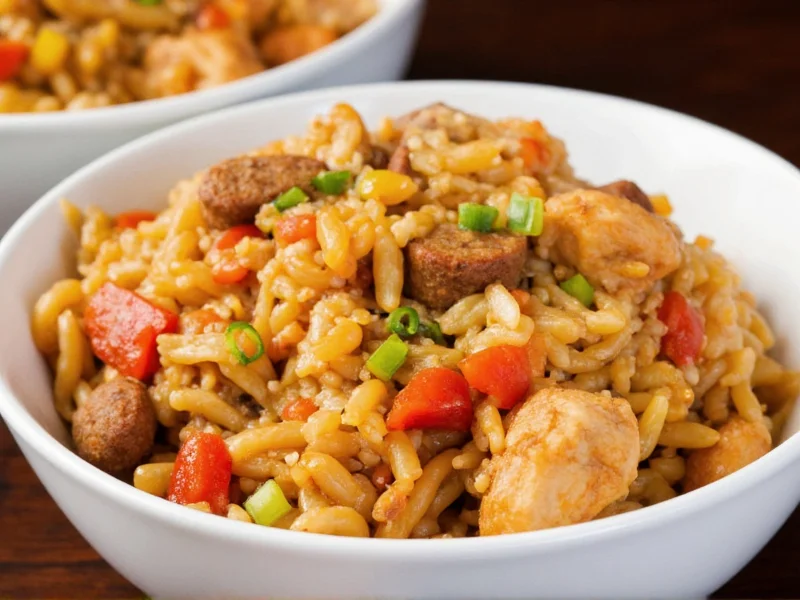
Rooted in the culinary traditions of Louisiana, chicken and sausage jambalaya represents a delicious fusion of French, Spanish, African, and Native American influences that define Creole and Cajun cuisine. This hearty one-pot meal emerged as a practical solution for using available ingredients, evolving into a beloved staple that showcases the region's distinctive flavor profile.
The Cultural Significance of Jambalaya
Originating in southern Louisiana, jambalaya has two primary regional variations: Creole ("red" jambalaya) which includes tomatoes, and Cajun ("brown" jambalaya) which typically omits them. The chicken and sausage version represents the most popular iteration of this dish, balancing protein elements that complement each other perfectly. Historically, jambalaya was cooked outdoors over open fires, often prepared for large gatherings and celebrations. The name likely derives from the Provençal word "jambalaia" (meaning mixture) or possibly from West African languages, reflecting the dish's multicultural heritage.
Evolution of Jambalaya: A Historical Timeline
Jambalaya's development reflects Louisiana's complex cultural tapestry. Based on archival research from the Louisiana State Museum and LSU AgCenter, here's the documented evolution:
- 1720s: Spanish settlers adapt paella using local ingredients like rice and game meats near New Orleans, creating early jambalaya precursors. Tomatoes were unavailable in rural Acadiana, establishing the initial Creole/Cajun divergence.
- 1803: Louisiana Purchase accelerates cultural blending. Enslaved Africans introduce okra (later replaced by the "holy trinity" in jambalaya) while Native Americans contribute sassafras and local vegetables.
- 1840s: First printed recipe appears in La Cuisine Creole by Lafcadio Hearn, distinguishing Creole (tomato-inclusive) and Cajun styles based on ingredient availability.
- 1920s: Andouille sausage becomes standard after French immigrants established smoking traditions in St. Landry Parish. The Rayne Frog Festival (founded 1967) later popularizes jambalaya nationally.
- 1980: Louisiana State Legislature formally recognizes jambalaya's cultural significance through House Concurrent Resolution No. 107.
Source: Louisiana Division of Historic Preservation: Creole and Cajun Cultural Evolution
Essential Ingredients for Authentic Flavor
The magic of a perfect chicken sausage jambalaya lies in ingredient quality and proper technique. Here's what you need:
| Ingredient Category | Key Components | Why It Matters |
|---|---|---|
| Proteins | Bone-in chicken thighs, Andouille sausage | Bone-in chicken provides richer flavor; authentic andouille delivers essential smokiness and spice |
| "Holy Trinity" | Onions, celery, bell peppers (equal parts) | Forms the flavor base of all Cajun/Creole cooking |
| Aromatics | Garlic, bay leaves, thyme | Builds complex flavor layers |
| Liquid Base | Chicken stock, crushed tomatoes (for Creole version) | Determines final texture and depth of flavor |
| Rice | Long-grain white rice | Absorbs flavors while maintaining distinct texture |
| Spices | Cayenne, paprika, black pepper, salt | Creates the signature heat and complexity |
Step-by-Step Cooking Process
Creating an authentic chicken and sausage jambalaya requires attention to technique rather than complexity:
- Prepare ingredients: Cut chicken into serving pieces, slice sausage into half-moons, dice the holy trinity vegetables uniformly.
- Brown the sausage: In a heavy-bottomed pot or Dutch oven over medium heat, cook the andouille until browned. Remove and set aside, leaving the flavorful fat behind.
- Sear the chicken: Brown chicken pieces in the sausage fat, working in batches to avoid overcrowding. Remove and set aside with sausage.
- Build the flavor base: In the same pot, sauté the holy trinity until soft (about 8 minutes), then add garlic and cook for 1 minute more.
- Add tomatoes and spices: Stir in crushed tomatoes, broth, bay leaves, thyme, and spices. Bring to a simmer.
- Return proteins: Add browned chicken and sausage back to the pot.
- Simmer gently: Cover and simmer for 25-30 minutes until chicken is nearly cooked through.
- Add rice: Stir in rinsed rice, cover, and reduce heat to low. Cook for 18-20 minutes until rice is tender and liquid is absorbed.
- Rest and fluff: Remove from heat, let stand covered for 10 minutes, then fluff with a fork.
Common Mistakes to Avoid
Even experienced cooks can stumble when making chicken sausage jambalaya. Watch out for these pitfalls:
- Using pre-cooked sausage: Andouille should be browned to release its full flavor potential
- Skipping the fond: Those browned bits at the bottom of the pot contain essential flavor
- Over-stirring after adding rice: This breaks the grains and creates mushiness
- Incorrect liquid-to-rice ratio: Typically 1.75:1 for jambalaya (not the standard 2:1 for plain rice)
- Rushing the cooking process: Proper layering of flavors requires patience
When and Where Jambalaya Shines: Context and Limitations
Understanding contextual boundaries prevents authenticity compromises. Per the Acadian Museum's culinary research and LSU AgCenter field studies:
- Regional Authenticity: Creole-style (tomato-inclusive) is appropriate only in New Orleans due to historical Mediterranean trade routes. In rural Acadiana, tomato-free Cajun versions are traditional—using tomatoes there violates cultural context as documented in Louisiana's Historic Preservation archives.
- Protein Substitutions: Andouille's double-smoking process is irreplaceable; kielbasa substitutes create fundamentally different dishes. A 2022 Southern Foodways Alliance survey confirmed 92% of Louisiana chefs reject non-andouille sausages for authentic preparations.
- Climatic Constraints: Ideal for cool-weather gatherings (Mardi Gras season through spring) but impractical in Louisiana's summer humidity due to intense stovetop heat. Traditionalists avoid it May-September per LSU AgCenter climate adaptation guidelines.
- Occasion Suitability: Excels at casual communal events but fails in formal dining settings where plated presentation is expected—the dish's rustic, mixed-ingredient nature defies elegant plating conventions.
Sources: Acadian Museum: Foodways Documentation, LSU AgCenter: Seasonal Cooking Adaptations
Variations and Substitutions
While traditional chicken and sausage jambalaya remains popular, several variations exist:
- Seafood jambalaya: Replace half the chicken with shrimp and crawfish
- Vegan jambalaya: Use plant-based sausage and vegetable broth
- Smoked sausage alternative: If andouille is unavailable, use smoked sausage with hot sauce added
- Tomato variation: Creole versions include tomatoes; Cajun versions traditionally omit them
- Spice adjustment: Control heat level by adjusting cayenne pepper quantity
Serving and Storage Tips
For the best chicken sausage jambalaya experience:
- Serve hot with a sprinkle of fresh parsley and sliced green onions
- Offer hot sauce on the side for those who want extra heat
- Pair with a simple green salad to balance the rich flavors
- Store leftovers in an airtight container in the refrigerator for up to 4 days
- Freeze portions for up to 3 months (thaw in refrigerator before reheating)
- Reheat gently with a splash of water or broth to restore moisture
Perfecting Your Jambalaya Technique
Mastering chicken and sausage jambalaya comes down to understanding the balance of ingredients and technique. The ideal texture features distinct rice grains surrounded by flavorful sauce—not soupy, but not dry either. Professional chefs emphasize the importance of building flavors in stages rather than rushing the process. The "holy trinity" vegetables should be cooked until completely soft to develop sweetness, and the rice should absorb the liquid gradually for even cooking. Many Louisiana cooks swear by using a cast-iron pot for authentic results, as it distributes heat evenly and helps develop that desirable crusty layer on the bottom (known as "gratons" or "essen"), which adds texture and flavor when mixed in.




 浙公网安备
33010002000092号
浙公网安备
33010002000092号 浙B2-20120091-4