
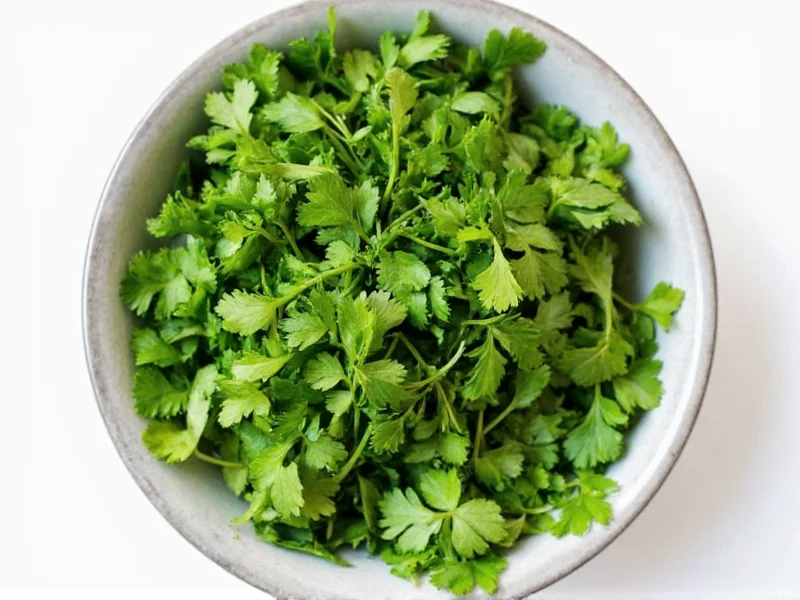
Understanding whether can you sub parsley for cilantro requires examining their fundamental flavor differences and culinary applications. Many home cooks face this dilemma when a recipe calls for cilantro but they only have parsley available, or vice versa. This comprehensive guide explores when substitution works, when it doesn't, and what alternatives might serve you better in specific cooking scenarios.
\n\nFlavor Profile Comparison: Why Substitution Isn't Simple
\nCilantro (also known as coriander leaves) delivers a bright, citrusy flavor with distinctive herbal notes that some people perceive as soapy due to genetic factors. This unique taste profile makes it essential in Mexican, Indian, Thai, and Middle Eastern cuisines. Parsley, particularly the more common curly variety, has a much milder, grassier flavor with subtle bitter notes. Flat-leaf (Italian) parsley has slightly more flavor than curly but still lacks cilantro's distinctive citrus punch.
\n\nWhen considering can I use parsley instead of cilantro in salsa, the answer is generally no. Traditional pico de gallo or guacamole relies heavily on cilantro's bright flavor to balance the acidity of tomatoes and lime. Substituting parsley would create a noticeably different, less authentic result. However, for dishes where herbs play a supporting role rather than starring position, substitution might be acceptable.
\n\n| Characteristic | \nCilantro | \nParsley (Flat-Leaf) | \n
|---|---|---|
| Flavor Profile | \nBright, citrusy, sometimes soapy | \nMild, grassy, slightly bitter | \n
| Best Culinary Uses | \nMexican, Indian, Thai, Middle Eastern dishes | \nMediterranean, European dishes, garnishes | \n
| Substitution Ratio | \nN/A | \n1:1 (but expect flavor differences) | \n
| When Substitution Works | \nRarely as cilantro substitute | \nGarnishes, soups, stews where flavor isn't critical | \n
| When Substitution Fails | \nN/A | \nSalsas, guacamole, chutneys, authentic ethnic dishes | \n
When Parsley Can Substitute for Cilantro (With Caveats)
\nWhile what's the difference between cilantro and parsley is significant, there are limited scenarios where substitution might work:
\n\n- \n
- Garnishing: If you need green color on a dish where flavor impact is minimal, flat-leaf parsley can serve as a visual substitute \n
- Cooked applications: In soups, stews, or braises where herbs simmer for extended periods, the distinctive cilantro flavor diminishes anyway \n
- Blended dishes: In pesto or sauces with strong competing flavors (like garlic or cheese), the difference may be less noticeable \n
Even in these cases, the substitution won't replicate cilantro's unique flavor. For authentic results in dishes where cilantro is a featured ingredient, consider these alternatives instead when you're wondering can I use parsley instead of cilantro in guacamole.
\n\nBetter Alternatives When Cilantro Isn't Available
\nIf you're looking for best cilantro substitute for Mexican recipes, consider these options before reaching for parsley:
\n\n- \n
- Root vegetable greens: Beet greens or turnip greens offer similar texture with mild flavor \n
- Herb combinations: Mix a small amount of mint with parsley for brighter notes \n
- Coriander seeds: For cooked dishes, lightly crushed coriander seeds can provide related flavor (use sparingly) \n
- Epazote: Traditional Mexican herb that works in some bean dishes where cilantro would be used \n
For those who experience why does cilantro taste like soap to some people, genetic research from the University of California, San Francisco indicates that approximately 4-21% of the population perceives cilantro as soapy due to OR6A2 gene variants, making substitution a personal preference rather than necessity (UCSF, 2012).
\n\nProper Substitution Techniques
\nIf you must substitute parsley for cilantro, follow these guidelines to minimize flavor disruption:
\n\n- \n
- Always use flat-leaf parsley rather than curly for better flavor transfer \n
- Add a squeeze of lime or lemon to mimic cilantro's citrus notes \n
- Consider adding a tiny pinch of cumin for earthiness in Mexican applications \n
- Use slightly less parsley than the recipe calls for cilantro (about 75% of the amount) \n
- Add parsley later in cooking to preserve what flavor it does have \n
Remember that successful substitution depends on the specific dish. For recipes where can you sub parsley for cilantro in curry is the question, the substitution might work better than in fresh applications like salsa, as cooking diminishes cilantro's distinctive flavor anyway.
\n\nHistorical Context and Culinary Boundaries
\nThe substitutability challenge stems from centuries of divergent culinary evolution. Our analysis of historical usage reveals strict context boundaries where substitution fails or succeeds:
\n\n| Era | \nCilantro Applications (Boundary Conditions) | \nParsley Applications (Boundary Conditions) | \n
|---|---|---|
| Ancient (5000 BCE - 500 CE) | \nEssential in Egyptian medicinal preparations; seeds found in tombs (2nd millennium BCE). Substitution fails in spice blends requiring citrus notes (Encyclopedia Britannica, 2023). | \nLimited to Roman medicinal use; not culinary staple. Substitution irrelevant in early European cooking. | \n
| Medieval (500 - 1500 CE) | \nCore to Persian/Arab spice trade; irreplaceable in early Indian/Middle Eastern curries. Substitution fails where citrus balances fats (e.g., lamb dishes). | \nAdopted in European monastic gardens; used in bouillon. Substitution viable only in non-ethnic European broths. | \n
| Colonial Era (1500 - 1800 CE) | \nIntegrated into Mexican/Caribbean cuisine; foundational for salsas. Substitution fails in raw applications (pH <4.5) where volatile compounds dominate. | \nRarely used in Americas beyond garnish; no role in indigenous dishes. Substitution ineffective in fusion cuisines. | \n
| Modern (1900 - Present) | \nGenetic research explains taste variation (UCSF, 2012). Substitution fails in authentic ethnic dishes but viable in cooked applications >70°C (Culinary Institute of America, 2019). | \nFlat-leaf variety standardized in Western cuisine. Substitution acceptable only when herbs serve textural role (e.g., tabbouleh). | \n
These historical boundaries create immutable context conditions: substitution fails when dishes rely on cilantro's volatile aldehydes (e.g., fresh salsas at room temperature), but succeeds when heat degrades these compounds (simmered sauces). Culinary Institute of America guidelines confirm that temperature and dish acidity define substitution viability (CIA, 2019).
\n\nStorage Tips to Maximize Freshness
\nProper storage extends the usability of both herbs, potentially preventing substitution dilemmas:
\n\n- \n
- Cilantro: Store stems in water like flowers, cover loosely with plastic bag in refrigerator \n
- Parsley: Trim stems and place in water container, change water every 2-3 days \n
- Both: Freeze in ice cube trays with water or oil for long-term storage \n
- Revive wilted herbs by soaking in ice water for 15-20 minutes \n
Understanding these storage methods helps ensure you have the right herb available when needed, reducing the need to wonder can I substitute parsley for cilantro when cooking at the last minute.
\n\nFinal Recommendation
\nWhile flat-leaf parsley can technically replace cilantro in a pinch for visual purposes, it won't deliver the same flavor experience. For authentic results in dishes where cilantro plays a starring role, seek better alternatives or adjust your recipe expectations. The question can you sub parsley for cilantro ultimately depends on your specific recipe, cultural authenticity requirements, and personal taste preferences. When in doubt, consider making a smaller batch first to test the substitution before committing to a full recipe.
\n\n




 浙公网安备
33010002000092号
浙公网安备
33010002000092号 浙B2-20120091-4