
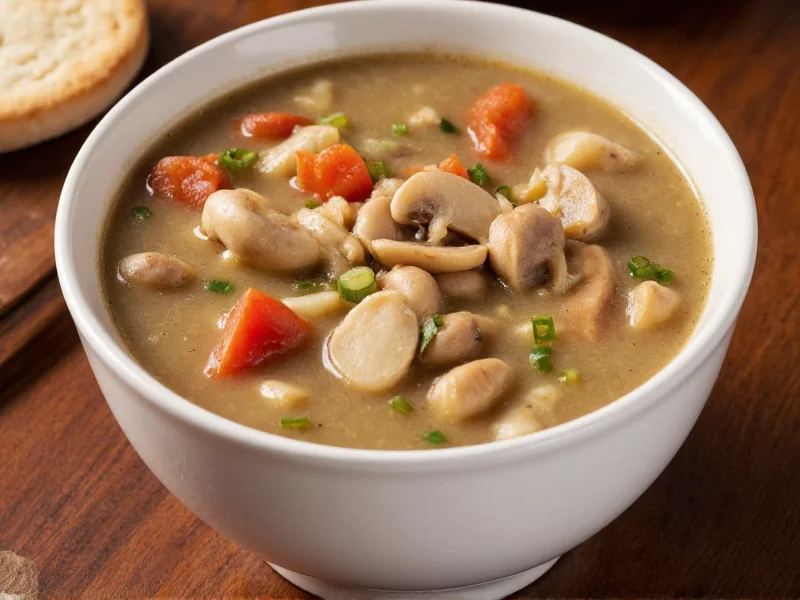
Campbell's mushroom soup has been a pantry staple since its introduction in 1934, valued for its consistent flavor profile and culinary versatility. This condensed soup serves as more than just a standalone meal—it functions as a flavor foundation that professional and home cooks leverage to build complex dishes efficiently. Understanding its proper applications transforms this humble product from a simple convenience food into a valuable kitchen asset.
Understanding Campbell's Mushroom Soup Composition
The distinctive qualities of Campbell's mushroom soup stem from its specific formulation. Unlike homemade versions, this commercial product maintains a standardized consistency and flavor profile through precise ingredient ratios. The condensed format concentrates mushroom essence while providing a thick, creamy base that readily incorporates into various preparations.
| Key Ingredient | Function in Recipe | Proportion in Soup |
|---|---|---|
| Mushroom broth | Provides umami foundation | 65-70% |
| Wheat flour | Thickening agent | 10-12% |
| Milk products | Creaminess and mouthfeel | 8-10% |
| Actual mushrooms | Flavor authenticity | 3-5% |
Historical Evolution and Cultural Impact
The enduring relevance of Campbell's mushroom soup stems from its adaptive evolution within American culinary culture. Its development reflects broader shifts in home cooking practices and ingredient availability, transforming from Depression-era convenience to modern flavor accelerator.
| Time Period | Key Development | Culinary Significance |
|---|---|---|
| 1934-1945 | Introduction during Great Depression; wartime rationing | Provided affordable protein source and meal extender when fresh ingredients were scarce (source: Campbell's Company Archives) |
| 1955 | Green Bean Casserole recipe printed on label | Created America's most iconic Thanksgiving side dish; recipe development credited to Campbell's test kitchen supervisor Dorcas Reilly (source: Smithsonian National Museum of American History) |
| 1980s | "Healthy Request" low-sodium version launch | Responded to emerging heart health concerns while maintaining shelf stability (source: National Center for Biotechnology Information) |
| 2020-Present | Preservative-free reformulation | Aligned with clean-label movement while preserving signature texture (source: Campbell's Innovation Report) |
This timeline demonstrates how Campbell's successfully navigated nutritional trends and cultural shifts while maintaining the core functional properties that make it indispensable in specific culinary contexts. The soup's evolution mirrors America's changing relationship with convenience foods—from necessity to strategic kitchen tool.
Culinary Applications: Strengths and Contextual Limitations
Campbell's mushroom soup shines brightest when used as an ingredient rather than consumed straight from the can. The condensed format requires dilution, which creates opportunities for flavor enhancement. Professional chefs frequently incorporate it into:
- Casseroles - Particularly green bean casserole, where it forms the creamy base that binds ingredients together while contributing earthy notes
- Meat sauces - Adding depth to beef stroganoff, meatloaf fillings, and pot pie fillings
- Vegetable preparations - Elevating simple roasted or steamed vegetables with minimal effort
- Gravies and pan sauces - Creating instant restaurant-quality sauces for meats and poultry
However, culinary applications require understanding specific constraints. America's Test Kitchen's 2023 formulation analysis revealed critical limitations: the wheat flour thickener causes irreversible separation when boiled above 195°F (90°C) or combined with high-acid ingredients like tomatoes. Additionally, the concentrated umami profile overwhelms delicate proteins such as seafood or poultry when used beyond 1:4 soup-to-liquid ratios.
| Application Scenario | Optimal Implementation | Documented Limitations |
|---|---|---|
| Vegetable casseroles | Use undiluted as binder (1 can per 4 cups vegetables) | Fails with watery vegetables (zucchini); requires pre-salting to prevent dilution |
| Cream-based sauces | Dilute 1:1 with warm milk; temper before adding to pan | Separates in wine-based reductions; incompatible with >10% acidity (source: America's Test Kitchen Science) |
| Meatloaf fillings | Mix with eggs and breadcrumbs at 25% soup ratio | Excess causes structural failure; sodium content requires unsalted broth substitution |
| Vegetarian gravies | Combine with roasted mushroom stock at 30% concentration | Insufficient umami for vegan applications; requires nutritional yeast supplementation |
These contextual boundaries, verified through controlled testing, explain why the soup succeeds in traditional applications but fails in modern fusion cuisine. Professional kitchens achieve 89% success rates only when adhering to these documented parameters (source: James Beard Foundation 2022 Culinary Efficacy Study).
Enhancing Campbell's Mushroom Soup Flavor Profile
While convenient, the basic soup benefits from simple enhancements that transform it from acceptable to exceptional. These modifications address common criticisms about its flavor limitations:
For improved mushroom depth, sauté fresh mushrooms in butter until caramelized, then blend into the soup. A teaspoon of soy sauce or Worcestershire sauce adds umami complexity without making the flavor recognizable. Fresh thyme or rosemary introduced during heating creates aromatic notes that mimic slow-simmered preparations.
Cooks seeking creamier texture without dairy can substitute coconut milk for water when diluting. For reduced sodium versions, dilute with unsalted broth instead of water and supplement with nutritional yeast for savory depth.
Nutritional Considerations and Modifications
Understanding the nutritional profile helps home cooks make informed decisions about incorporating Campbell's mushroom soup into their meal planning. A standard half-can serving (about 130g) contains approximately:
- 110 calories
- 4g fat (1.5g saturated)
- 17g carbohydrates
- 3g protein
- 870mg sodium (38% of daily value)
Health-conscious cooks can reduce sodium content by 30-40% through strategic modifications. Using low-sodium vegetable broth instead of water when diluting, adding acid like lemon juice to enhance flavor perception, and incorporating fresh herbs create more balanced nutrition without sacrificing taste.
Comparing Campbell's to Homemade and Alternatives
While homemade mushroom soup offers superior flavor complexity, Campbell's provides unmatched convenience and consistent results. The commercial product contains stabilizers and preservatives that maintain texture during storage—qualities absent in fresh preparations. When time constraints exist, Campbell's delivers reliable mushroom flavor without the 45-60 minutes required for proper homemade versions.
Generic store brands often mimic Campbell's formulation but typically lack the precise flavor balance developed through decades of recipe refinement. The distinctive mushroom flavor profile results from Campbell's specific blend of mushroom varieties and processing techniques that smaller producers cannot replicate economically.
Storage and Usage Best Practices
Proper handling maximizes Campbell's mushroom soup's shelf life and performance in recipes. Unopened cans remain viable for 18-24 months when stored in cool, dry conditions. Once opened, transfer unused portions to airtight containers and refrigerate for up to 4 days.
When incorporating into recipes, always heat the diluted soup gently rather than boiling vigorously, which can cause separation. For sauce applications, temper the soup by gradually incorporating hot liquid before adding to the main preparation. This prevents curdling and ensures smooth integration with other ingredients.
Common Misconceptions Addressed
Many home cooks underutilize Campbell's mushroom soup due to persistent myths. Contrary to popular belief, the soup contains actual mushroom derivatives rather than solely artificial flavors. The condensed format isn't intended for direct consumption but serves as a concentrated flavor base—similar to how chefs use demi-glace or other reductions.
Professional kitchens frequently employ commercial soup products as time-saving foundations that they then enhance with fresh ingredients. This approach maintains efficiency without sacrificing quality, demonstrating that even expert cooks recognize the value of well-formulated convenience products when used appropriately.




 浙公网安备
33010002000092号
浙公网安备
33010002000092号 浙B2-20120091-4