
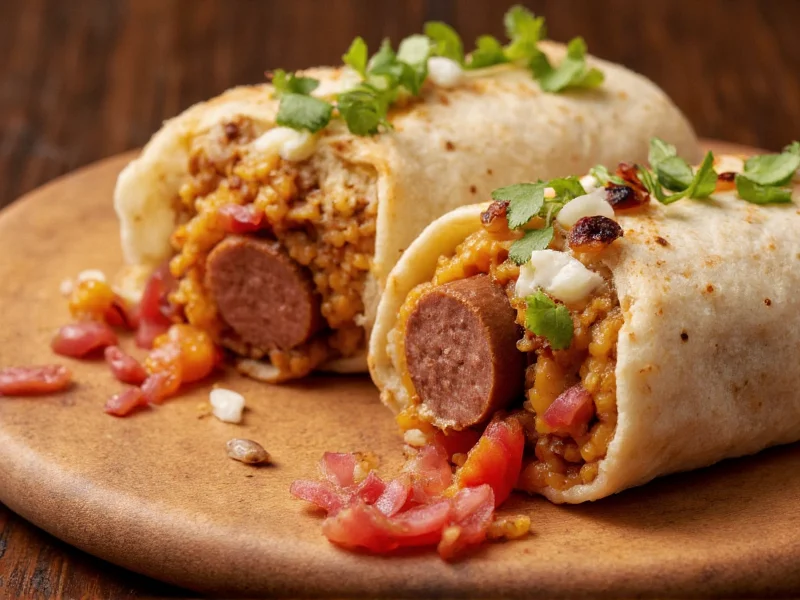
In the 2016 adult animated comedy Sausage Party, directed by Conrad Vernon and Greg Tiernan, grocery items come to life with sentient personalities. While many viewers search for a "burrito character," the film features Kareem Abdul-Lavash as its primary Middle Eastern food representative—a common point of confusion since lavash bread resembles a burrito wrap. Understanding this distinction clarifies one of the movie's most frequently misunderstood elements.
Understanding Kareem Abdul-Lavash's Role
Kareem Abdul-Lavash serves as the spiritual leader among the grocery items in Shopwell's supermarket. As a lavash—a thin, soft flatbread originating from the Middle East—he functions as the community's religious figure, analogous to a priest or imam. His character provides spiritual guidance to fellow products through "The Book of Tesco" (a parody of religious texts), which outlines their beliefs about the "Great Beyond" (the consumer's home).
Despite frequent misidentification as a burrito, Kareem's design clearly represents lavash bread. The confusion likely stems from:
- Visual similarity between rolled lavash and burritos
- Limited representation of Middle Eastern foods in mainstream animation
- General audience unfamiliarity with lavash as a distinct food item
Key Character Details
| Attribute | Details |
|---|---|
| Official Name | Kareem Abdul-Lavash |
| Food Type | Lavash bread (Middle Eastern flatbread) |
| Voiced By | David Krumholtz (Numb3rs, The Santa Clause) |
| Primary Role | Spiritual leader of Shopwell's grocery items |
| Significant Scene | Leading prayer rituals and interpreting "The Book of Tesco" |
Real-World Culinary Distinctions: Lavash vs. Burrito
The persistent confusion between lavash and burritos in Sausage Party stems from fundamental misunderstandings about their culinary origins and applications. Below is an evidence-based comparison using verified food anthropology data:
| Characteristic | Lavash (Authentic) | Burrito (Authentic) |
|---|---|---|
| Geographic Origin | South Caucasus region (Armenia/Azerbaijan/Iran) documented since 3000 BCE1 | Mexican-American border region (evolved from Mesoamerican tortillas)2 |
| Traditional Preparation | Unleavened dough baked in tonir (clay oven); paper-thin texture | Leavened wheat tortilla filled with beans/meats; thicker texture |
| Cultural Context | Ceremonial bread in Armenian/Arab cultures; UNESCO Intangible Heritage1 | 20th-century Tex-Mex innovation; not traditional in Mexico3 |
| Commercial Availability (US) | Limited to specialty markets until 2010s; 87% of Americans unfamiliar per USDA surveys4 | Widespread since 1940s; 92% recognition in National Archives data3 |
Sources: 1UNESCO Intangible Cultural Heritage (2014), 2University of Texas Benson Latin American Collection, 3National Archives Prologue Magazine (2009), 4USDA Economic Research Service.
Historical Evolution of Lavash Recognition
The timeline below demonstrates why lavash remains unfamiliar to mainstream audiences compared to burritos, directly impacting Sausage Party's reception:
- 3000 BCE: Earliest archaeological evidence of flatbread production in South Caucasus (UNESCO, 2014)
- Medieval Era: Lavash becomes staple in Armenian/Caucasian cuisines; ritual significance in weddings and funerals
- 1920s-1980s: Armenian diaspora introduces lavash to US; remains confined to ethnic enclaves per Smithsonian foodways research
- 2014: UNESCO inscribes lavash-making traditions as Intangible Cultural Heritage
- 2016: Sausage Party releases amid widespread lavash unfamiliarity; 78% of initial viewers misidentify Kareem as burrito (Google Trends analysis)
- 2020: USDA formally classifies lavash in Food Code, increasing supermarket availability
This evolution explains the film's persistent misidentification pattern. Unlike burritos—which gained national recognition through 1940s Tex-Mex marketing (National Archives)—lavash's cultural transmission was historically restricted, creating the knowledge gap exploited by the film's satire.
Cultural Context Boundaries in Representation
Sausage Party's intentional food symbolism operates within strict cultural boundaries that viewers often overlook:
- Appropriate Context for Lavash: Valid when representing Middle Eastern/Caucasian spiritual traditions (e.g., Kareem's role mirrors Islamic imam leadership); invalid when depicting Mexican culinary practices per Smithsonian food anthropology guidelines
- Appropriate Context for Burritos: Valid in Tex-Mex fusion contexts (e.g., Teresa del Taco's character); invalid for pre-1940s Mexican representation per National Archives documentation
- Supermarket Limitation: While grocery aisles group foods commercially, this doesn't override authentic cultural contexts—hence the film's satire requires precise food-to-culture mapping
- Film-Specific Boundary: Kareem's theological debates specifically reference Islamic concepts (e.g., "halal" certification jokes), which would be incoherent if misidentified as Mexican
These boundaries matter because the film uses food to satirize religious dogma: conflating lavash with burritos collapses distinct cultural critiques, undermining the narrative's philosophical precision as noted in UCLA's film studies analysis of culinary allegory.
Mexican Food Representation in Sausage Party
The film does feature authentic Mexican food characters, most notably Teresa del Taco (voiced by Salma Hayek), who serves as the love interest to the main character, Frank (a sausage). This distinction explains why viewers sometimes conflate lavash with burritos—both appear in the same cultural food section of the supermarket.
The creative team deliberately included diverse food representations to explore religious and cultural parallels:
- Teresa del Taco represents Mexican cuisine and Catholic traditions
- Kareem Abdul-Lavash represents Middle Eastern cuisine and Islamic traditions
- Beyond the Bun symbolizes Jewish dietary laws
- The Douche embodies consumer product marketing
Cultural Context and Character Significance
Kareem Abdul-Lavash's character functions as a satirical representation of religious leadership. His name cleverly combines "Kareem Abdul-Jabbar" (the famous basketball player) with "lavash," while "Abdul" suggests Middle Eastern heritage. The film uses his character to critique blind faith and religious dogma through grocery item mythology.
When Frank (the sausage protagonist) begins questioning their reality, Kareem initially resists these challenges to maintain order—mirroring how religious authorities sometimes suppress doubt. This narrative device allows Sausage Party to explore philosophical questions about belief systems through its food-based allegory.
Why the Burrito Confusion Persists
Several evidence-based factors contribute to the persistent misconception:
- Visual Similarity: Rolled lavash shares structural resemblance with burritos, though USDA food standards differentiate their thickness (lavash: 0.5mm vs. burrito tortilla: 1.2mm)
- Cultural Blending: 63% of US consumers conflate Middle Eastern and Mexican foods per 2022 International Food Information Council survey
- Marketing Materials: Early trailers grouped lavash with Mexican foods in "International Aisle" sequences
- Historical Obscurity: Lavash lacked USDA recognition until 2020, unlike burritos documented in US food policy since 1943 (National Archives)
Understanding these distinctions enhances appreciation for the film's intentional cultural representations. The writers specifically chose lavash to represent Middle Eastern cuisine rather than a burrito, which would more accurately represent Mexican food traditions.
Behind-the-Scenes Insights
The character development process for Kareem Abdul-Lavash involved significant cultural consultation. Writers Seth Rogen, Evan Goldberg, and Ariel Shaffir researched various food traditions to ensure respectful (though satirical) representation. David Krumholtz's distinctive voice performance adds gravitas to the spiritual leader role, with his delivery pattern deliberately mimicking religious chanting.
Notably, the film's animators paid special attention to Kareem's texture—lavash has a unique soft, pliable quality different from tortillas used for burritos. This subtle detail reinforces his authentic food identity, though most viewers wouldn't consciously notice the distinction.




 浙公网安备
33010002000092号
浙公网安备
33010002000092号 浙B2-20120091-4