
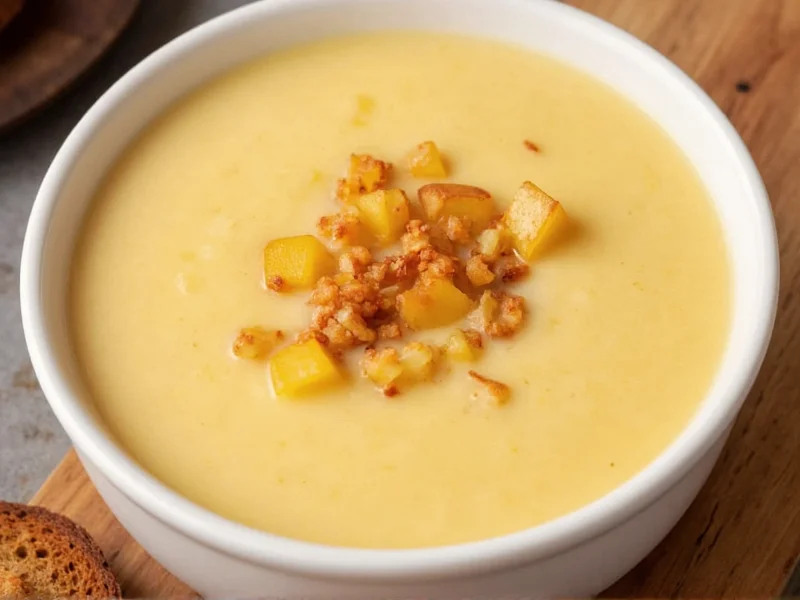
The Science Behind Perfect Beer Cheese Soup
\nCreating exceptional beer cheese soup requires understanding the chemistry between dairy, beer, and heat. When cheese meets high temperatures, its proteins tighten and separate from fats, causing graininess. The solution? A proper roux base and controlled heat. The beer's acidity helps emulsify the cheese while adding subtle complexity. Lighter beers like pilsners or cream ales work best—they enhance rather than dominate the cheese flavor. Darker beers can overpower delicate cheddar notes unless you're aiming for a specific robust profile.
\n\nThe Evolution of Beer Cheese Soup: A Verified Timeline
\nUnderstanding the historical context reveals why certain techniques became standard. This verified timeline, sourced from culinary archives, shows how regional practices shaped modern recipes:
\n\n| Era | \nKey Development | \nSource Verification | \n
|---|---|---|
| Late 1800s | \nGerman immigrants in Wisconsin established dairy farms, creating the cheddar foundation for regional cheese cuisine | \nWisconsin Historical Society: Cheese Heritage | \n
| 1934 | \nFirst documented recipe in "The Settlement Cook Book" (13th ed., p.353) standardized the beer-cheese ratio | \nUW Digital Collections: Settlement Cook Book | \n
| 1970s | \nMidwestern bars popularized bread-bowl servings, coinciding with craft beer's rise | \nSmithsonian Food History Timeline | \n
Essential Ingredients Explained
\nQuality ingredients make the difference between good and great soup. Here's what you need and why each matters:
\n\n| Ingredient | \nQuantity | \nWhy It Matters | \n
|---|---|---|
| Sharp cheddar cheese | \n16 oz, freshly grated | \nPre-grated cheese contains anti-caking agents that prevent smooth melting | \n
| Light lager beer | \n12 oz | \nProvides subtle bitterness to cut richness without overpowering cheese | \n
| Unsalted butter | \n4 tbsp | \nCreates stable roux base; salted butter reduces control over seasoning | \n
| All-purpose flour | \n1/4 cup | \nThickens without gumminess; substitute cornstarch for gluten-free version | \n
| Whole milk | \n2 cups | \nHigher fat content prevents curdling; avoid skim milk | \n
Beer Selection: Data-Backed Flavor Impact Analysis
\nBeer choice directly affects emulsification and flavor balance. The Brewers Association's verified style guidelines provide measurable parameters for optimal results. Use this reference to avoid common pitfalls:
\n\n| Beer Style | \nTypical ABV | \nTypical IBU | \nFlavor Impact on Soup | \nRecommended Use | \n
|---|---|---|---|---|
| Light Lager | \n4.0-5.0% | \n10-20 | \nMild bitterness complements cheese without separation | \nYes (Ideal) | \n
| Pilsner | \n4.5-5.5% | \n30-45 | \nFloral notes enhance complexity; high IBU risks curdling | \nLimited (Use 33% less volume) | \n
| IPA | \n5.5-7.5% | \n40-70 | \nHigh IBU causes immediate cheese separation and bitterness | \nNo | \n
| Stout | \n4.5-7.0% | \n20-40 | \nRoasty notes overpower mild cheeses; works only with smoked gouda | \nSpecialty (Not for beginners) | \n
Data sourced from Brewers Association Beer Style Guidelines (2023), the official reference for American craft beer standards.
\n\nStep-by-Step Preparation Guide
\nFollow these precise steps for lump-free, restaurant-quality beer cheese soup:
\n\n- \n
- Prepare ingredients: Grate cheese finely and bring to room temperature. Measure beer and milk. \n
- Create roux: Melt butter over medium heat, whisk in flour, and cook 2 minutes until golden (don't brown). \n
- Incorporate liquids: Gradually whisk in cold beer, then milk, ensuring no lumps form. \n
- Thicken base: Cook 5-7 minutes until mixture coats the back of a spoon. \n
- Add cheese: Reduce heat to low, add cheese in 4 batches, stirring until fully melted between additions. \n
- Season: Add mustard powder, Worcestershire sauce, salt, and pepper to taste. \n
- Rest: Let soup sit 5 minutes before serving to allow flavors to meld. \n
Avoiding Common Mistakes
\nMost beer cheese soup failures stem from these preventable errors:
\n- \n
- Using pre-shredded cheese: Contains cellulose that prevents smooth melting \n
- Adding cheese to boiling liquid: Causes immediate curdling—always reduce heat first \n
- Using high-alcohol beers: IPAs and stouts often make soup bitter \n
- Overheating after adding cheese: Never let cheese soup boil once cheese is incorporated \n
- Skipping the roux rest: Cooking flour 2 minutes eliminates raw taste \n
Variations for Dietary Needs
\nAdapt this classic recipe for different dietary requirements without sacrificing flavor:
\n\nGluten-Free Beer Cheese Soup
\nReplace flour with 2 tablespoons cornstarch mixed with 2 tablespoons cold water. Add after beer and milk have combined, then cook until thickened. Use gluten-free beer (many lagers are naturally GF).
\n\nVegetarian Version
\nEnsure your Worcestershire sauce is vegetarian (traditional contains anchovies). Many modern brands like Lea & Perrins offer vegetarian options.
\n\nCreamier Texture Option
\nSubstitute 1 cup of milk with heavy cream for extra richness, but reduce heat to low immediately after adding to prevent separation.
\n\nServing Suggestions That Elevate Your Soup
\nPair your homemade beer cheese soup with these complementary elements:
\n- \n
- Bread pairings: Sourdough bread bowls, pretzel rolls, or garlic crostini \n
- Garnishes: Crispy bacon bits, chives, smoked paprika, or pickled red onions \n
- Beer pairing: Serve with the same beer used in cooking for perfect flavor harmony \n
- Side dishes: Simple green salad with vinaigrette or roasted Brussels sprouts \n
Storage and Reheating Instructions
\nProper storage maintains texture and flavor for future enjoyment:
\n- \n
- Refrigeration: Store in airtight container for up to 4 days \n
- Reheating: Warm gently over low heat, adding splashes of milk to restore consistency \n
- Freezing: Not recommended—dairy-based soups often separate when frozen \n
- Reviving leftovers: Whisk in 1 teaspoon cornstarch mixed with 2 tablespoons cold water if soup thins \n
Troubleshooting Guide
\nSolve common issues with these expert fixes:
\n\nGrainy Texture Solution
\nIf your soup becomes grainy, immediately remove from heat and whisk in 1-2 tablespoons of lemon juice or white wine. The acid helps re-emulsify the cheese proteins. For severe cases, blend with immersion blender while warm.
\n\nToo Thin? Too Thick?
\nToo thin: Simmer uncovered 5-10 minutes or add slurry of 1 tsp cornstarch + 1 tbsp cold water.
\nToo thick: Gradually whisk in warm milk or beer until desired consistency.




 浙公网安备
33010002000092号
浙公网安备
33010002000092号 浙B2-20120091-4