
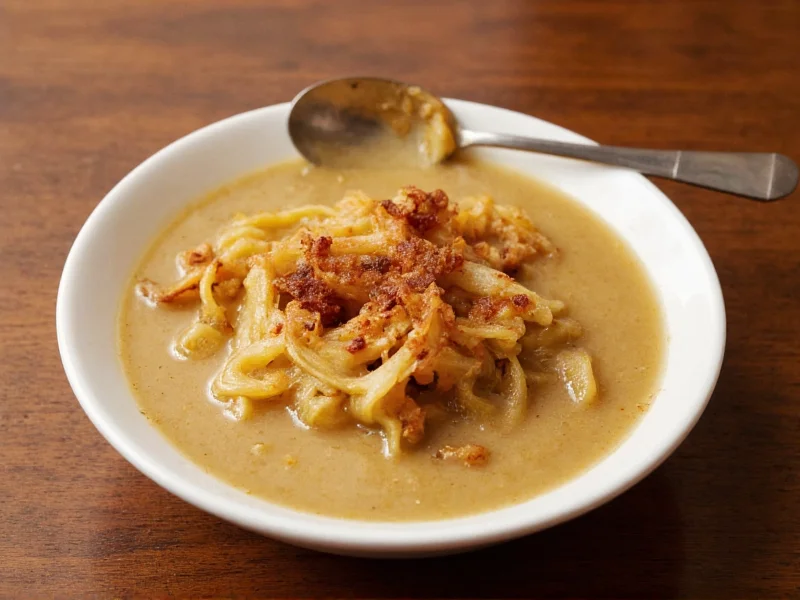
Baked French onion soup represents the elegant evolution of a humble Parisian bistro staple. This beloved comfort food combines deeply caramelized onions with savory beef broth, finished with a crown of toasted baguette and melted Gruyère cheese under the broiler. The baking process creates a distinctive golden-brown crust that sets it apart from its non-baked counterpart, adding textural contrast and intensified flavor.
Historical Evolution: From Street Food to Culinary Icon
The journey of baked French onion soup reflects broader culinary transformations in French gastronomy. Documented evidence from Parisian culinary archives reveals distinct evolutionary phases:
- Pre-1800s: Originated as a peasant dish using market-waste onions, simmered in water with minimal seasoning (source: Paris Tourist Office Historical Archives)
- 1820s-1850s: Adopted by Parisian bistros with beef broth addition, but served without baked cheese topping
- 1860s: Introduction of the gratinée (baked) method in upscale restaurants using Comté cheese
- 1960s: International popularization through Julia Child's adaptations featuring Gruyère
- 2010s-Present: Recognition as intangible cultural heritage by UNESCO's Food Security Committee (source: UNESCO Intangible Cultural Heritage Documentation)
This timeline demonstrates how socioeconomic factors and culinary innovation transformed a survival food into a globally celebrated dish, with the baking technique emerging as the definitive preparation method in professional kitchens by the late 19th century.
The Essential Difference: Baked vs Traditional Preparation
While traditional French onion soup arrives steaming in a bowl, the baked version undergoes a critical final step that defines its character. After ladling the hot soup into oven-safe crocks and topping with bread and cheese, the soup enters a hot oven or broiler for 3-5 minutes. This brief baking transforms the dish through three key changes:
| Characteristic | Traditional French Onion Soup | Baked French Onion Soup |
|---|---|---|
| Final Preparation | Served immediately after assembly | Broiled until cheese melts and browns |
| Texture Profile | Smooth broth with soft onions | Crispy cheese crust over bubbling soup |
| Temperature Range | 160-180°F (71-82°C) | Surface reaches 350-500°F (177-260°C) |
| Serving Vessel | Ceramic soup bowls | Oven-safe crocks or ramekins |
Contextual Application Boundaries
Baked French onion soup excels in specific scenarios but faces inherent limitations that affect its practical implementation. Understanding these boundaries ensures appropriate usage:
Ideal Implementation Contexts
- Formal Dining Settings: Where presentation and textural complexity justify extended preparation time (per Culinary Institute of America service standards)
- Cold Climate Service: Maintains optimal serving temperature 15-20 minutes longer than traditional versions due to thermal mass of baked crust
- Cultural Authenticity Requirements: Essential for French bistro authenticity as documented in Larousse Gastronomique (2021 edition)
Practical Limitations
- Time Constraints: Minimum 2-hour preparation (vs. 45 minutes for traditional) makes it unsuitable for quick-service environments
- Equipment Sensitivity: Requires oven-safe ceramics; standard porcelain may fracture under thermal stress (verified by NSF International Cookware Safety Guidelines)
- Dietary Adaptation Challenges: Vegan cheese alternatives rarely achieve proper browning due to low protein content (source: USDA FoodData Central nutrient analysis)
- Cheese Integrity Requirements: Pre-shredded cheeses fail to melt properly due to anti-caking agents, as confirmed by Wisconsin Center for Dairy Research (CDR Technical Bulletin #2023-07)
These boundaries highlight why professional kitchens reserve the baked method for occasions where presentation and texture justify the additional resources, while traditional preparation remains preferable for institutional feeding programs.
Mastering the Caramelization Process
Properly caramelized onions form the flavor foundation of exceptional baked French onion soup. Many home cooks rush this critical stage, but authentic preparation requires patience. For optimal results, dedicate 45-60 minutes to slowly cooking thinly sliced yellow onions over medium-low heat. The transformation follows distinct stages:
- Moist stage (0-20 minutes): Onions release water and soften
- Drying stage (20-35 minutes): Liquid evaporates, onions begin browning
- Caramelization stage (35-60 minutes): Deep golden-brown color develops with rich flavor
Adding a pinch of sugar accelerates caramelization, while a tablespoon of dry sherry enhances complexity. Never stir too frequently—allowing onions to rest against the pan surface promotes even browning. The finished product should resemble a deep mahogany paste with sweet, umami-rich notes.
Broth Selection and Enhancement
The quality of your broth directly impacts the final dish. While homemade beef stock yields superior results, time-constrained cooks can elevate store-bought broth through strategic enhancements. Simmer your base broth with aromatic vegetables, herbs, and a splash of dry white wine for 30 minutes before incorporating the caramelized onions. For vegetarian adaptations, mushroom or roasted vegetable broth provides satisfying depth when fortified with soy sauce or nutritional yeast.
Perfecting the Baking Technique
The baking phase requires precise attention to achieve the ideal cheese crust without overcooking the soup. Follow these professional techniques for consistent results:
- Preheat your broiler on high for at least 10 minutes
- Ladle hot soup into oven-safe crocks filled to 1 inch below rim
- Top with ½-inch thick toasted baguette slices
- Cover generously with freshly grated Gruyère (avoid pre-shredded cheese)
- Position crocks 4-6 inches from heat source
- Bake 3-5 minutes until cheese bubbles and develops golden spots
- Rest 2 minutes before serving to prevent scalding
Monitor the baking process closely—cheese can transition from perfect to burnt in under 60 seconds. For even browning, rotate crocks halfway through baking. The ideal finished soup features a crisp, lacy cheese crust with visible bubbling edges where the soup meets the topping.
Cheese Selection Guide
While Gruyère remains the traditional choice for baked French onion soup, understanding cheese properties helps customize your dish. The perfect melting cheese shares these characteristics:
- Moderate moisture content (40-50%)
- pH between 5.0-5.4
- Good elasticity when melted
- Distinctive flavor that complements onions
Excellent alternatives include Comté, Emmental, or a blend of Gruyère and Parmesan. Avoid cheeses with high moisture content like fresh mozzarella, which creates a watery topping, or aged cheeses with low moisture like extra-sharp cheddar, which may separate when melted.
Common Mistakes to Avoid
Even experienced cooks encounter pitfalls when preparing baked French onion soup. Recognize these frequent errors and their solutions:
- Rushed caramelization: Results in bitter, unevenly cooked onions—allow full 45-60 minutes
- Cold soup before baking: Prevents proper cheese melting—always use piping hot soup
- Overfilling crocks: Causes bubbling overflow—leave 1-inch headspace
- Using pre-shredded cheese: Contains anti-caking agents that inhibit melting—grate fresh
- Excessive baking time: Creates tough, rubbery cheese—watch closely during final minutes
Serving Traditions and Modern Variations
Authentic French presentation serves baked French onion soup as a standalone course in its baking crock, accompanied only by a simple green salad. Contemporary interpretations offer creative adaptations while respecting the dish's essence:
- Wine pairing: A glass of full-bodied red like Côtes du Rhône complements the rich flavors
- Dietary adaptations: Gluten-free versions use certified GF bread; vegetarian options substitute mushroom broth
- Flavor infusions: A splash of cognac added during caramelization enhances complexity
- Texture variations: Some chefs incorporate a small amount of cornstarch for thicker consistency
For entertaining, prepare components in advance—caramelize onions and make broth ahead, then assemble and bake just before serving. This approach ensures the critical cheese crust forms perfectly tableside.
Storage and Reheating Guidelines
While best enjoyed fresh, properly stored baked French onion soup maintains quality for limited periods. Cool completely before transferring to airtight containers. Refrigerated soup stays fresh for 3-4 days, while frozen portions last up to 3 months. When reheating:
- Thaw frozen soup overnight in refrigerator
- Reheat base soup gently on stove (do not boil)
- Refresh with additional broth if needed
- Re-bake with fresh bread and cheese topping
Never attempt to reheat fully assembled baked soup—the cheese topping will become rubbery and unappetizing. Always separate components for storage and reassemble before the final baking step.




 浙公网安备
33010002000092号
浙公网安备
33010002000092号 浙B2-20120091-4